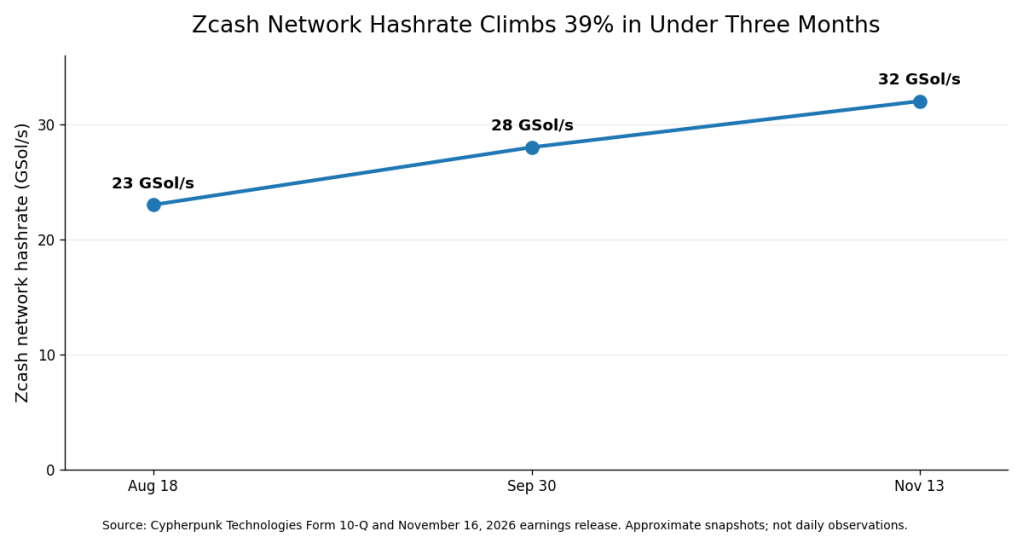
Zcash mining competition accelerated during the autumn as a surge in Equihash ASIC capacity reduced one major operator’s share of the network. Cypherpunk Technologies reported November 16 that Zcash network hashrate rose from approximately 23 GSol/s on August 18 to 32 GSol/s on November 13, 2026. The increase represents 39.1% growth over 87 days, calculated as (32 ÷ 23 − 1) × 100.
Despite operating roughly 4.2 GSol/s of Bitmain Antminer Z15 Pro equipment, Cypherpunk’s estimated network share fell from around 18% at launch to 13.1%. The contrast demonstrates a fundamental proof-of-work reality: a mining fleet can perform reliably while becoming less competitive relative to the entire network. Unlike Bitcoin’s SHA-256 ASICs, Zcash miners execute Equihash solution calculations, measured in solutions per second.
One Minus demonstration of Bitmain Z15 Pro hardware and benchmarking, published in 2026. Archival independent hardware footage, not a tour of Cypherpunk facilities. Open video on YouTube.
Network hashrate rose faster than Cypherpunk’s deployed fleet
The company’s Form 10-Q records approximately 28 GSol/s by September 30, with Cypherpunk holding about 15% of the network. By November 13, the network reached 32 GSol/s while the company’s reported fleet remained approximately 4.2 GSol/s. The decline to 13.1% equals about 4.9 percentage points, not a 4.9% fall in raw hashrate.
Cypherpunk launched its fleet in August after acquiring Z15 Pro machines and hosting rights for $33.33 million through an equity-linked transaction involving an affiliate of Winklevoss Capital. The ASICs are located at third-party facilities in Texas, Tennessee and West Virginia. Our September fleet report covered the initial mining expansion, before the latest network-share figures became available.
Why Z15 Pro efficiency does not guarantee the same rewards
According to BITMAIN’s official specifications, a standard Z15 Pro is rated at 840 KSol/s, draws 2,780 watts at the wall at 25°C, and achieves approximately 3.31 joules per kilosolution. The dedicated Equihash chips cannot simply be switched into GPU AI rentals or Bitcoin SHA-256 mining when economics change. Operators must account for electricity, cooling, repairs, pool performance and network difficulty.
Independent 2026 video reviewing a Z15 Pro setup and real-world mining economics. Archival independent hardware footage, not a tour of Cypherpunk facilities. Open video on YouTube.
A $30 million ASIC plan still has no binding purchase agreement
Cypherpunk entered a nonbinding letter of intent with Bitmain for up to $30 million of next-generation Zcash machines, paying a refundable $6 million deposit. The company expects possible deliveries in mid-2027, but no definitive purchase is signed. Specifications, unit pricing and final delivery conditions remain unannounced. Its aspirational target of about 25% of network hashrate would require 8 GSol/s at today’s 32 GSol/s network size, and more if competitors keep growing.
Equipment buying pressure extends beyond one company. Our earlier Fortitude report examined another prospective Bitmain ASIC arrangement. Firmware remains an operational constraint; LuxOS support for the Z15 Pro illustrates the ongoing maintenance requirements.
Production was strong, but revenue was not cash
Across 44 operating days from August 18 through September 30, Cypherpunk mined 8,967.29 ZEC, valued at $9.9 million in accounting revenue using an average fair value of $1,105.46 per coin. The company retained the mined coins rather than selling them for cash. It reported roughly 95% fleet uptime and $104.33 cost per ZEC excluding depreciation, rising to $237.46 including equipment depreciation; neither figure is a guaranteed future cost.
An additional protocol change complicates comparisons. Zcash activated NU7 on November 5, reducing its target block interval from 75 to 25 seconds without increasing the intended daily ZEC subsidy to miners. Faster blocks can affect stale shares and pool software. Our NU7 engineering coverage explains the new interval. Larger fleets and faster hardware may produce more hashes, but total block issuance and operating economics still impose limits.
The broader lesson applies across ASIC mining: equipment efficiency is only one side of an equation shaped by network competition, fixed block rewards, energy costs and capital spending. Cypherpunk’s 2027 purchases remain proposals, and neither future hashrate nor profitability can be assumed.
Primary sources and methodology
Sources: Cypherpunk SEC Exhibit 99.1, November 16, 2026, September 30 Form 10-Q, filed November 2026, and BITMAIN Z15 Pro engineering specifications. Network figures are approximate dated snapshots, not continuous observations. Reported production, costs and contractual terms are company disclosures, not independently audited hardware benchmarks.
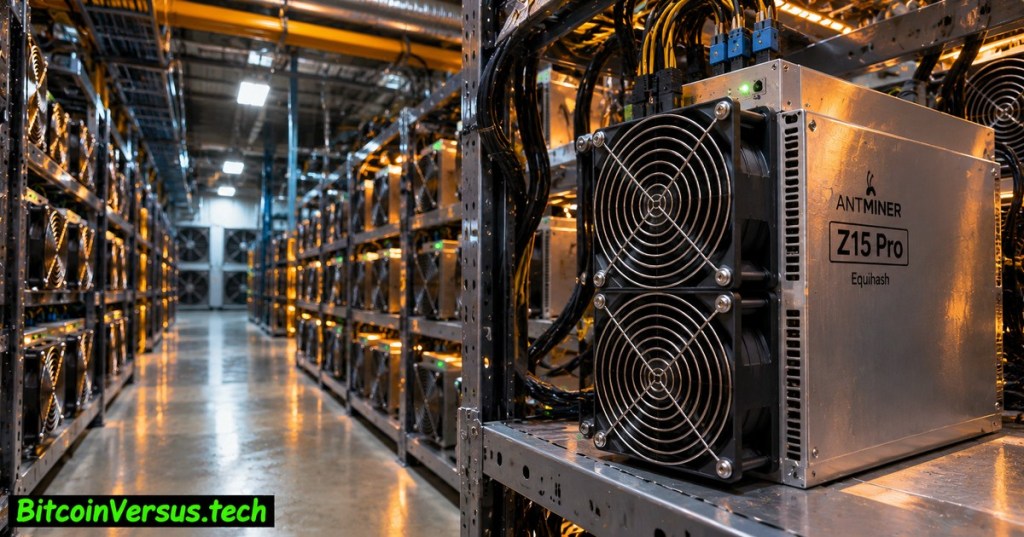
Reporting Note: The featured cover is an original photorealistic illustration, not a photograph of Cypherpunk’s mining facilities. The videos independently demonstrate Z15 Pro hardware and are not evidence of Cypherpunk’s results. Crypto-asset prices, operating costs and equipment deliveries are subject to substantial uncertainty. Nothing in the report constitutes investment advice.
Editor’s Note: We volunteer daily to ensure the credibility of information on our platform is Verifiably True. Support our research by scanning the QR code below to donate 5,000 sats.

For mobile scanning, open the article on another display and scan the QR code with a Bitcoin wallet. Verify receiving address 3C9o19EH5HSiwEPyCTmEKzxhNCbo2X6TTb before sending.
BitcoinVersus.tech provides technical and financial journalism for informational purposes only and does not provide investment, legal or cybersecurity assurance.


Leave a Reply