Zcash activated its NU7 protocol upgrade on November 6, 2026, at block 3,543,405, changing the target interval between blocks from 75 seconds to 25 seconds. A public mainnet tracker records activation at 02:34 UTC, while the official deployment specification, ZIP 259 defines the consensus rules. The upgrade also changes how miners receive transaction fees and retires the network’s oldest private-transaction format.
Zcash, like Bitcoin, uses proof-of-work mining to append blocks of transactions to a blockchain. Its shielded transfers additionally use cryptographic proofs to validate payments while hiding selected transaction information. A block target is an average intended interval, not a guaranteed countdown: actual times fluctuate with mining luck and network difficulty.
One confirmation now targets 25 seconds
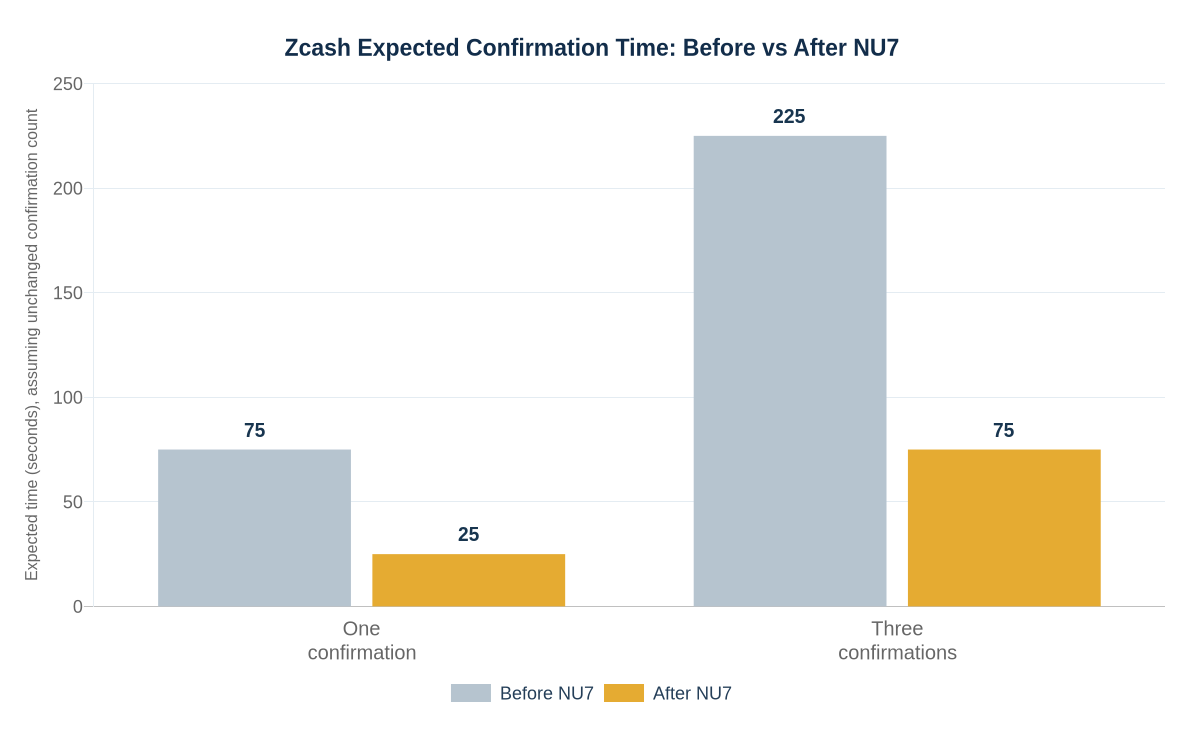
Under ZIP 218, the expected wait for one confirmation falls from 75 to 25 seconds once mining difficulty adjusts. Three confirmations correspond to approximately 225 seconds before NU7 versus 75 seconds afterward, assuming the same confirmation count. Exchanges and recipients independently choose how many blocks to require, and a smaller number of blocks may represent different rollback risk under new network conditions.
To prevent the shorter schedule from tripling new coin creation, NU7 cuts the scheduled block subsidy from 1.5625 ZEC to approximately 0.52083333 ZEC. At target spacing, miners collectively create about 1,800 ZEC per day under either schedule. The protocol retains its 21-million-ZEC maximum supply and intended calendar halving rhythm.
Fees begin feeding a future security reserve
The Network Sustainability Mechanism sends 60% of transaction fees into an on-chain reserve, leaving 40% of current fees to miners. Under ZIP 237, reserved value begins returning through future block rewards at height 8,939,664, expected around February 2031. Funds in the reserve are temporarily removed from circulation, not permanently destroyed. The mechanism aims to supplement mining incentives as ordinary subsidies decline, although future fee revenue remains uncertain.
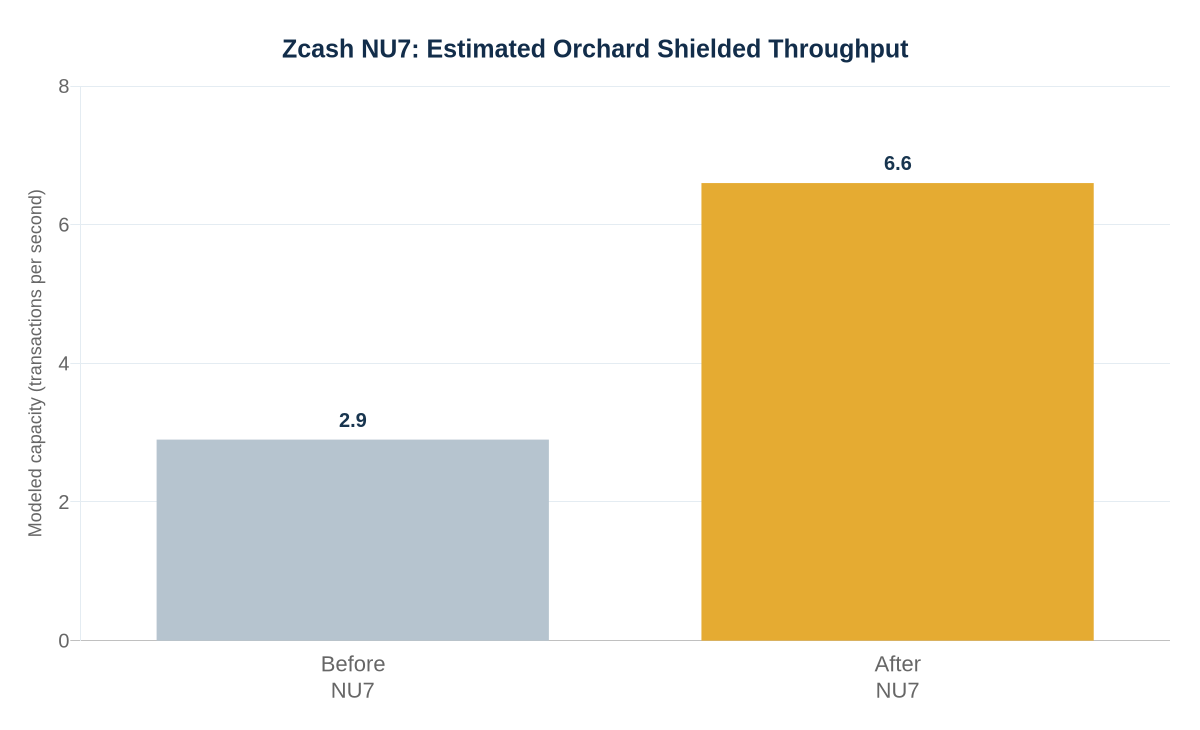
NU7 also introduces per-pool limits on shielded actions to reduce the work imposed on light wallets by transaction spam. ZIP 218 estimates a rise in standard Orchard shielded capacity from approximately 2.9 to 6.6 transactions per second, while reducing worst-case light-wallet synchronization bandwidth from 271 to 169 megabytes daily. Both figures describe specification-based capacity modeling, not measured real-world transaction throughput.
Older Sprout funds become unspendable
The most consequential downside affects Zcash’s legacy Sprout shielded pool. NU7 invalidates version 4 transactions, the only format through which Sprout funds could be spent. The chain tracker reports approximately 12,224 ZEC remained in Sprout at activation. Such balances are unspendable under the new consensus rules; describing them as automatically transferred, recovered or burned would be inaccurate.
Node operators needed NU7-compatible software, including Zebra 7.0.0 or compatible Zakura releases. The Zcash Foundation’s October 22 node-release notice also records seven security fixes. Faster blocks place greater importance on prompt propagation and validation, since competing blocks can increase wasted proof-of-work.
Earlier BitcoinVersus.Tech coverage of a 15 MW Zcash mining site and planned Zcash ASIC procurement provides mining-industry context. Related research on privacy designs proposed for Bitcoin and hashrate versus mining difficulty helps distinguish Zcash’s consensus engineering from Bitcoin’s separate rules.
The upgrade is now active, but faster average confirmations, stable mining incentives and lower wallet-sync costs require continued measurement. NU7 changes protocol parameters and economic incentives; it does not guarantee transaction settlement times or demonstrate a rise in ZEC’s market price.
Primary evidence: ZIP 259 deployment rules; ZIP 218 block spacing and capacity estimates; ZIP 235 fee allocation; ZIP 237 reserve and reissuance; Zcash Foundation’s Zebra 7.0.0 release; activation chain tracker.
Editor’s Note: Zcash NU7 activated on November 6, 2026, at 02:34 UTC, equivalent to November 5 in some U.S. time zones. Consensus parameters come from Zcash Improvement Proposals. Confirmation waits and Orchard throughput are modeled or target values, not guaranteed live measurements. The official Zcash development-call recording predates activation. Featured artwork is conceptual, not evidence of network performance.
Support BitcoinVersus.Tech
To contribute 5,000 satoshis toward research, scan the original approved QR below using a compatible Bitcoin wallet. On mobile, open the article on another screen or use your wallet’s supported image-scanning feature. Verify the recipient and amount before sending.

We volunteer daily to ensure the information on this platform is Verifiably True. If you would like to support the research, please scan QR code.


Leave a Reply