
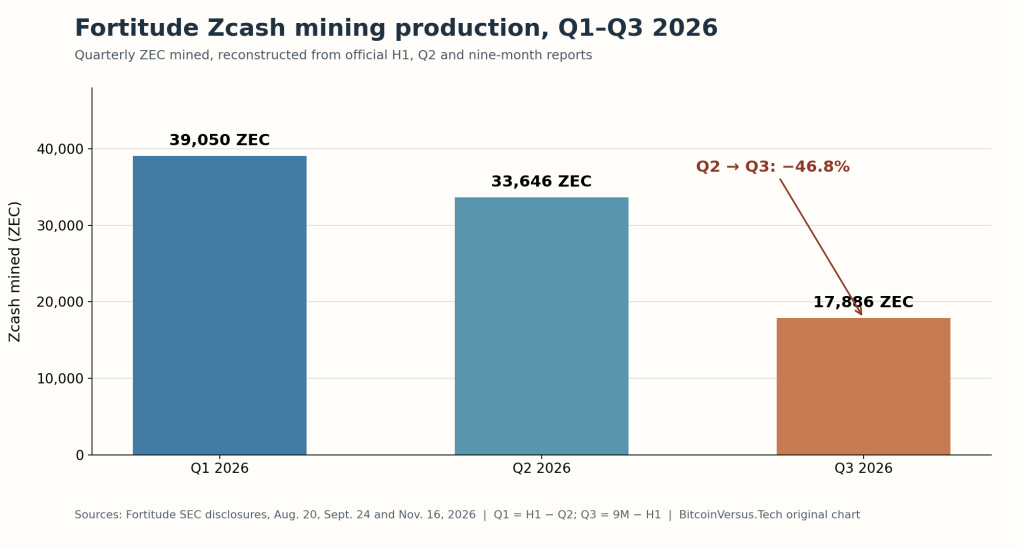
A Zcash mining operator’s expanding ASIC fleet has not prevented a sharp decline in reported coin output. Fortitude Mining’s November 16, 2026 operating update reported 90,582 ZEC mined through September. Comparing that cumulative total with Fortitude’s earlier six-month production and standalone second-quarter release reveals 17,886 ZEC in Q3, down 46.8% from Q2. Fortitude also said deliveries of 9,000 purchased Antminer Z15 Pro machines had started, creating a striking contrast between historical mining output and future equipment capacity.
OneMiners’ June 2026 Z15 Pro unboxing and benchmark shows the Equihash ASIC model Fortitude ordered. The seller’s demonstration, including promotional claims, does not verify Fortitude’s shipments or operating performance. Watch the original equipment video.
Three quarters of ZEC output tell the story
The September SEC-filed mining disclosure reported 72,696 ZEC for January–June. The company’s August 20 Q2 release recorded 33,646 ZEC. Subtracting gives approximately 39,050 in Q1. Subtracting the six-month figure from the November-reported nine-month total gives approximately 17,886 in Q3. Quarterly production therefore declined from 39,050 to 33,646 to 17,886 ZEC. The Q2-to-Q3 reduction was 15,760 coins, or 46.8%. These quarterly values are arithmetic reconstructions from company disclosures, not separately audited production tallies.
Fortitude stated its first-half ZEC production represented about 28% of network issuance, versus 21.5% across the first nine months. Those percentages describe overlapping periods, not separate Q2 and Q3 market shares. Stronger competing hashpower, variable pool rewards, temporary shutdowns and changing machine efficiency can alter a miner’s coin production. The filings alone do not isolate one cause of the decline.
Nine thousand ASICs could add 7.56 GSol/s
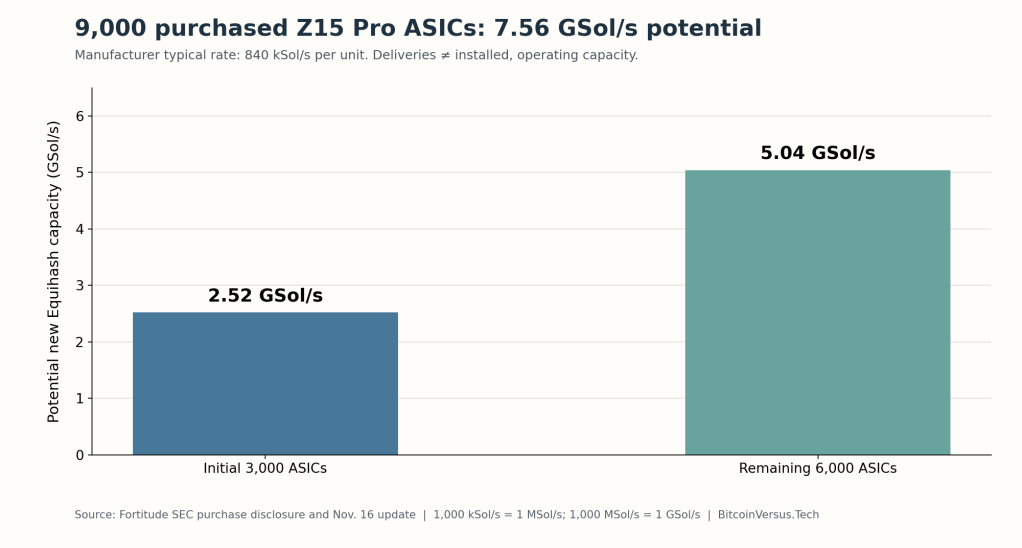
Fortitude purchased 9,000 Bitmain Antminer Z15 Pro miners, with a company-disclosed typical rate of 840 kilosolutions per second per machine. The first 3,000 represent about 2.52 GSol/s; the remaining 6,000 represent about 5.04 GSol/s. Combined, the order carries 7.56 GSol/s of nominal potential. In the November 16 update, Fortitude said the first tranche was beginning delivery and reported currently operating Zcash hashrate exceeding 5.4 GSol/s. Ordered units should not be counted as online before verified energization.
The Equihash GSol/s unit measures candidate solutions evaluated per second, unlike Bitcoin’s SHA-256 terahashes or exahashes per second. Cross-algorithm hashrates cannot be treated as equivalent measures of computing power or energy efficiency.
Sixty megawatts controlled does not mean sixty megawatts energized
The company reports more than 60 MW of controlled power capacity across seven sites. Control rights, grid service, working electrical gear and active miners are separate infrastructure milestones. Its Nebraska operation also joined a regional demand-response market, as BitcoinVersus.Tech previously reported. Curtailment could reduce production while generating grid-service payments; the latest filing does not quantify curtailment as the explanation for Q3’s shortfall.
Red Panda Mining’s May 2026 Z15 Pro setup demonstrates cabling, firmware, pool configuration and power measurements. The creator discusses personal profitability and referral offers; figures in the video are not Fortitude’s financial results. View the independent machine demonstration.
Mining revenue and accounting profit tell different stories
For January–September, Fortitude reported $57.9 million in net mining revenue and $17.1 million adjusted EBITDA, but its reconciliation also listed a $16.2 million GAAP net loss. Adjusted EBITDA excludes specified costs and is not net income. Management reported direct cash cost to mine ZEC at roughly 23% of production value; the metric excludes categories such as depreciation and should not be mistaken for a 77% net profit margin.
Related coverage explains Fortitude’s original ASIC purchase, rising Zcash network competition, and the subsequent NU7 network upgrade. The last development occurred after the Q3 measurement period and therefore cannot explain Q3 production.
What the next report needs to verify
The strongest follow-up would compare actually delivered and energized Z15 Pro counts with measured Equihash capacity, pool payouts, electricity cost, site uptime and Q4 ZEC mined. Fortitude’s equipment purchase is documented; realizing the projected hashrate and reversing its production decline remain separate operational tests.
Primary sources and calculations: August Q2 results, SEC-filed six-month production and ASIC terms, and November nine-month update. All derived quarterly production and percentage changes use the rounded values disclosed by Fortitude.
We volunteer daily to ensure the credibility of the information on this platform is Verifiably True. If you would like to support to help further secure the integrity of our research initiative, please scan the QR code below.



Leave a Reply