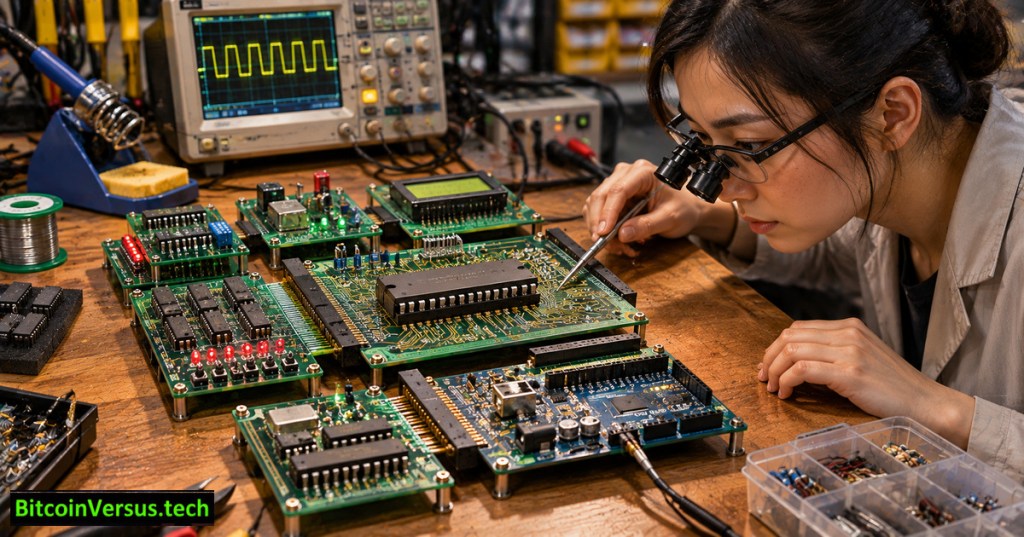
Before computers became sealed laptops and single-board systems, their fundamental parts were easier to see: a processor, memory, a clock, and wires carrying addresses and data. Argentine electronics creator Carlinho Rienzi is reviving that hands-on experience with the 20c, an open-hardware, modular computer built around the classic MOS 6502 processor family. The project gained fresh attention when Adafruit featured it on November 20, 2026. The goal is education and experimentation, not a new commercial home-computer launch.
OsoLabs.tech, Episode 1, explores the 6502 CPU, its pins and a dedicated processor circuit board. Original project video in Spanish with English captions. Watch directly on YouTube.
A computer divided into visible components
Rather than soldering every part onto one motherboard, the 20c separates functions onto interchangeable circuit boards. The project describes modules for 6502-family CPUs, read-only memory (ROM), random-access memory (RAM), clock generation, bus connections, address-decoding glue logic, and peripheral input/output devices. Each module is approximately 6 × 6 inches, providing physical room for test points and a nearby breadboard.
The design is motivated by a real frustration of electronics labs: dozens of loose jumper wires can make breadboard experiments unreliable and debugging slow. A dedicated connector system joins address, data and expansion buses without rebuilding an entire tangle of cables for every lesson. Students can isolate one module, observe its signals, and then change the configuration while keeping the rest of the experiment recognizable.
Why the 6502 remains a good teaching chip
The 6502 has an 8-bit data bus and a 16-bit address bus. Sixteen address signals can select 2¹⁶, or 65,536 addresses, corresponding to a 64 KiB address space for a byte-addressed machine. A clock coordinates each operation; read/write control signals indicate whether the CPU is fetching or storing data. The design reveals where software becomes electrical activity, an idea also covered in our lessons on transistors and logic gates and printed circuit boards.
OsoLabs documents the CPU board with a 40-pin socket, reset control, and headers exposing address, data and expansion lines. The published files include editable circuit designs, bills of materials and Gerber manufacturing data. Those are valuable engineering assets, but a board design file is not a guarantee that every student build will operate without soldering, electrical testing or troubleshooting.
Turn an Arduino into a bus observer
An especially useful module connects an Arduino Mega so the microcontroller can function as a simple protocol analyzer. Instead of guessing why a program fails, a learner can inspect the CPU’s address lines, data values and control transitions. The creator’s third episode demonstrates the analyzer with the processor and clock modules. The Arduino observes signals; it is not a replacement for the original 6502 CPU in the experiment.
OsoLabs.tech, Episode 3, demonstrates the Arduino Mega protocol-analyzer module and the 20c buses. Original project video in Spanish with English captions. Watch directly on YouTube.
Rebuild the ideas behind classic game machines
The modular approach can help explain differences between related processors. The project discusses 6502, 6510, 8502 and 6507 options, as well as peripheral chips associated with the Commodore 64 and Atari 2600. A corresponding CPU-and-I/O arrangement can teach how those machines were organized, although swapping a few boards does not create a fully compatible console with its original graphics, sound, timing and software.
Our coverage of the revived Atari 800XL looks at retro computing from the modern product side, while the Raspberry Pi introduction explains a more integrated learning computer. The 20c goes in the opposite direction: it deliberately exposes the pieces modern machines hide.
Open design does not mean a finished boxed product
The creator’s public GitHub repository contains episode-based hardware design files, including CPU, clock, analyzer, ROM and glue-logic materials, under a CERN open-hardware license. The creator’s project site supplies English articles and Spanish-language demonstrations. Neither source establishes broad commercial availability, a standardized kit price, or independently certified performance.
The 20c is worth watching because it transforms abstract computer architecture into something that can be probed, modified and understood. The most meaningful next steps are additional documented modules, reproducible builds and verified example programs, not raw clock-speed claims.
Primary references: Adafruit, November 20 feature; OsoLabs Episode 1 technical documentation; OsoLabs Episode 3; 20c hardware source repository.
We volunteer daily to ensure the credibility of the information on this platform is Verifiably True. If you would like to support to help further secure the integrity of our research initiative, please scan the QR code below.



Leave a Reply