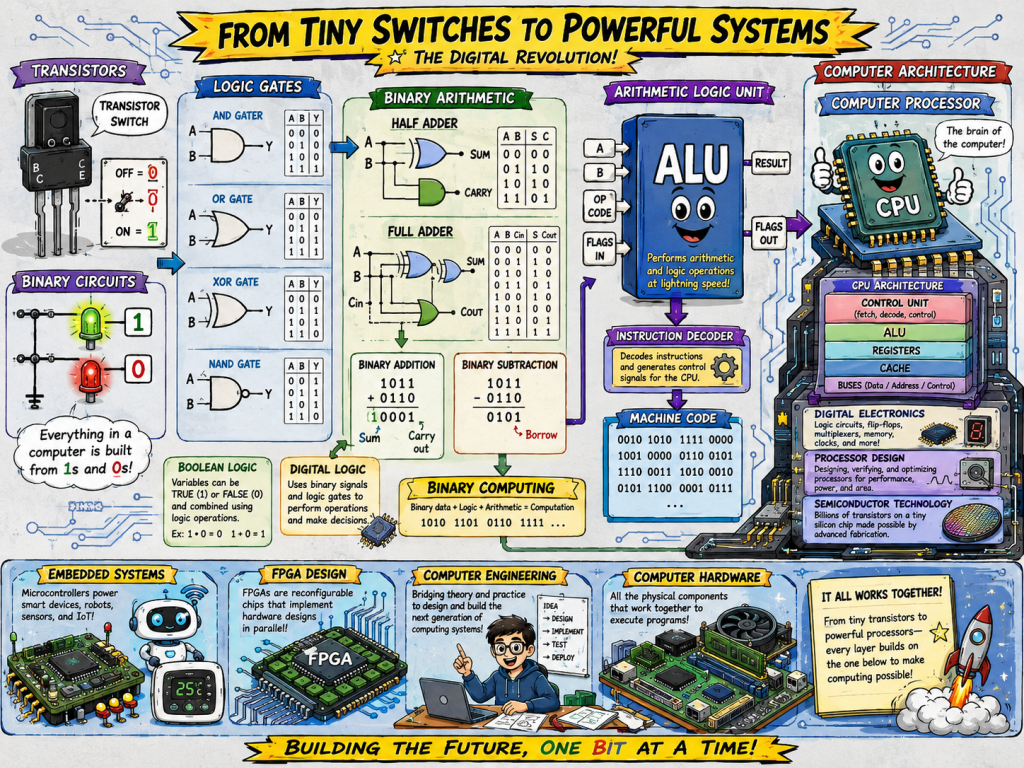
At the lowest level, a modern computer is built from an enormous number of extremely simple electronic decisions. Transistors act as microscopic switches, controlling whether electrical current is allowed to pass through a circuit.
By representing these electrical states as binary values (typically 1 and 0) engineers can organize transistors into structures capable of processing information.
What begins as a basic on-or-off switch ultimately becomes the foundation for processors, memory systems, embedded devices, GPUs, and nearly every other form of digital computing.
The first major abstraction above the transistor is the logic gate. Gates such as AND, OR, NOT, NAND, NOR, and XOR combine binary inputs according to defined logical rules.
An AND gate, for example, produces a logical 1 only when its required inputs are also 1, while an XOR gate is especially useful when determining whether two binary values differ.
These operations may appear simple individually, but combining thousands or millions of them creates circuits capable of performing meaningful computation.
Turning Logic Into Binary Arithmetic
One of the clearest demonstrations of digital logic is binary addition. By combining XOR and AND gates, engineers can construct a half adder, which calculates both the sum and carry produced when adding two binary digits. Expanding this concept produces a full adder, capable of accepting a carry from a previous calculation.
Multiple full adders can then be connected together to process larger binary numbers. An 8-bit processor can perform calculations across eight bits, while wider architectures can operate on 16, 32, 64, or even larger groups of bits. The same fundamental logic can also support subtraction by using techniques such as binary complements and controlled arithmetic operations.
This demonstrates one of computing’s most important principles: complex behavior can emerge from repeated combinations of extremely simple components.
Decoders Turn Machine Instructions Into Actions
Performing arithmetic is only part of what a processor must do. Computers must also determine which operation should happen next.
This is where circuits such as decoders become important. A decoder examines a binary input and activates a particular output based on the pattern it receives. Inside a processor, similar logic helps interpret machine instructions and route signals toward the hardware required to execute them.
An instruction stored as binary might tell the processor to add two values, move information between registers, compare numbers, access memory, or jump to another instruction. Decoder and control circuitry translate those binary instruction patterns into electrical signals that coordinate the processor’s internal components.
Machine code therefore is not merely a sequence of abstract numbers. At the hardware level, those numbers ultimately control real transistor switching events occurring inside silicon.
From Adders to the Arithmetic Logic Unit
When arithmetic circuits and logical operations are combined, they form one of the most important structures inside a processor: the Arithmetic Logic Unit, or ALU.
The ALU can perform operations such as:
- Binary addition and subtraction
- AND, OR, XOR, and other logical operations
- Comparisons between values
- Bit shifting
- Incrementing and decrementing numbers
- Testing whether results are zero, negative, or carry beyond a register’s capacity
A processor’s control logic determines which ALU operation should be performed, while registers temporarily hold the values being processed. The resulting data can then be stored, sent to memory, or used by another instruction.
What appears to a programmer as something simple like:
A + B
eventually becomes a carefully coordinated sequence of electrical changes across transistor-based circuits.
Abstraction Makes Modern Computing Possible
Perhaps the most important lesson is the idea of abstraction.
Engineers do not need to design an entire processor transistor by transistor every time they build a new system. Instead, computer engineering is organized into layers.
Transistors → Logic Gates → Adders and Decoders → ALUs → CPUs → Machine Instructions → Software
Each layer hides much of the complexity underneath it while providing useful building blocks for the next layer. A software developer can write an addition operation without thinking about individual logic gates, while a digital hardware designer can work with registers and ALUs without manually controlling every transistor.
Yet all of those abstractions eventually return to the same physical foundation: enormous networks of electronic switches manipulating binary information.
Why Understanding Transistors and Logic Gates Still Matters
Learning how transistors become logic gates, adders, decoders, and ALUs provides an important bridge between electronics and computer science. It explains what is actually happening beneath assembly language, firmware, operating systems, and application software.
The concept also helps connect several fields that sometimes appear separate. Digital electronics, FPGA design, microcontrollers, embedded systems, CPU architecture, semiconductor engineering, and computer programming all depend on many of the same fundamental principles.
Modern processors may contain billions of transistors and execute billions of operations every second, but their behavior is ultimately built from combinations of remarkably simple binary decisions.
Understanding that progression makes the computer far less mysterious. At its core, computing is the process of taking tiny electronic switches, organizing them into increasingly powerful abstractions, and using those abstractions to transform data into useful information.
BitcoinVersus.Tech Editor’s Note:
We volunteer daily to ensure the credibility of the information on this platform is Verifiably True. If you would like to support to help further secure the integrity of our research initiatives, please donate here: 3C9o19EH5HSiwEPyCTmEKzxhNCbo2X6TTb
BitcoinVersus.tech is not a financial advisor. This media platform reports on financial subjects purely for informational purposes.


Leave a Reply