
Renesas Electronics launched the RX74M and RX74N on October 22, 2026, introducing its first RX-family 32-bit microcontrollers manufactured on a 22-nanometer process with embedded magnetoresistive RAM (MRAM). The new devices run up to 600 MHz and target factory automation, industrial robots, energy equipment and building systems. These are embedded controllers—not Bitcoin mining ASICs or GPU replacements.
Key Takeaways
- Both chips use a 600 MHz RXv3e core, compared with 240 MHz in their predecessors.
- They integrate 1 MB of MRAM, 256 KB of tightly coupled memory and 1.5 MB of SRAM.
- RX74M adds industrial networking, while RX74N targets control equipment such as smart meters and HVAC.
Why MRAM Matters
Conventional embedded flash typically needs an erase operation before rewriting stored data. MRAM can write data without that separate erase step, potentially reducing update delays for device settings, logs and firmware. This is why the technology differs from familiar computer RAM and ROM and why our earlier coverage of MRAM in AI servers has a different application.
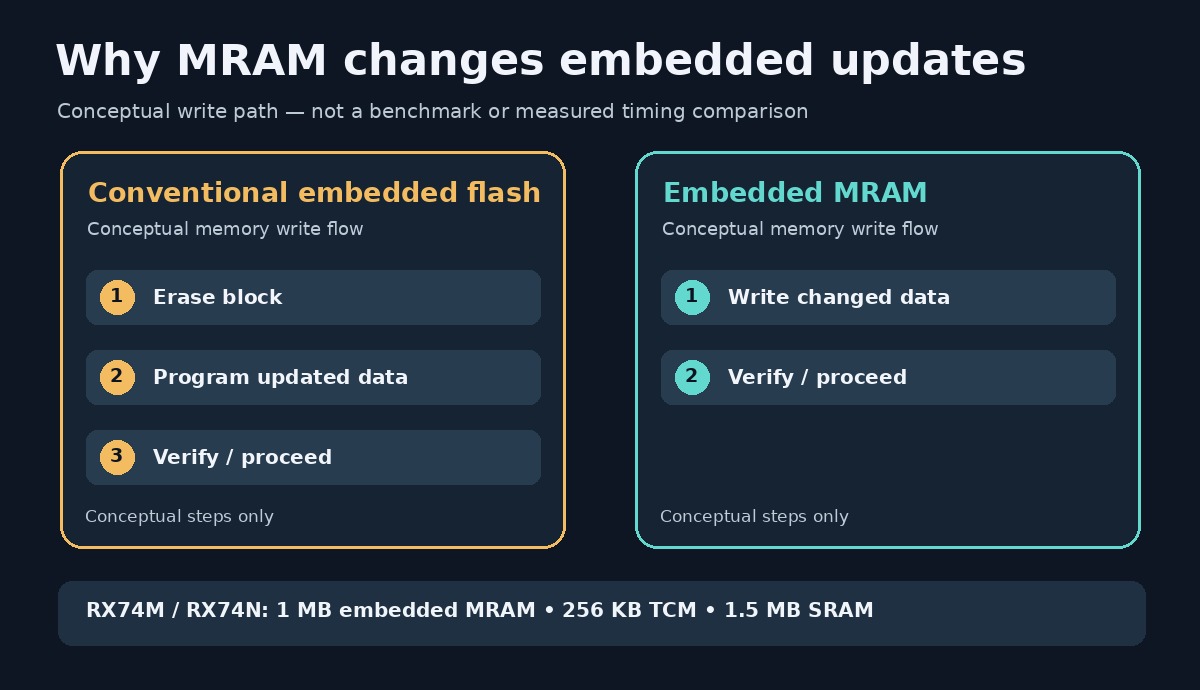
Renesas specifies 1 MB of embedded MRAM alongside 256 KB of zero-wait-state tightly coupled memory and 1.5 MB of SRAM. Those numbers describe different memory functions; they should not simply be added together as if the chip had one interchangeable memory pool.
Industrial Networks and Security
The RX74M integrates an EtherCAT slave controller, a time-sensitive-networking-capable Gigabit Ethernet switch and CAN FD. That enables industrial connectivity including EtherCAT, PROFINET and EtherNet/IP. For context, our EtherCAT lesson explains why predictable packet timing matters to machines.
The RX74N is intended for smart meters, power conditioners and HVAC controllers. Both designs include hardware security capabilities aimed at device isolation, authenticated operations and emerging post-quantum cryptography requirements. Such features provide building blocks for secure products, not an automatic guarantee of immunity to attacks.
What Engineers Should Watch
Renesas says 300 MHz variants consume more than 20% less power than the 600 MHz versions, but the announcement does not establish an equivalent reduction for complete industrial machines. The devices are available now, with development support from the company’s software and partner ecosystem.
The announcement is another example of semiconductor advances moving into the control equipment surrounding data centers, electrical systems and automation. Faster controllers, nonvolatile memory and secure updates can improve industrial operations—even when the headline chip itself does not perform high-volume AI inference or Bitcoin hashing.
BitcoinVersus.Tech Editor’s Note: We volunteer daily to ensure the credibility of the information on this platform is Verifiably True. If you would like to support to help further secure the integrity of our research initiatives, please donate using the QR code provided

For best QR-code scanning results, please scan this donation code from a desktop or larger screen. Mobile screens may prevent camera recognition.


Leave a Reply