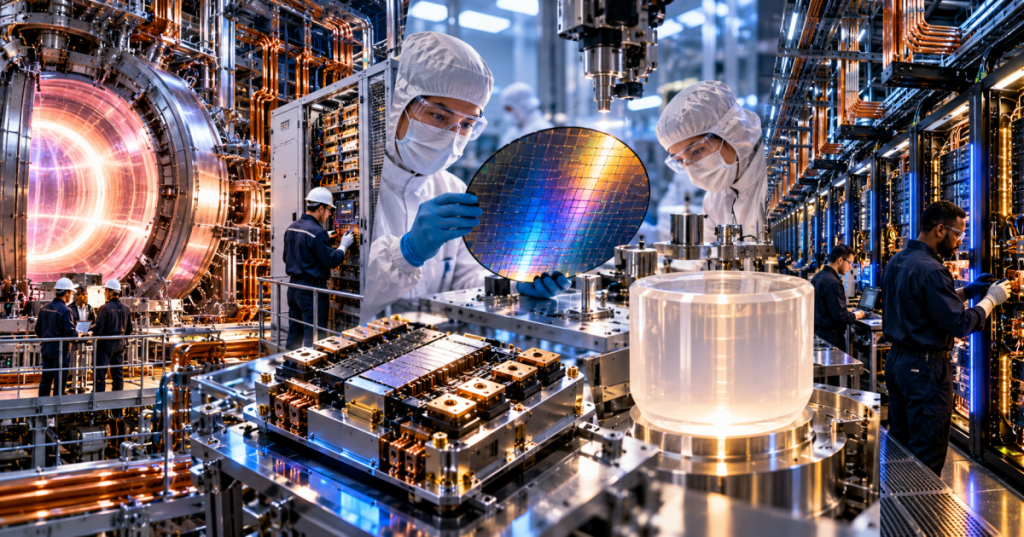
The U.S. Department of Commerce announced on October 22, 2026, four letters of intent for up to $389 million in CHIPS Act research funding. The proposed awards target power semiconductors for fusion energy and AI infrastructure, plus ultra-high-purity quartz essential to semiconductor manufacturing. These are proposed awards, not finalized or disbursed grants.
Key Takeaways
- Four companies signed letters of intent totaling up to $389 million.
- Fusion power electronics, vertical gallium nitride and semiconductor-grade quartz are the priorities.
- The government would receive minority, non-controlling, non-voting equity interests if final agreements are reached.
- Award amounts, schedules and technical outcomes remain conditional.
Four Proposed CHIPS Awards
| Recipient | Proposed federal award | Research focus |
|---|---|---|
| Helion | Up to $175 million | High-voltage pulsed-power devices and fusion modules |
| Commonwealth Fusion Systems | Up to $85 million | Radio-frequency heating, control and fusion electronics |
| Vertical Semiconductor | Up to $73 million | Vertical GaN power transistors for advanced computing |
| Sibelco | Up to $56 million | Ultra-high-purity quartz processing and finishing |
Why These Devices Matter
Helion requires precisely switched high currents to drive and recover energy from fusion magnets. Commonwealth Fusion Systems is developing electronics for plasma heating, diagnostics and plant control. Its earlier engineering update below illustrates its SPARC hardware; the video predates this funding announcement.
Vertical Semiconductor proposes vertical GaN technology for a claimed 2.5 MW AI rack demonstration—a development target, not a demonstrated commercial rack. Sibelco’s quartz research supports crystal-growth crucibles and precision manufacturing components.
Power conversion losses ultimately become heat. That makes semiconductor packaging, switching performance and supply materials relevant to data centers as well as experimental energy plants. See our reporting on GaN in servers, 800 V rack power, and atomic-scale chip manufacturing.
Inside Fusion Power Engineering
This earlier Helion technology explanation describes magnetic compression and energy recovery. Its official Polaris video provides engineering background, not evidence of commercial fusion electricity delivery or completion of the proposed chip research.
What Happens Next
Final awards require negotiations and approvals. The Commerce Department release says the government would take non-voting equity stakes in each recipient. The measurable milestones will be finalized terms, independently demonstrated semiconductor performance and domestic research or manufacturing capacity—not the announced dollar figures alone.
An October 22 public fusion-community discussion provides additional social context; the government and company releases remain the factual sources.
BitcoinVersus.Tech Editor’s Note:
We volunteer daily to ensure the credibility of the information on this platform is Verifiably True. If you would like to support to help further secure the integrity of our research initiatives, please donate using the QR code provided

For best QR-code scanning results, please scan this donation code from a desktop or larger screen. Mobile screens may prevent camera recognition.


Leave a Reply