STMicroelectronics unveiled its STM32G5 mixed-signal microcontroller family on November 4, 2026, targeting real-time power conversion in AI data centers and precision motor control in robotics. The Geneva-based semiconductor company says the new Arm Cortex-M33 devices deliver approximately twice the benchmark compute performance of the previous STM32G4 family, while adding tighter timing controls and stronger embedded security. Unlike a research prototype, initial single-core STM32G5 chips are already in production.
The November 4 announcement identifies digital power supplies, humanoid robot joints, renewable-energy inverters and industrial drives as target applications. An embedded microcontroller does not perform the large AI calculations handled by graphics processors; it measures signals and adjusts electrical hardware on tight schedules.
STMicroelectronics’ official STM32 Summit 2026 keynote discusses its microcontroller strategy, product announcements and physical-AI applications. Source: STMicroelectronics, YouTube.
Faster control loops for power and motors
STM32G5 operates at up to 280 MHz and scores 1,136 CoreMark, compared with 569 CoreMark for the older STM32G4 at 170 MHz. The ratio is approximately 2.0, a benchmark comparison rather than proof that every industrial workload runs twice as fast. ST also specifies a 111-picosecond high-resolution timer, a 12-channel timing subsystem, position-encoder support and upgraded analog-to-digital conversion.
In an AI server power supply, tighter control of switching transistors can help regulate rapidly changing electrical loads. Wide-bandgap gallium nitride and silicon carbide power devices can switch at high frequencies, but their real efficiency depends on circuit topology, thermal design, magnetics and firmware. ST has not published a universally applicable percentage reduction in data-center electricity use attributable to the STM32G5 alone.
Security and production details
The chips combine Arm TrustZone isolation with ST’s immutable root-of-trust features, secure firmware-update mechanisms and cryptographic support that includes post-quantum libraries. Availability of cryptographic functions should not be confused with independent certification of every finished product. Device makers still need to secure keys, configure boot policy and test updates under failure conditions.
ST says production variants span 64 KB to 512 KB of on-chip Flash, with package options from QFN32 to LQFP128. Pricing starts at $1.034 per chip for orders of 10,000 units, a volume quotation rather than an individual retail price. Dual-core STM32G5 variants are planned for 2027, not commercially shipping as part of the initial launch.
The company is also offering the NUCLEO-G564RE development board, STM32CubeMX2 configuration tools and digital-power and motor-control software libraries. Engineers evaluating the parts can compare the manufacturer’s technical overview and product specifications against the switching frequency, analog noise and fault-response requirements of their own designs.
What the launch changes
The new microcontroller line extends the industry’s push toward specialized control silicon alongside AI accelerators. BitcoinVersus.Tech has previously examined ST’s AI data-center outlook, low-power Renesas controllers, industrial microcontrollers with MRAM and firmware fault containment. STM32G5 addresses a different design trade-off: precise analog and power control rather than maximizing general-purpose computing throughput.
The next measurable tests will be third-party converter-efficiency data, real robotic-control demonstrations and confirmation of the planned dual-core product rollout. Until system-level results arrive, the performance and efficiency claims should remain tied to ST’s specified chip benchmarks and engineering capabilities.
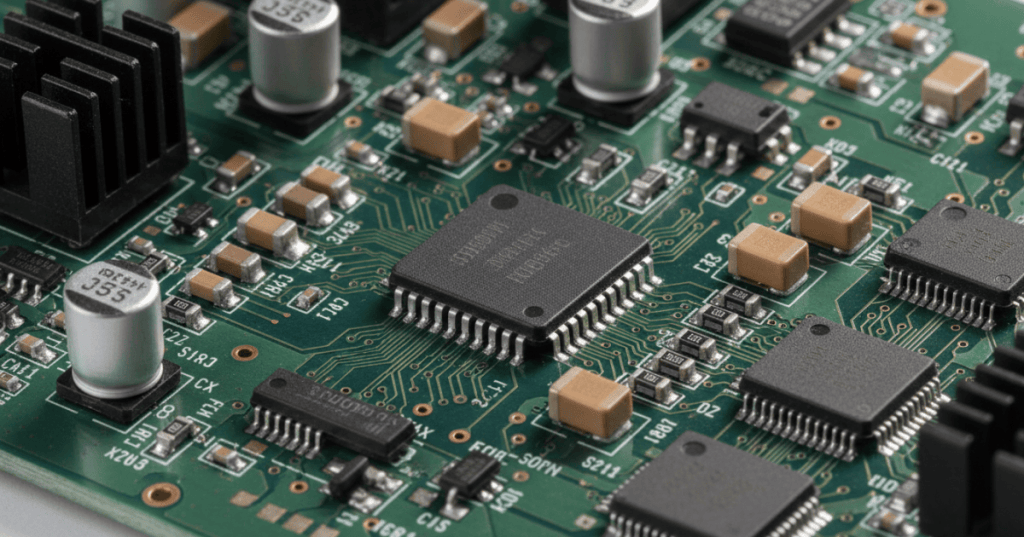
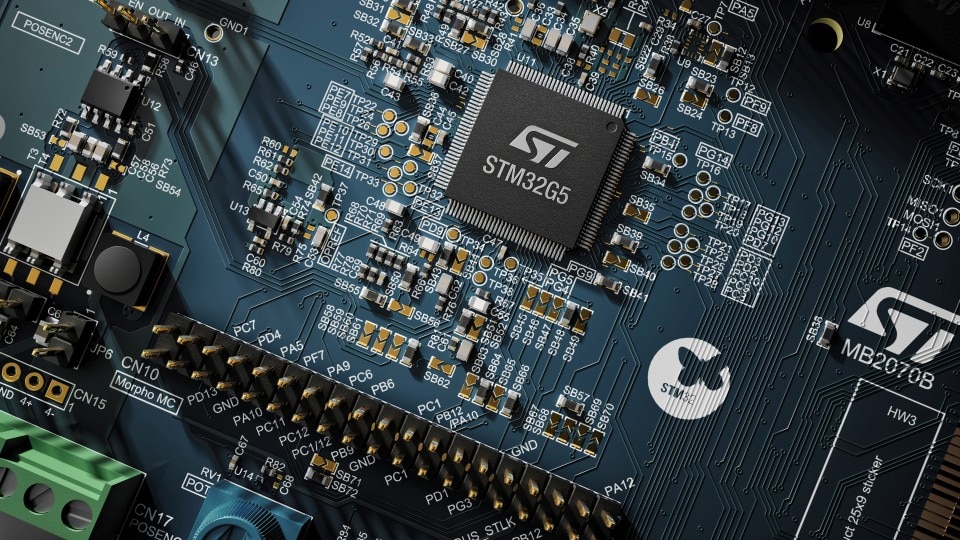
Editor’s Note: STMicroelectronics’ November 4 release and technical product documentation are primary sources. The featured cover is an original editorial rendering, while the in-body board photograph and summit video come from ST. Benchmark comparisons do not establish identical gains in complete power or robotics systems.

Scan the donation QR from a laptop or larger screen to donate 5,000 sats. Bitcoin address: 3C9o19EH5HSiwEPyCTmEKzxhNCbo2X6TTb.
We volunteer daily to improve the credibility of the information on this platform. If you would like to support the research, please donate here: 3C9o19EH5HSiwEPyCTmEKzxhNCbo2X6TTb
BitcoinVersus.tech is not a financial advisor. This media platform reports on technical and financial subjects purely for informational purposes.


Leave a Reply