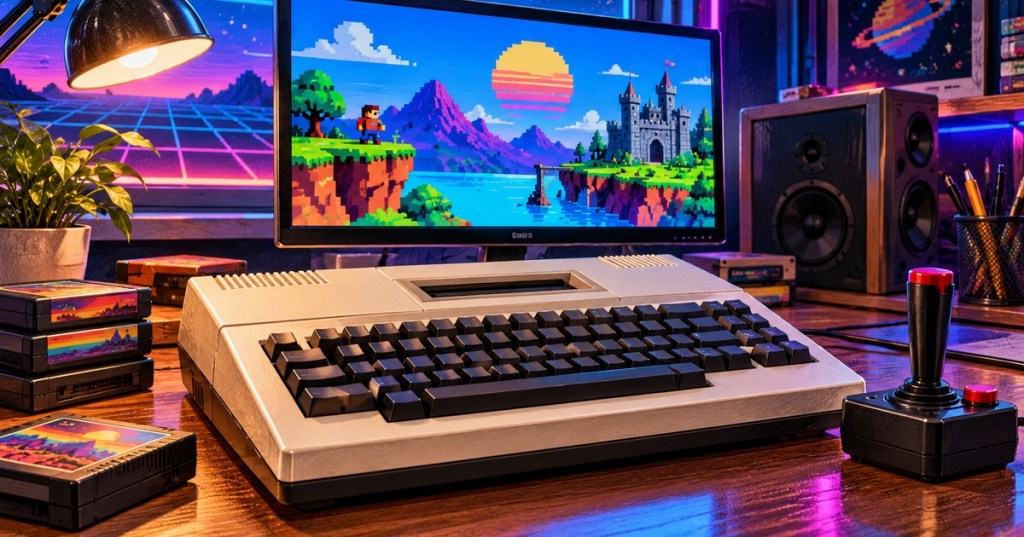
Atari is bringing back the 800XL—not as a tiny novelty console, but as a full-size programmable home computer with a working keyboard and cartridge slot.
The newly announced THE 800XL recreates Atari’s 1983 8-bit computer while adding the conveniences expected from modern retro hardware: HDMI output, USB storage, save states, rewind, a modernized joystick and support for software images loaded from flash drives. Atari is taking preorders now for $219.99, with shipping scheduled for late April 2027.
What makes this revival more interesting than another plug-and-play box is the keyboard. Atari BASIC is built in, which means the machine still carries the original idea that a home computer should let the owner make software as well as consume it. That connects directly to the longer history BitcoinVersus covered in how programming languages changed computing.
This Is a Computer, Not Just a Retro Console
The original Atari 800XL arrived in 1983 with 64 KB of memory, a full keyboard and custom graphics and sound hardware. It belonged to the era when the line between “game system” and “personal computer” was much thinner than it is today. Owners could play cartridges, load software from disks or cassettes and then sit down at the same machine to write code.
The new model deliberately preserves that identity. According to Atari’s official product page, THE 800XL includes a full-size mechanical keyboard, a functional cartridge slot and built-in Atari BASIC. It supports most Atari 400, 800, XL and XE cartridges while also accepting compatible 8-bit software through USB storage.
That is a very different proposition from a miniature retro box with a decorative keyboard. A working keyboard makes the machine useful for BASIC programming, text adventures, utilities and the strange homebrew experiments that helped define early personal computing.
25 Games Are Built In
The system ships with 25 games spanning first-party Atari releases and well-known third-party titles. The lineup includes Asteroids, Basketball, BattleZone, Berzerk, Boulder Dash, Centipede, Crystal Castles, M.U.L.E., Millipede, Missile Command, Miner 2049er, The Seven Cities of Gold and several others.
Atari is also letting owners load additional cartridge, disk and cassette images from USB flash drives. That makes the machine less dependent on whatever happens to be included in the box and gives retro-computing enthusiasts a modern way to reach a much larger software library.
BitcoinVersus has covered the same preservation impulse from the software side in its story on 1,300+ retro PlayStation games. THE 800XL takes the opposite approach: preserve the software by rebuilding the machine around it.
HDMI Solves the Most Obvious 1983 Problem
Connecting an original 800XL to a modern television is possible, but it usually requires adapters, converters or a display that still accepts legacy analog video. THE 800XL sidesteps that entire problem with HDMI output.
The output supports 50 Hz and 60 Hz modes, authentic 4:3 presentation, pixel-perfect display modes, optional CRT filters and multiple display frames. In other words, the machine can connect directly to a modern panel without pretending that a 1980s pixel image was designed for a widescreen television.
The move is a good example of why old hardware revivals need selective modernization. The new system keeps the physical interaction people remember while replacing the interface most likely to make the experience frustrating today.
USB Becomes the New Disk Box
Four USB-A ports support controllers and storage devices. That means a small flash drive can hold software that once required shelves of cartridges, floppy disks and cassette tapes. The same basic USB standard used for keyboards, storage and modern peripherals becomes the bridge between 1980s software and a 2027 recreation.
THE 800XL can load cartridge, disk and cassette images from USB storage. Atari also says the system supports software created for the Atari 5200, expanding the practical library beyond software made specifically for the XL family.
The Working Cartridge Slot Matters More Than It Sounds
Retro hardware often recreates the appearance of the original machine while moving every real function into internal emulation. Atari and Retro Games Ltd. instead kept a functional top-mounted cartridge slot that supports most original Atari 400, 800, XL and XE cartridges.
That gives physical software collections a reason to exist. An old cartridge becomes something that can still be inserted into a new machine rather than an artifact that has to sit beside it on a shelf.
There are still compatibility questions. Enthusiasts immediately began asking whether vintage SIO peripherals, unusual cartridge hardware and original controller accessories will work. The Verge notes that the revival emphasizes cartridge support, USB and modern connectivity, while Atari’s specifications do not promise full compatibility with every legacy peripheral.
Atari Added Save States and Rewind
The 1980s experience is not being preserved completely untouched. THE 800XL includes four save slots per game and a rewind feature that can jump backward by up to 40 seconds.
Purists can ignore those features. Everyone else gets a practical reminder that some modern conveniences became standard for good reasons. A difficult arcade game becomes easier to revisit when a single lost life does not always mean replaying the entire session.
The Joystick Is Back Too
The package includes THECXSTICK, a modern recreation of Atari’s classic joystick. The new version keeps the unmistakable vertical stick shape while adding eight action and function buttons for the expanded feature set.
That combination tells you exactly what the product is trying to do: preserve the hand feel and silhouette of early home computing without requiring the user to live with every limitation of 1983 hardware.
Built-In BASIC Is the Feature That Makes This Different
The most culturally important feature may be the least flashy one: turn the machine on without a game and Atari BASIC is there.
Early home computers taught generations of users that a computer was something you could command directly. Type a few lines, run them, watch them fail, change the code and try again. For many people, games were the doorway into programming rather than a completely separate activity.
That makes THE 800XL unexpectedly relevant in an era dominated by AI-generated code and no-code tools. Modern systems are trying to make programming easier by hiding more of the machinery. The 800XL revival makes programming approachable by exposing the machinery again.
$219.99 Buys Nostalgia, but Also a Real Learning Machine
At $219.99, the new machine costs more than the smallest plug-and-play retro consoles but considerably less than many collector-grade recreations or restored original systems once displays, storage adapters and controllers are added.
The value proposition depends on what the buyer wants. Someone interested only in playing Asteroids has cheaper options. Someone who wants the mechanical keyboard, BASIC prompt, cartridge slot, physical desk presence and the strange hybrid identity of an early home computer is buying something much harder to replace with a software emulator.
Retro Computing Is Becoming Hardware Again
The revival also says something broader about retro gaming. Emulation preserved old software for decades, but a growing market now wants the physical machine back too: the keyboard angle, the cartridge motion, the joystick, the boot screen and the limitations.
THE 800XL is not trying to beat a modern gaming PC. It is trying to recreate the moment when a game machine and a programming computer could be the same object sitting on a bedroom desk.
For a machine born in 1983, that idea has aged surprisingly well.


Leave a comment