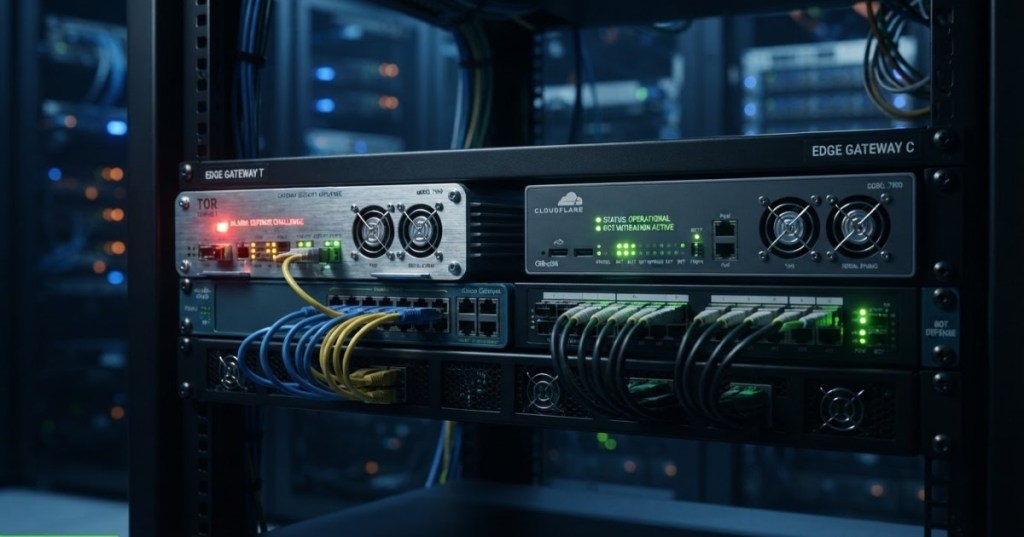
Proof of work is already operating as a defense against certain network attacks. The Tor Project introduced client puzzles for onion services in August 2023, while Cloudflare’s Turnstile documentation describes computational puzzles as one input in a broader challenge system. Neither deployment demonstrates that a cryptographic cost can prevent most or all viruses.
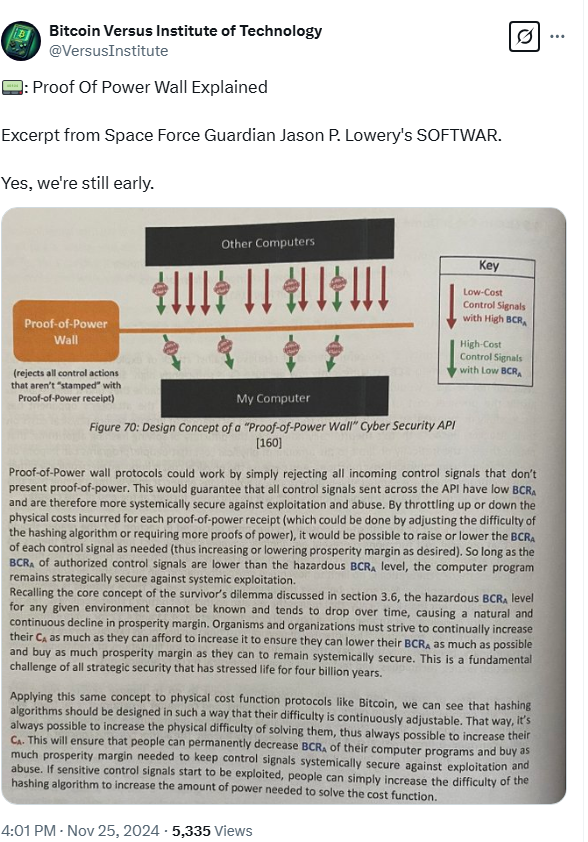
The comparison provides a concrete follow-up to BitcoinVersus.Tech’s original Proof-of-Power Wall concept and its malware-cost lesson. Rather than asking only whether hostile requests can be priced, working services must decide which requests deserve processing and how the security challenge affects legitimate users.
Anthony Scaramucci, November 15, 2026. Original X commentary calling proof of work a firewall of the AI age; a prediction rather than an independently measured malware prevention result.
Tor uses effort to prioritize scarce service capacity
Tor’s design begins with a service facing too many introduction requests. Its protocol specification allows a client to calculate a puzzle solution, submit its work score, and enter a priority queue. Under pressure, requests demonstrating greater effort receive preference. A service operator can enable or tune the defense, rather than requiring every normal connection to pay a permanent high price.
A priority system is different from rejecting every request that fails a fixed puzzle. Tor adjusts suggested effort according to recent congestion and can reduce effort to zero when the defense is unnecessary. Resource constraints still matter: clients using slower devices can experience increased latency or battery consumption, and attackers with many compromised machines may spread computation across them.
Cloudflare combines challenges with behavioral signals
Cloudflare does not describe Turnstile as a simple Bitcoin-style hashing wall. Its documentation lists proof of work alongside proof of space, browser API checks, and other signals. A client can finish a computational step and still fail automated traffic evaluation; Cloudflare explicitly notes that a solved challenge does not guarantee a human visitor.
Cloudflare Developers, June 26, 2025. Official archival tutorial on protecting forms with Turnstile and validating tokens server-side. The video documents anti-bot integration, not malware elimination.
Cloudflare’s bot protection guidance recommends combining application firewalls, bot evaluation and challenges. A request’s claimed identity, origin behavior and permission remain separate from the amount of processing its sender spent. Server-side token validation is essential; accepting an unverified browser response would defeat the intended control.
Why difficulty alone cannot price every attacker out
For an illustrative hash puzzle, increasing target difficulty from 18 to 22 leading zero bits multiplies expected work by sixteen, from 262,144 attempts to 4,194,304. That calculation follows the independent trial probability of approximately one in 2 raised to the difficulty. It is not a measured challenge time or a promised cost in dollars.
A botnet controlling thousands of machines can distribute the puzzle workload, potentially spending electricity paid for by victims. Malware already executing on an infected endpoint does not need to break an external challenge to encrypt local files or steal credentials. Our earlier report on compromised AI servers running cryptominers illustrates why making computation expensive can sometimes harm the victim more than the attacker.
BitcoinVersus.Tech, August 11, 2022. Archival X post quoting Jason P. Lowery on cooperation and power projection. Included for historical context rather than as evidence of a deployed firewall.
A specific role for the proposed wall
A defensible application is admission control for expensive unauthenticated operations, including repeated submissions to forms or certain service introductions. Authentication, software patching, authorization, monitoring and endpoint protection must remain independent layers. Our API validation coverage describes one complementary control, while Lowery’s Softwar analysis separates physical effort from permission to issue commands.
The question for future trials is measurable: how many abusive attempts are delayed, how many legitimate requests are affected, and how much electricity or server capacity is consumed? Until controlled measurements answer those questions, a proof-of-work firewall is an additional network defense, not a general antivirus replacement.
Sources
- Tor Project, August 2023: proof-of-work defense
- Tor protocol specification: puzzle and priority queue
- Tor 2026 proof-of-work technical FAQ
- Cloudflare Turnstile overview and challenge types
- Cloudflare challenge outcomes and limitations
Editor’s Note: We volunteer daily to ensure the credibility of the information on this platform is Verifiably True. If you would like to support our work and help further secure the integrity of our research initiatives, please scan the QR code below to donate 5,000 sats.

For mobile scanning, open this article on a laptop or larger display and scan the original QR code using a Bitcoin wallet. Confirm the receiving address 3C9o19EH5HSiwEPyCTmEKzxhNCbo2X6TTb before sending.
BitcoinVersus.tech is not a financial advisor. This media platform reports on financial subjects purely for informational purposes.


Leave a Reply