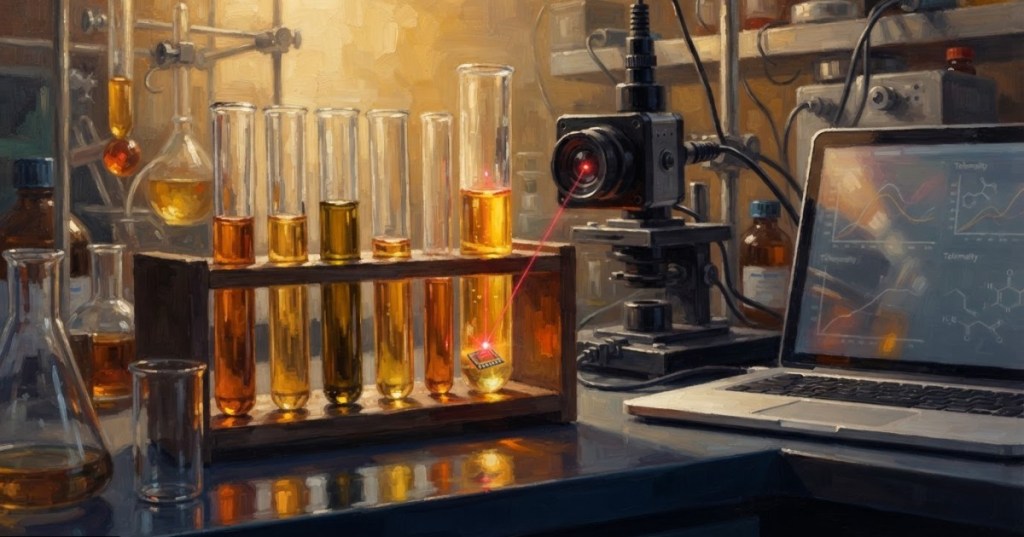
Stanford and Cornell researchers have turned tiny optical microchips into live monitors for chemical reactions. Their new system places a sensor measuring about 0.5 millimeter inside each test tube, then transmits temperature readings every half-second. Announced on November 19, 2026, and described in the journal Science, the work could help chemists identify failed reactions and unsafe heat buildup without waiting for experiments to finish.
Official Cornell University technology-licensing video, December 2020: OWiC Technologies cofounder Alejandro Cortese explains the optical microchip platform. Archival company presentation, not a demonstration of Stanford’s 2026 chemistry study.
How a chip smaller than rice sends data
The devices are Optical Wireless Integrated Circuits, or OWiCs. Each combines a temperature-sensitive electronic circuit with light-based power reception and optical communication. The research team adapted the chips for liquid chemistry by protecting the silicon with a chemically resistant coating. A tiny laser sends information back to external equipment, avoiding wired probes inserted into every small reaction vessel.
Wireless temperature monitoring is not new by itself. The advance lies in the sensor’s size and its ability to operate inside a dense set of parallel chemistry experiments. Our previous reporting on a battery-free graphene temperature sensor explores another approach to extracting measurements without ordinary batteries. The power-transfer mechanisms differ.
Nearly 700,000 readings instead of 96
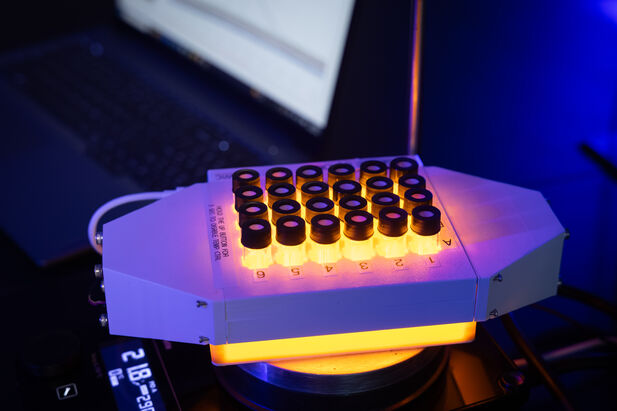
Stanford describes a typical batch of 96 reactions, with conventional analysis often producing one final measurement per tube. One chip providing two readings per second generates 7,200 readings during a 60-minute experiment. Multiplying 7,200 by 96 tubes produces 691,200 time-stamped measurements across the batch.
The comparison is 691,200 divided by 96, or 7,200 times as many observations. It does not establish a 7,200-fold improvement in reaction speed, experimental productivity or scientific accuracy. A temperature trace also cannot replace chemical identification by spectroscopy or chromatography.
Finding failed catalysts and dangerous heat
Stanford doctoral researchers Sukwoo Lee and Evan Weingarten tested whether continuous temperature histories could identify catalyst poisoning, in which a contaminant disrupts the desired reaction. The researchers also used the readings to flag excessive heat generation and adjust reaction conditions in small-scale experiments. Live thermal histories can reveal when a process changed, information an end-point reading may miss.
Official Stanford Sarafan ChEM-H seminar, May 2023: professor Polly Fordyce explains high-throughput biochemical measurement. Earlier academic context on parallel experimentation, not footage of the 2026 optical sensors.
The method could complement PNNL’s planned autonomous bioscience laboratory, Stanford’s virtual biotech research and AI-assisted chemistry modeling. Each system addresses a different stage of discovery; no direct integration has been announced.
What remains unproven
The reported demonstrations concern temperature and associated heat signals, not general chemical composition. Future versions might measure acidity, optical transmission or conductivity, but the Stanford team presents those as possibilities. Routine use would also require dependable optical access, calibration, chip recovery, repeatability across solvents and a demonstrated cost advantage. Stanford has not supplied a production price or independently validated drug-development speedup.
Commercial interests deserve disclosure. Several coauthors founded or work for OWiC Technologies, while Stanford professor Song Lin advises the company. The university identifies related patents and patent applications. Commercial involvement does not invalidate the reported experiments, but readers should distinguish research measurements from product claims.
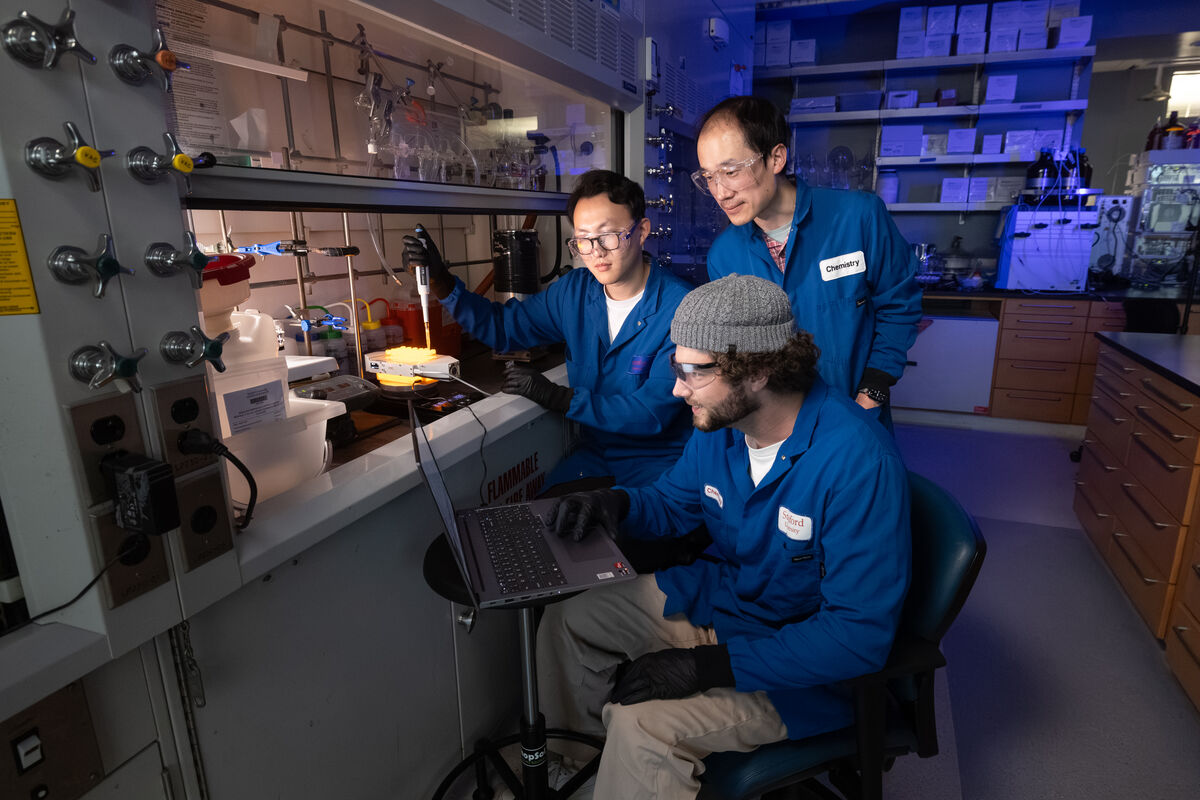
For researchers running dozens of reactions simultaneously, a half-millimeter chip can transform a final temperature reading into a continuous record. The engineering result is a better window into reaction behavior, with its biggest potential benefit still dependent on repeatable results outside the study’s controlled laboratory setup.
Primary sources and media
Research: Stanford University release, November 19, 2026; Lee and colleagues, Science, DOI 10.1126/science.aei7840; and OWiC Technologies company disclosures. Stanford supplied the original laboratory imagery and demonstration. Both YouTube videos are archival background from the organizations identified in their captions. The featured painting is conceptual artwork.


Leave a Reply