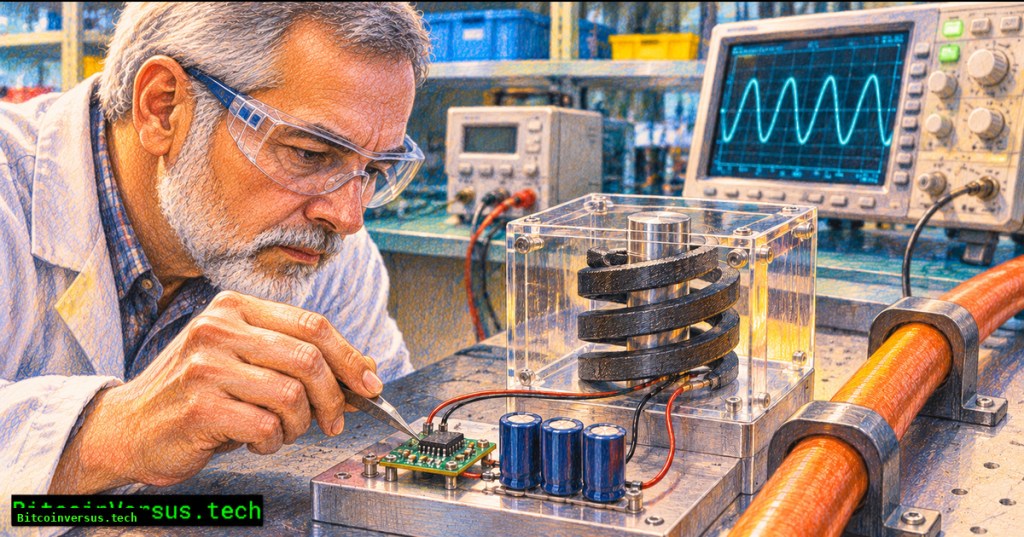
Researchers at the University of Arkansas and University of Michigan have powered a tiny temperature sensor using energy collected from the 60-hertz magnetic field around an electrical cable, without a conventional battery. Their October 20, 2026, peer-reviewed study describes a graphene inductor, a voltage-conversion circuit and capacitors that store enough charge to run a nanowatt-scale load. The achievement is a laboratory prototype, not an installation-ready wireless sensor.
A current flowing through a power wire generates a magnetic field. An inductor placed nearby can intercept some changing magnetic flux, creating an alternating voltage without direct electrical contact with the conductor. At the United States grid frequency of 60 cycles per second, the available harvested energy depends on cable current, distance, coil geometry and electrical losses.
University of Arkansas official 2021 interview featuring physicist Paul Thibado on harvesting energy from freestanding graphene. Earlier research background, not footage of the October 2026 magnetic-field sensor. Credit: University of Arkansas / YouTube.
How graphene harvests a 60 Hz field
The team developed flat spiral and three-dimensional helical graphene inductors and tested the induced voltage and current near a cable. A steel core strengthened one version’s response. A Cockcroft-Walton rectifier and voltage-multiplier circuit converted the low-voltage alternating signal into a form suitable for charging three storage capacitors.
Capacitors matter because a temperature sensor consumes small bursts of energy rather than drawing a perfectly constant current. The researchers configured charging to exceed average consumption. Physics professor Paul Thibado told the university the stored charge could support operation for at least 24 hours during an outage, with roughly a week considered possible under the team’s conditions.
Graphene’s role in an inductor differs from the thermal-ripple harvesting concept previously pursued by the same laboratory. Here, the energy originates in an externally generated magnetic field; it is not electricity obtained from nothing. The distinction is important alongside research on strain-sensitive magic-angle graphene, which measures an entirely different material property.
Capacitors can run a sensor, but cannot guarantee a cold start
The prototype also differs from the group’s 2025 light-powered temperature sensor. The earlier version used graphene-based solar cells, whereas the new device targets environments where wiring is present even if sunlight is not. Researchers ultimately want multi-source harvesting that combines power-line fields with solar, motion or other local sources.
One important limitation remains: the team initially charged the capacitors and programmed the sensor controller before evaluating operation. A completely autonomous cold start from an empty energy store was not demonstrated. The ability to power a sensing circuit also does not establish sufficient energy for continuous wireless transmission, encrypted networking or complex edge processing.
The original paper’s narrow output should not be confused with a broad Internet-of-Things deployment. Nanowatt-scale electronics trade speed and functionality for extraordinarily low consumption. A 400 Hz robotic fingertip sensor, for example, has different sensing and communication requirements and cannot automatically use the same supply.
University of Arkansas official 2017 video on Thibado’s early graphene energy research. Archived technical context; the 2026 sensor uses an inductor to capture power-line magnetic fields, not the mechanism shown here. Credit: University of Arkansas / YouTube.
Prospects for monitoring and industrial sensors
The graphene research forms part of a wider search for new semiconductor and two-dimensional material functions. Our survey of post-silicon materials separates prospects for logic chips, sensors and specialized devices. Likewise, coal-derived nanodots in 2D transistor research represent a materials-fabrication advance rather than a comparable energy source.
University of Arkansas officials said commercial licensee NTS Innovations is developing integration opportunities, and more than 60 parties have expressed interest in testing graphene energy-harvesting technology. Expressions of interest are not purchase orders, installations or verified field lifetimes. A multi-decade operating life remains a target rather than an observed result.
Potential uses include temperature monitoring around utility infrastructure, logistics equipment and indoor industrial machines. Real-world tests must establish how close sensors need to sit to current-carrying conductors, the effect of variable loads, electromagnetic compatibility and safe installation methods. Battery elimination can reduce maintenance, but only if the lifetime of the whole sensing package matches the harvesters’ projected durability.
The next decisive proof will be an instrument that starts itself from a depleted capacitor, consistently measures temperature under variable cable loading and transmits useful readings without external charging. Until then, the result shows that local magnetic fields can sustain a carefully engineered, low-power sensor under test conditions.
Sources and methodology: University of Arkansas official announcement, October 23, 2026; Kabir and colleagues, “Graphene powerline energy harvester powers a batteryless sensor,” Journal of Vacuum Science & Technology B, October 20, 2026; Graphene-Info engineering summary; 2025 precursor study. Findings describe a controlled laboratory sensor and must not be generalized to entire wireless IoT systems.
Editor’s Note: The 2026 study describes a batteryless sensing circuit that harvested power from an existing 60 Hz electrical field. Researchers precharged storage capacitors, so autonomous cold-start operation remains unverified. A decades-long service life is a development objective, not field-demonstrated durability. The featured 1200 × 630 colored-pencil cover is conceptual artwork featuring a fictional older engineer, not a photograph of the Arkansas research team. The neon-green Bitcoinversus.tech pixel-style watermark appears on a black rectangular tag. University of Arkansas videos are authenticated archival background and are not representations of the 2026 test. Embed playback in external browsers and on mobile devices has not been independently verified.

BitcoinVersus.Tech is volunteer-run and publishes independent technical journalism. An optional 5,000-satoshi donation supports ongoing research. Scan the original QR from a second screen using a compatible Bitcoin wallet; on the same phone, use a wallet that can import a saved QR image when supported. Independently verify recipient 3C9o19EH5HSiwEPyCTmEKzxhNCbo2X6TTb and the 5,000-satoshi amount before sending. Bitcoin transfers are generally irreversible.
We volunteer daily to ensure the information on BitcoinVersus.Tech is Verifiably True. Technical and financial coverage is educational and informational, not personalized engineering, securities, tax or investment advice.


Leave a Reply