Daikin Applied unveiled a 60-megawatt AI-factory cooling reference architecture on November 10, 2026, integrating liquid-cooled GPU racks, oil-free chillers, dry coolers and plant controls. Called D60-W, the blueprint is based on NVIDIA’s DSX AI Factory Platform and Vera Rubin NVL72. It describes a prospective engineering configuration, not an operating 60 MW data center.
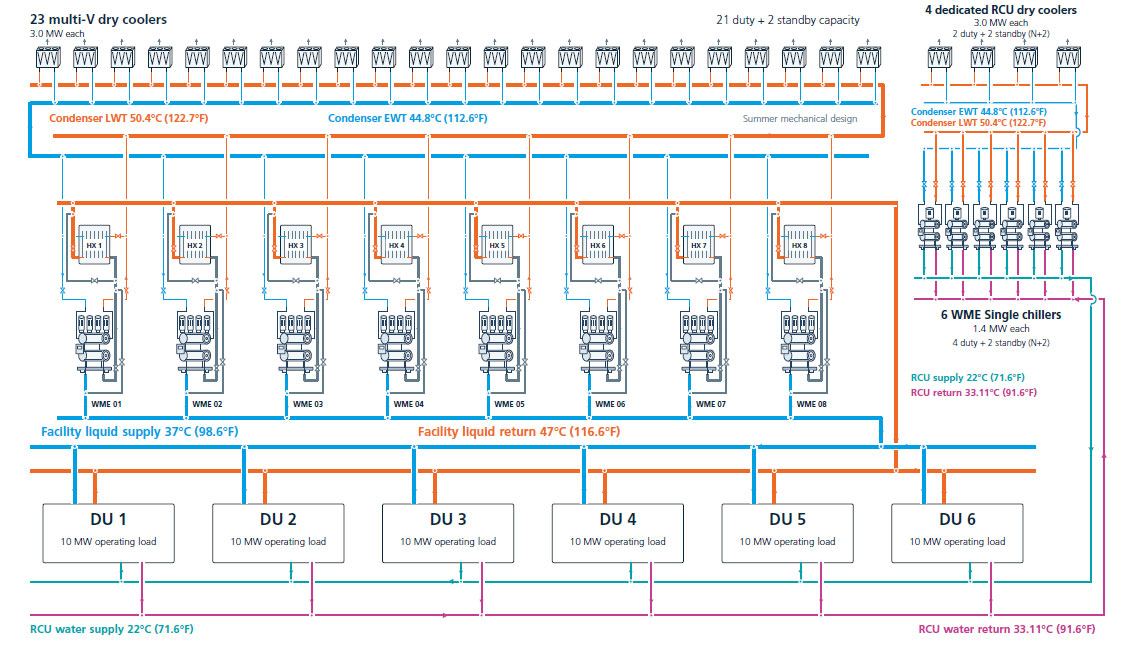
Daikin assigns 92% of heat removal to liquid cooling and 8% to rack air cooling. A high-temperature loop feeds coolant distribution units (CDUs) serving the racks; a lower-temperature circuit supplies rack containment units (RCUs) that capture residual air-side heat. Different water-temperature requirements influence pumps, chiller operation and outdoor heat rejection.
Daikin Applied Europe demonstrates its Intelligent Data Centre Manager (iDCM), April 2026. Archival technology explanation, not a D60-W installation. Credit: Daikin Applied Europe/YouTube.
Six units, 55.2 MW of liquid-cooled load
The detailed reference allocates 10 MW of operating IT load to each of six deployable units. Total liquid-side cooling equals 60 × 0.92 = 55.2 MW; residual air-side cooling is 60 × 0.08 = 4.8 MW. Those values describe design heat loads, not verified energy savings.
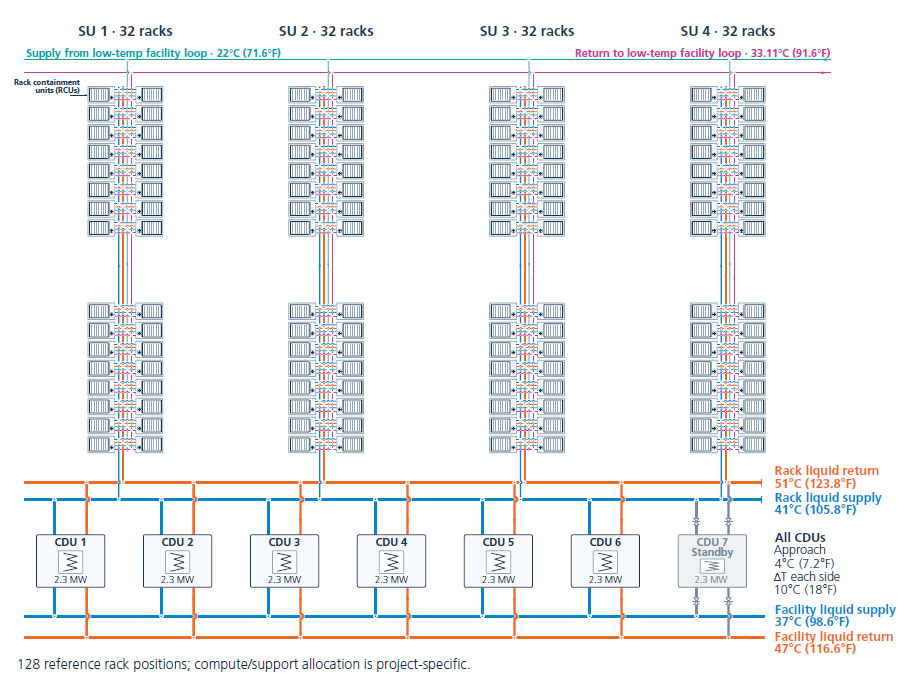
Each unit includes 128 reference rack positions in four scalable groups. Seven nominal 2.3 MW CDUs appear in the drawing: six duty, one standby. The 13.8 MW combined duty-CDU rating exceeds the 10 MW plant operating allocation; it is not extra commissioned IT capacity. Across six units, the plan includes 768 reference positions. Final compute density and support allocation remain project-specific. BitcoinVersus.Tech recently covered quick-disconnect inspection for liquid-cooled racks.
Weather determines the cooling mode
D60-W alternates among dry cooling, hybrid economizer operation and compressor-driven mechanical cooling. When outdoor conditions permit, dry coolers reject heat without chiller compressors. Hybrid mode precools return water before chillers complete the duty. Daikin uses Ashburn, Virginia, as its reference climate; annual efficiency cannot be assumed identical elsewhere.
Official NVIDIA video describing DSX AI-factory power delivery and closed-loop liquid cooling, September 2026. Not a measured D60-W performance test. Credit: NVIDIA/YouTube.
Replacing evaporative towers with dry coolers removes cooling-tower make-up water from Daikin’s proposal; it does not establish zero water consumption or a measured annual water-usage effectiveness. Location matters: an independent survey of data centers in water-stressed areas highlights the cooling and environmental trade-offs.
Redundancy targets and 2027 equipment
Daikin specifies oil-free Magnitude WME magnetic-bearing chillers and redundancy across cooling stages, including six-plus-two high-temperature-loop chillers. Eliminating a traditional oil-lubrication circuit can reduce maintenance and standby requirements, but restart resilience and availability still require real-world commissioning tests.
Critically, Daikin says its new CDU and data-center dry cooler are still in development, with availability targeted for the second half of 2027. The company disclosed no D60-W customer site, independently tested PUE, deployment cost or operating electricity measurement. The launch establishes an engineering reference, not a validated commercial installation.
Cooling must also integrate with electrical capacity and infrastructure contracts. Related BitcoinVersus.Tech coverage examines 800 VDC transformer development and large-load utility tariffs. Neither grid access nor energy cost is resolved merely by selecting a cooling architecture.
Sources and methodology
Primary sources: Daikin’s November 10 release and the original D60-W technical reference. All capacities are supplier design values. Both diagrams are official Daikin technical materials; the videos illustrate related systems.
Editor’s Note: Load splits, rack counts, control modes and component timelines were checked against Daikin’s primary documentation. The original 1200 × 630 oil-painting cover is conceptual artwork, not a real facility photograph. Both diagrams come from Daikin Applied. Two authentic official videos are background material predating the release. Independent energy performance, field commissioning and end-user video playback remain unverified.
Support BitcoinVersus.Tech
Optional 5,000-satoshi donations support independent reporting. Scan the original QR code from another device with a compatible Bitcoin wallet. On mobile, save the QR image and import it through a wallet supporting image-based QR scanning. Verify the recipient and amount before sending.

BitcoinVersus.Tech is volunteer-run and aims to keep independent reporting verifiably true. Support is voluntary, and Bitcoin transactions are generally irreversible. Confirm recipient 3C9o19EH5HSiwEPyCTmEKzxhNCbo2X6TTb and the intended 5,000-satoshi amount. Reporting is informational, not a certification of engineering performance or investment advice.


Leave a Reply