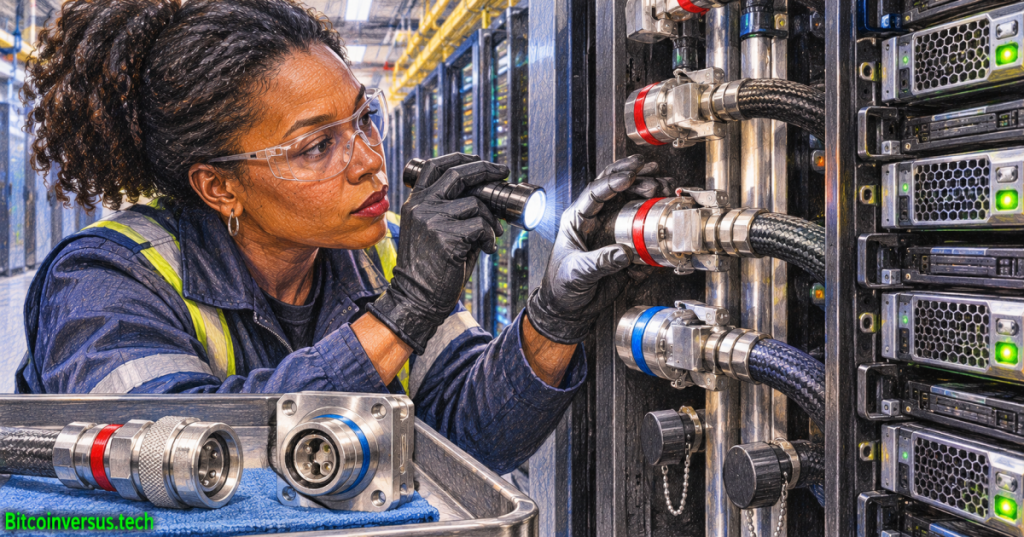
OSDCTC.018 examines the metal quick-disconnect (QD) couplings that join liquid-cooled servers to rack manifolds. A coupling lets qualified staff service an approved server loop without necessarily draining an entire rack, but a disconnected fitting can still release residual coolant or introduce contamination. The lesson follows OSDCTC.017 on condensation monitoring and OSDCTC.016 on CDU and leak telemetry.
CPC | Quick Disconnect Fittings & Couplings, May 19, 2026. Official Everis product demonstration covering non-spill, latched, blind-mate and universal QD designs. Manufacturer marketing describes supported products rather than certifying every installed combination. Credit: CPC / YouTube.
Hand-mate, blind-mate and dry-break connections
A hand-mate connector is coupled manually; a blind-mate interface engages when a tray or server slides into a designed position. Double-shutoff and flush-faced valves limit fluid escape on separation. They do not guarantee literally zero moisture: CPC’s engineering guide notes residual wetting and pressure-dependent fluid loss. The exact allowed leakage depends on connector specifications and service conditions.
The Open Compute Project integration guidance directs teams to inspect manifolds, hoses, connections and unused port caps for damage, verify safe locking positions, and document results. A red or blue collar helps identify a circuit but is not proof of compatible plug and socket geometry.
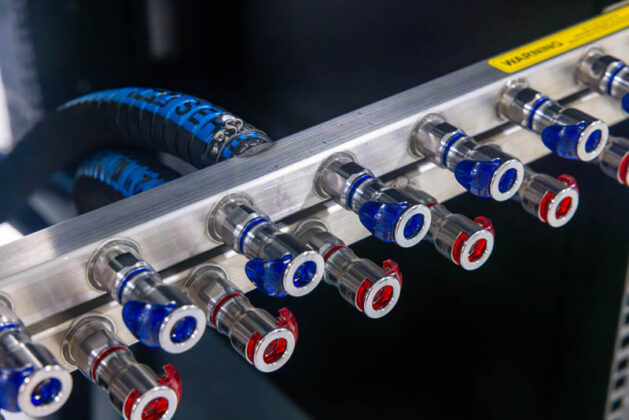
Inspection points before any connection change
From an authorized safe position, record the rack and manifold identity, connector manufacturer, exact mating part numbers, revision, line designation and coolant formulation. Look for dampness, deposits, damaged seals, bent mounting features, hose abrasion, tight bend radii and debris near exposed faces. Check installed retention indicators and ensure unused ports retain approved protective caps. Never force a coupling to overcome misalignment.
Blind-mate tolerances are especially important. Amphenol’s October 2026 guide separates radial and angular alignment, repeatability, pressure-drop budgets and coolant-material compatibility. A connector that physically fits may still lack verified pressure, fluid or temperature compatibility. Inspect rather than improvising a mixed-vendor replacement.
CoolIT Systems, June 14, 2017. Original manufacturer video describing Stäubli metal quick disconnects used in rack-based direct liquid cooling and server serviceability. Historical product demonstration; current connector qualifications may differ. Credit: CoolIT Systems / YouTube.
Leak alarms and service limitations
CoolIT’s rack-manifold documentation describes double-sided serviceable manifolds, color-coded ports and manufacturer leak testing. A non-spill design may permit individual server replacement while adjacent equipment remains operational, only where the exact integrated system authorizes the procedure. Never infer permission to hot-disconnect from the fitting’s appearance or vendor promotional language.
Review branch pressure, coolant temperatures and leak-alarm history before approving maintenance. OSDCTC.014 covers rack thermal observations, while OSDCTC.015 addresses electrical feed verification around serviced servers. A leak near energized equipment requires the site’s emergency response and isolation procedures, not hands-on troubleshooting under pressure.
Practical conclusion: A reliable QD inspection establishes matched hardware, secure engagement, intact seals, clean interfaces and traceable operating conditions. Manufacturer-approved commissioning tests—not a dry-looking fitting—confirm acceptance.
Editor’s Note: Connector principles were verified against CPC, Amphenol, OCP and CoolIT documentation. The original 1200 × 630 colored-pencil cover uses a small neon-green Bitcoinversus.tech watermark and depicts a conceptual scene. The in-story manifold photograph is authentic, credited to ServeTheHome. No generated technical diagram, pressurized disconnect test or independent browser video-playback test was performed.

BitcoinVersus.Tech is volunteer-run and publishes independent technical education. An optional 5,000-satoshi donation supports research. Scan the original QR from a second screen using a compatible Bitcoin wallet; on the same phone, use a wallet supporting import of a saved QR image. Independently confirm recipient 3C9o19EH5HSiwEPyCTmEKzxhNCbo2X6TTb and amount. Bitcoin transactions are generally irreversible.
We volunteer daily to ensure the information on BitcoinVersus.Tech is Verifiably True. Educational material does not authorize work on live coolant lines or energized racks and is not certified engineering, financial or investment advice.


Leave a Reply