Researchers in Taiwan have produced a copper-based crystal that behaves electrically like a metal and responds strongly to infrared light. The metal-organic framework, or MOF, reached 120 siemens per centimeter in laboratory conductivity measurements and a peak 8,100 amperes per watt of photocurrent responsivity. The peer-reviewed study appeared in Advanced Science on November 9, 2026, followed by a National Taiwan University announcement on November 19.
The result is interesting because many metal-organic frameworks contain pores and organic linkers that make electrical transport difficult. Here, repeating copper-sulfur connections offer a route for charges to move across a crystal. The material is a research specimen, not a finished infrared camera chip or commercial semiconductor replacement.
IFIMAC Condensed Matter Physics Center, October 14, 2024: archived research lecture on conductivity in metal-organic frameworks. Background on the material family, not footage of the 2026 experiment.
How the copper-sulfur crystal works
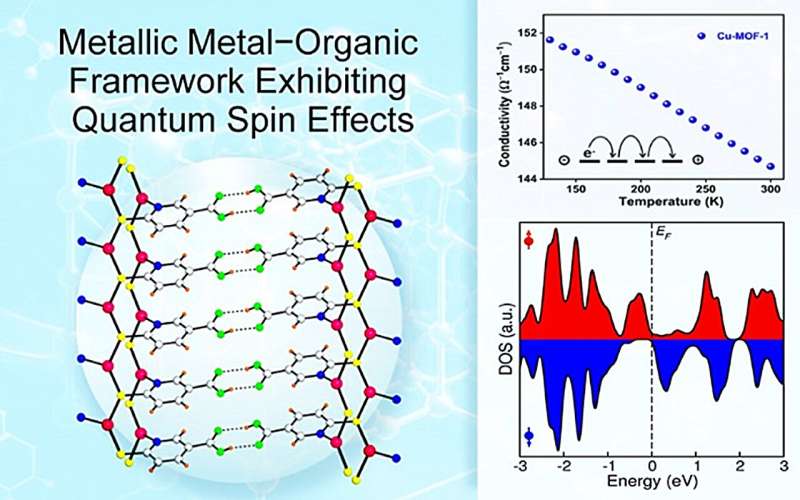
The team synthesized a framework based on copper ions and the organic molecule 6-mercaptonicotinic acid. The resulting crystalline arrangement includes connected copper-sulfur chains. Measurements on fabricated single-crystal devices showed a peak conductivity of 120 S/cm and a temperature dependence consistent with metallic transport, rather than the thermally activated conduction typical of many semiconductors.
Metallic transport does not mean conductivity comparable to bulk copper wiring. Ordinary copper is thousands of times more conductive. The advance is the combination of substantial charge transport with the chemical design flexibility associated with metal-organic frameworks. Device performance also depends on contacts, crystal quality and measurement geometry.
A powerful infrared response, with conditions attached
Under 808-nanometer illumination, a near-infrared wavelength, the study reports responsivity as high as 8,100 A/W at an incident power density of 40 W/m². Responsivity describes electrical current produced per watt of incident light. It is not the same as detection speed, accuracy, camera resolution or efficiency when integrated into a complete system.
Photoconductive gain can produce a large current when light-generated charge carriers persist long enough to contribute repeatedly to conduction. A large responsivity therefore needs context from noise, bandwidth, stability and dark-current testing. Independent device trials will be necessary before calling the crystal a superior practical sensor.
Institut Català de Nanociència i Nanotecnologia, September 9, 2022: Professor Carl Brozek’s research talk on electrical conductivity and dynamic bonding in nanoscale MOFs. Archival technical context only.
Spintronic behavior is still a prediction
Researchers also calculated a possible half-metallic electronic structure: one electron-spin channel has metal-like bands while the other has semiconductor-like bands. That electronic structure could matter to spintronics, where information depends on electron spin as well as charge. The half-metallic result comes from density-functional theory modeling; the study does not demonstrate a fabricated spin valve or commercially useful spin filter.
The distinction between measurement and modeling is important. Temperature-dependent conductivity and infrared photocurrent were measured. Spin-resolved band structures were calculated and would benefit from further experimental confirmation.
Why the result matters beyond one laboratory
BitcoinVersus.Tech recently covered a perovskite chip that performs several optical functions, and a separate method for growing graphite through electrical transport. Both involve distinct materials and devices, but all seek alternatives to familiar fabrication routes.
Other examples include strain-sensitive twisted graphene and Stanford’s miniature optical sensing chips. Comparisons should account for different measurements and operating conditions rather than simply ranking large headline numbers.
The next engineering questions concern reproducible crystal growth, thin-film fabrication, device lifetime, measured noise and whether predicted spin polarization survives realistic contacts and temperatures. For now, the work establishes a notable combination of metallic transport and infrared photoresponse in a laboratory copper-organic crystal.
Primary sources and original media
- Kamal et al., Spin-Polarized Metallic Metal-Organic Framework With High Conductivity and Half-Metallic Behavior, Advanced Science, November 9, 2026
- US National Library of Medicine, indexed paper abstract and authors
- National Taiwan University via Asia Research News, November 19, 2026, institutional release and authorized research graphic
- Open-access full study, experimental measurements and density-functional theory calculations
- Nature Communications, 2019, earlier copper-sulfur MOF conductivity study for historical comparison
Editor’s Note: We volunteer daily to ensure the credibility of the information on our platform is Verifiably True. If you would like to support our work and the integrity of our research initiatives, scan the QR code below to donate 5,000 sats.

For mobile scanning, open the article on another display and scan the QR code with a Bitcoin wallet. Verify receiving address 3C9o19EH5HSiwEPyCTmEKzxhNCbo2X6TTb before sending.
BitcoinVersus.Tech provides technology and engineering journalism for informational purposes and does not provide investment, legal or professional engineering advice.


Leave a Reply