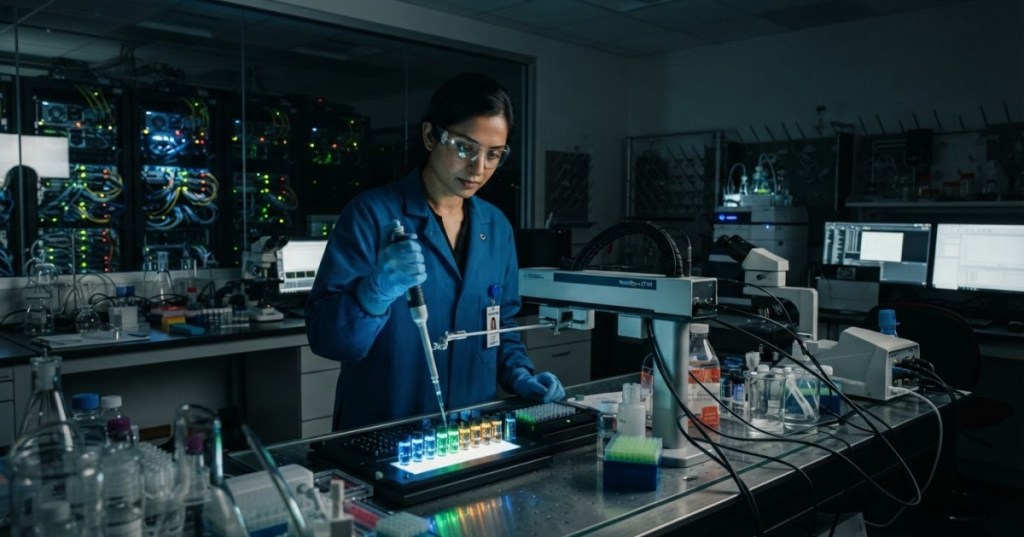
NVIDIA introduced Nemotron for Science on November 16, 2026, combining a customizable multimodal AI model with chemistry datasets and techniques for adapting it to laboratory research. In a demonstration involving quantum dot synthesis, collaborator Lila Sciences reported a 61% task score after training with experimental feedback, versus 54% for GPT-6 Astra under NVIDIA’s stated comparison. The seven percentage point gap is a company-reported result, not an independently replicated finding of general scientific superiority.
The launch also includes LitmusBench v0.2, an openly released chemistry reasoning dataset containing nearly 50,000 questions. It is designed to help research groups evaluate models on molecular properties and experiment-related problems; dataset access and trained-model availability do not mean any drug or new material has received clinical or commercial approval.
Why experiment feedback matters
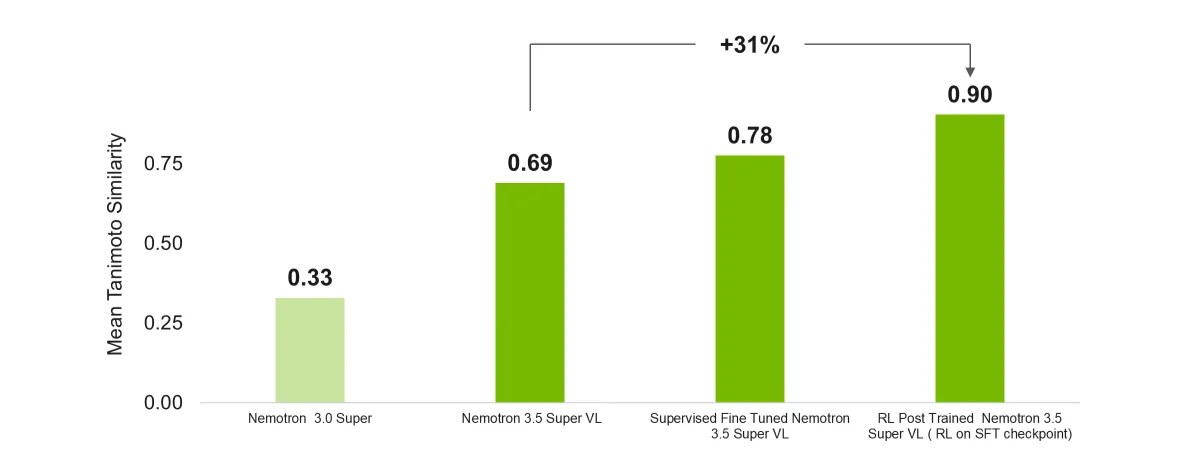
Nemotron 3.5 Super VL serves as the model foundation. Researchers can train it further using examples tied to measurements, such as a molecular reaction’s experimentally observed outcome. NVIDIA’s technical walkthrough describes a reinforcement learning method in which the model proposes a predicted molecule, then a verifier scores the answer against a known result.
One chemistry example represents molecules as SMILES strings, a text notation describing atom and bond arrangements. The verifier compares predicted and reference molecular fingerprints with Tanimoto similarity, a score ranging from zero to one. Higher similarity indicates more shared fingerprint features; it does not by itself establish biological effectiveness or safety.
Archival official NVIDIA Developer presentation, March 30, 2026. Bryan Catanzaro explains the Nemotron open model ecosystem; the video predates the November science release.
For drug metabolism prediction, NVIDIA reports that supervised fine-tuning improved its evaluation by 12%, with additional reinforcement learning providing another 17% improvement under the documented experimental setup. Those improvements describe a separate chemistry benchmark, not the quantum dot result, and should not be added together as a universal accuracy figure.
Quantum dots provide a controlled example
Quantum dots are nanoscale semiconductor crystals whose properties depend on composition, size and manufacturing conditions. Lila Sciences used laboratory feedback to refine Nemotron’s instructions for making them. NVIDIA says performance rose to 61%, compared with 54% on the selected test for GPT-6 Astra, while inference cost was 10 to 20 times lower. Both performance and cost comparisons originate from the announcement; independent replication and workload details remain important before generalizing them.
Other early adopters reported narrower outcomes. Terray Therapeutics said its adapted model recovered about 76% of annotated chemistry reactions under the RxnScribe benchmark’s matching rules. KTH Royal Institute of Technology said an agent corrected 81% of test molecular dynamics setups in an overnight evaluation, with fixes checked by GROMACS software. Neither score is interchangeable with successful drug discovery.
From model results to operating laboratories
NVIDIA also named Argonne National Laboratory and Jülich Supercomputing Centre among research groups integrating Nemotron into scientific workflows. Its optimized model can run locally on a 128 GB DGX Spark configuration, although larger research workloads may require dedicated computing infrastructure.
Archival NVIDIA video, March 17, 2026, examining Edison’s Kosmos research agent and earlier Nemotron components. It provides agent-workflow background and is not a demonstration of the November quantum dot trial.
Commercial relevance will depend on whether the system reliably converts paper knowledge and experimental results into actions scientists can verify. BitcoinVersus.tech previously covered PNNL’s autonomous biology facility and El Capitan’s protein prediction throughput, both related to faster scientific workflows through different hardware and experimental approaches.
Our reporting on AI performance on wet-lab tasks and the $1 million AI materials challenge underscores another constraint: favorable task metrics need independent evaluation before researchers can rely on outputs in safety-critical work.
What comes next
The strongest next evidence would be openly reproducible tasks, comparisons using equal hardware and token budgets, and physical experiments demonstrating successful results beyond the initial collaborators. Nemotron for Science offers researchers models and tools now; broader claims about breakthrough medicines or materials must await validated laboratory outcomes.
Primary documentation: NVIDIA announcement, November 16; NVIDIA scientific post-training methods; LitmusBench dataset catalog.


Leave a Reply