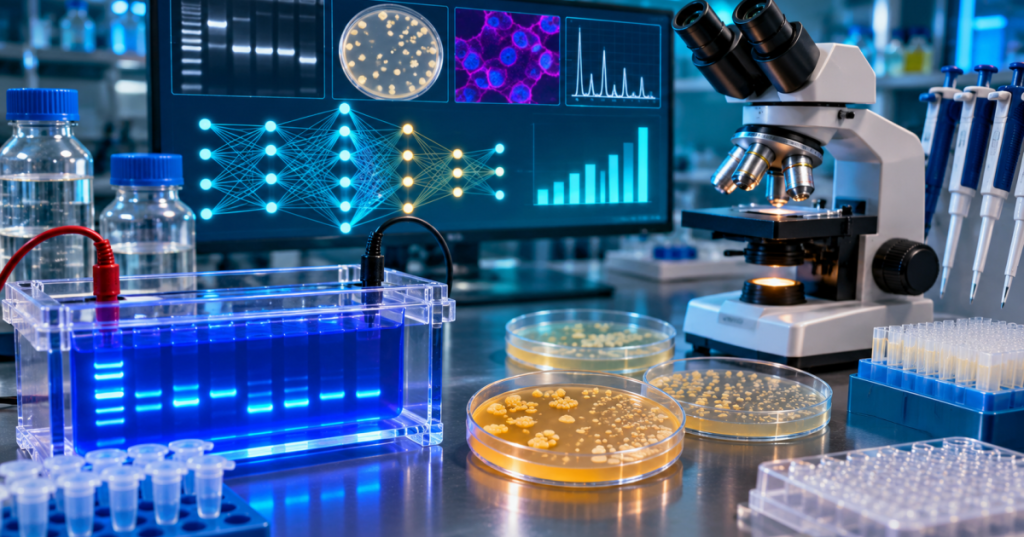
OpenAI introduced BioBasicsBench on November 6, 2026, a benchmark built with enzyme-design company Ligo to test whether artificial-intelligence agents can interpret the raw evidence produced by biological laboratories. On 100 tasks, GPT-6 Astra earned an average of 66.7% of available rubric credit at the reported “xhigh” reasoning setting, compared with 43.8% for GPT-5.6 Sol. The primary research announcement cautions that stronger test scores do not make an AI agent reliable enough to replace scientific judgment.
Wet-lab research means experiments performed with physical biological samples, equipment and reagents. Researchers interpret DNA gels, microscopy images, colonies grown on agar, sequencing data and instrument records. Unlike a biology knowledge quiz, BioBasicsBench asks models to examine original experimental material, detect errors and recognize when available evidence cannot justify a conclusion.
Seven models tested on 100 tasks
OpenAI evaluated seven models across 37 model-and-reasoning configurations. Each configuration received five attempts at every task, creating 18,500 scored responses. Rubrics award partial credit for findings, measurements, explanations and appropriate uncertainty; the percentages are therefore mean reward scores, not the share of tasks fully solved. At xhigh effort, GPT-6.1 Sol scored 62.0%, GPT-6 Luna 38.3%, GPT-5.5 35.4%, GPT-5.4 33.2% and GPT-5.2 31.2%.
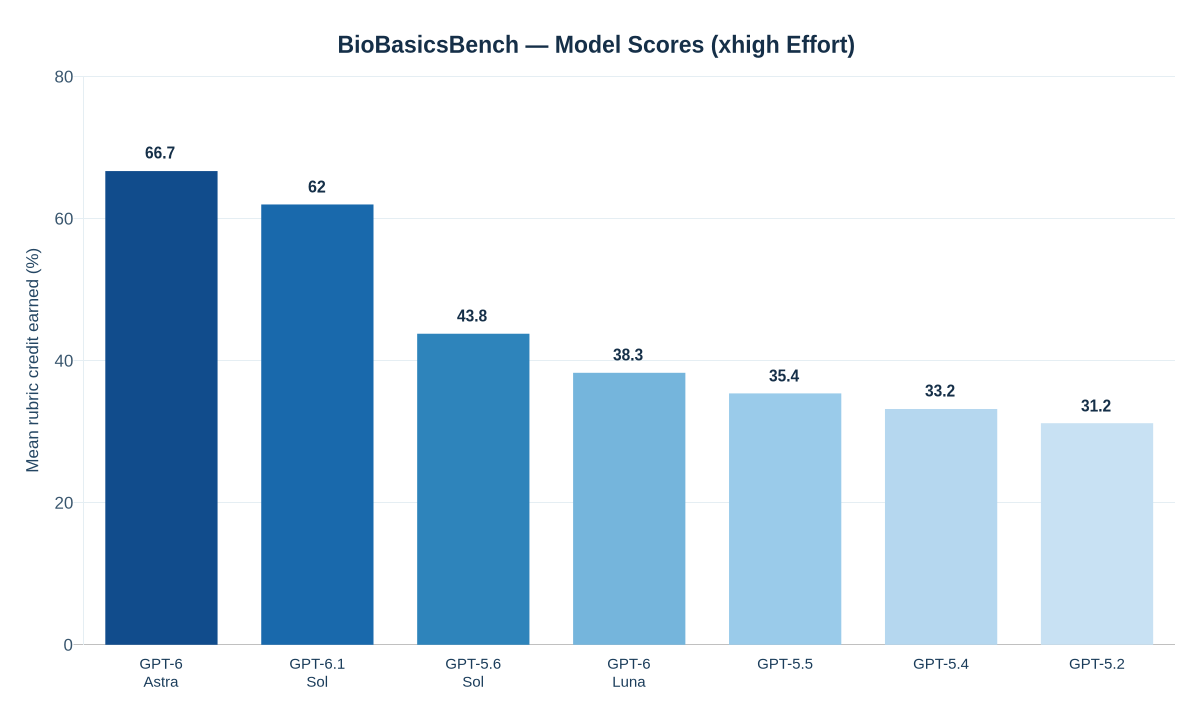
The 22.9-percentage-point gap between Astra and GPT-5.6 Sol suggests improvements in interpreting images and experimental context, but OpenAI did not publish a corresponding human performance baseline. Confidence intervals and test conditions matter: the developer’s research environment is not necessarily representative of a laboratory running an autonomous production workflow.
Raw evidence exposes different failure modes
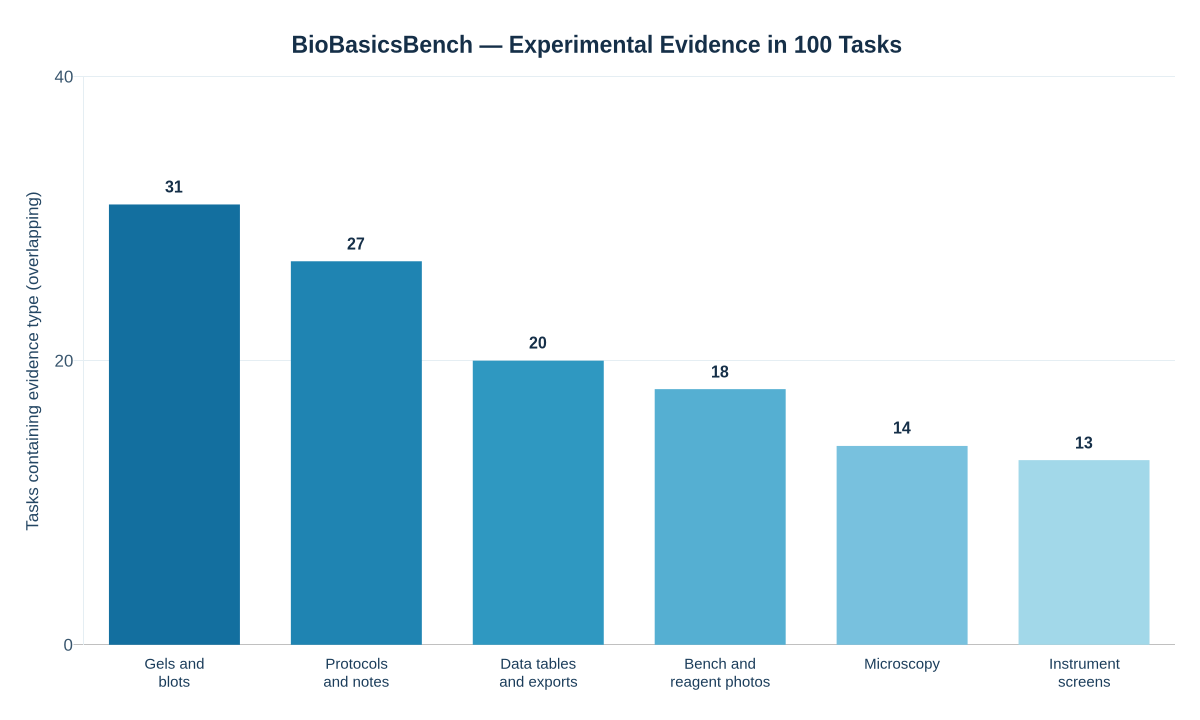
The tasks span protein methods, imaging and cytometry, assays, nucleic acids and cloning. Of the 100 tasks, 31 involve gels or blots, 27 include protocols or notes, 20 use tables or instrument exports, and 14 involve microscopy. Evidence types overlap, meaning the category counts cannot be summed into 100 separate experiments.
One example involved overlapping fluorescent detector channels: Astra recognized that a bright signal did not prove cell death without controls separating the dyes. In another task, the model noticed an antibiotic label inconsistent with the expected negative control, avoiding an invalid cloning conclusion. However, it also misidentified candidate colonies in a PCR example and overcounted bacterial colonies by approximately 12% in another.
Better analysis is not laboratory autonomy
AI may help scientists triage noisy evidence and plan follow-up tests, as earlier BitcoinVersus.Tech reporting examined in automated laboratory robotics and AI-assisted drug development. But interpreting images correctly is different from independently controlling instruments, validating assays, establishing causation or demonstrating treatment effectiveness.
The benchmark also illustrates limitations relevant to AI systems tackling materials-science challenges and models interpreting pharmaceutical evidence. Independent replication, calibrated uncertainty and transparent failure analysis are more informative than a single leaderboard ranking.
BioBasicsBench is a research evaluation, not an approval for clinical decisions, a demonstrated medical breakthrough or proof of autonomous wet-lab operation. The next evidence should come from independently reproduced experiments and clear reporting on whether model assistance reduces error without introducing new ones.
Sources: OpenAI, “Measuring how AI agents handle everyday wet-lab science,” November 6, 2026; OpenAI’s April 16 GPT-Rosalind background; official OpenAI research interview; and official experimental-design demonstration.
Editor’s Note: All benchmark scores and case examples are attributed to OpenAI and Ligo’s reported evaluation. Mean reward is partial-credit rubric performance, not full-task completion or independently established real-world reliability. Both OpenAI videos predate the benchmark release, and the featured cover is AI-generated conceptual artwork, not a photograph of a laboratory test.
Support BitcoinVersus.Tech
Support independent research with the original approved QR below for a 5,000-satoshi Bitcoin donation. On mobile, open the page on another screen and scan using a compatible Bitcoin wallet. Verify the destination and amount before payment.
We volunteer daily to ensure the information on this platform is Verifiably True. If you would like to support the research, please scan QR code.


Leave a Reply