
Google DeepMind says its new AlphaGenome 2 model identified more disease-relevant genetic variants in a controlled single-cell benchmark, raising causal variant recall from 16% to 30% while retaining the evaluation’s precision constraint. Announced November 11, 2026, the research system analyzes how DNA sequences affect specific human cell types rather than predicting gene activity only across averaged tissue samples. The findings describe an AI research tool, not a new DNA sequencing machine or a clinical diagnostic.
Official video: Google DeepMind’s September 2026 AlphaGenome Atlas explainer outlines the earlier genome prediction platform. AlphaGenome 2 was announced separately in November and has a different cell-conditioned architecture.
Why the same DNA can behave differently across cells
Nearly every nucleated human cell carries the same genome, but a neuron, immune cell and heart muscle cell read different portions of that sequence. Regulatory switches can increase or decrease gene expression depending on cell identity and activation state. Genetic association studies often locate regions linked to disease without establishing which particular variant changes which gene in which cell.
AlphaGenome 2 receives a DNA sequence of up to roughly one million letters together with a description of a target cell type or state. A cell encoder can also derive that condition from fresh single-cell gene activity data. Google says the model was trained with more than 107 million cell profiles spanning 68 tissues, alongside other human and mouse data. Unlike DNA sequencing, the model does not read a physical sample. It predicts biological behavior computationally from sequence and experimental context.
Original social announcement: Google DeepMind on X, November 11, 2026. The direct source link is provided alongside the native Gutenberg embed for readers whose browsers restrict social content.
From 16% to 30% recall in a defined benchmark
According to DeepMind’s technical announcement, AlphaGenome 2 found 30% of causal gene-expression variants in the TenK10K immune-cell dataset, compared with 16% for the earlier model and comparison approaches at the stated precision operating point. That represents an increase of 14 percentage points, or 87.5% relative improvement, not a claim that all variants are detected. For predicting the direction of a variant’s effect on gene activity, reported recall increased from 23% to 43%. The benchmark covers 28 primary immune-cell types, so results should not be extrapolated automatically to every tissue or disease.
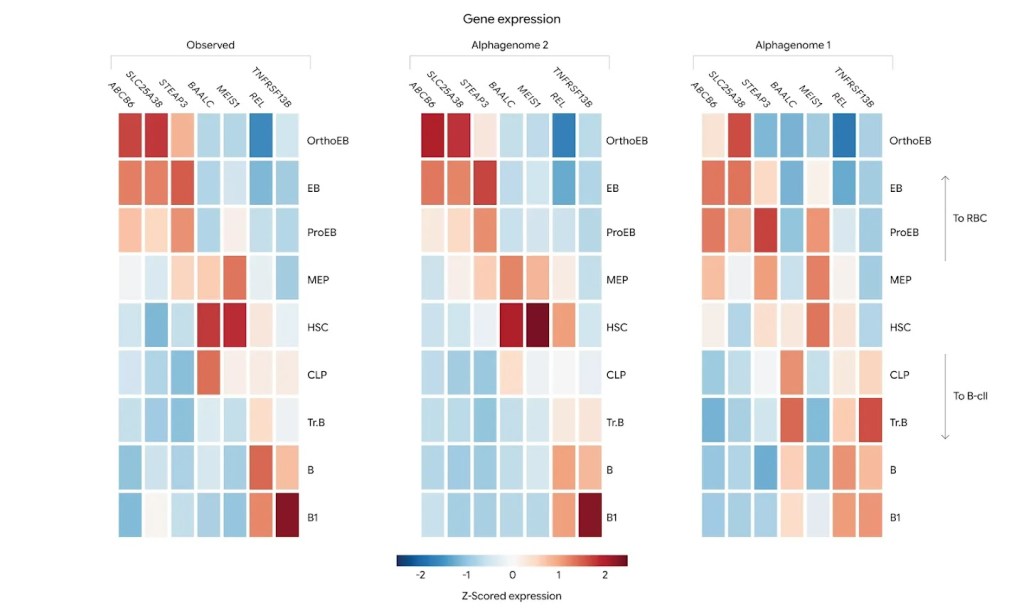
The official heatmaps compare observed blood-cell gene activity with both model generations. Separately, DeepMind reports that AlphaGenome 2 computationally reproduced a previously published link between an inflammatory bowel disease variant and increased ETS2 activity in gut macrophages. The model reproduced a known biological relationship; it did not independently discover a new treatment. Laboratory assays such as Salk’s CRISPR off-target measurements remain critical for testing predictions.
Open research access, limited clinical claims
Google offers AlphaGenome 2 through its API for noncommercial research, with commercial research access in private preview. Its underlying technical paper is a preprint, so independent peer review and replication still matter. Computational estimates may fail outside training distributions, miss tissue context or reflect biases in the underlying cell atlases. Google explicitly says AlphaGenome 2 is neither validated nor approved for clinical or diagnostic use.
The advance follows growing work on AI systems for biology. Google previously opened frontier models to European researchers, while separate benchmarking has tested AI performance on wet-lab tasks. Predictions can help prioritize experiments, but they do not replace controlled laboratory evidence.
The central engineering change is conditional prediction: a single model can ask how a DNA variant behaves in a chosen biological state, including certain new states represented by fresh single-cell data. Better ranking of candidate variants could speed research into disease mechanisms. Whether those gains translate into successful therapies will require additional biological validation and clinical work.
Primary sources: Google DeepMind announcement, November 11, 2026; AlphaGenome 2 preprint; Google DeepMind’s original X announcement.


Leave a Reply