TSMC’s $265 billion Arizona semiconductor program now spans operating production lines, equipment installation, construction sites and facilities without announced commissioning dates. A new Gantt schedule based on company disclosures separates what is operating from what remains a promise. The distinction matters for the U.S. supply of N3, N2 and future advanced chips.
The timeline begins with TSMC’s first Phoenix investment announcement in 2020 and traces the actual fab-by-fab milestones through November 18, 2026. TSMC’s original $12 billion commitment became $65 billion for three fabs, expanded to $165 billion in 2025, and rose to $265 billion after another $100 billion pledge on July 16, 2026. Announced capital is not equivalent to money already invested or fabs already completed.
SmartChart #34: Which Arizona fabs are ready?
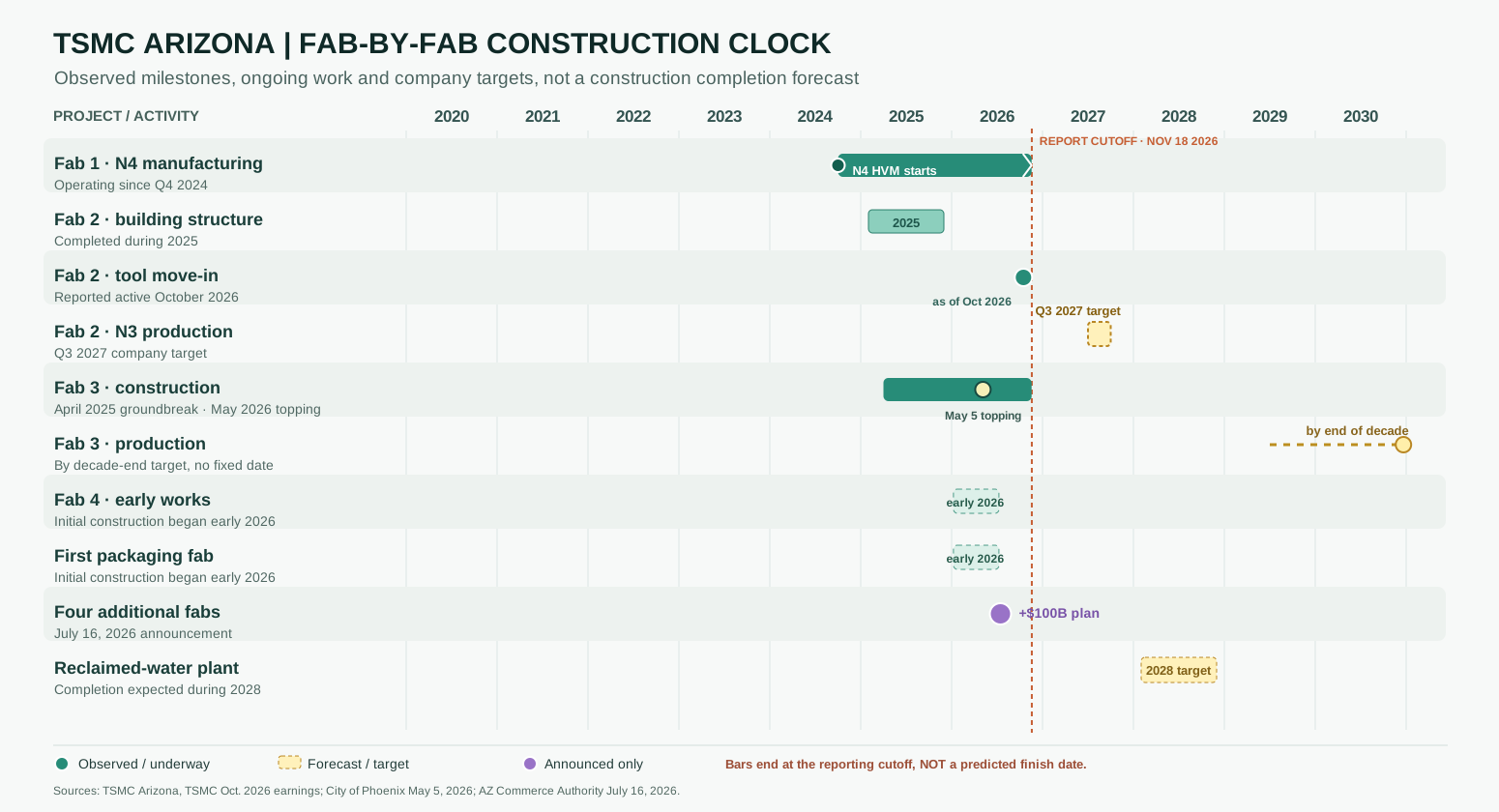
The first fab entered high-volume production on the N4 manufacturing process in the fourth quarter of 2024. Volume production means the factory is commercially manufacturing wafers, not simply running engineering samples. The company’s second fab completed its structure in 2025. TSMC reported in October 2026 that tool move-in and installation were underway and placed N3 volume manufacturing in the third quarter of 2027, ahead of its earlier second-half timetable.
Fab 3 broke ground in April 2025 and reached its topping-out milestone on May 5, 2026, according to Phoenix city officials. Installing the highest structural beam does not mean cleanroom qualification, tool commissioning or chip production has finished. TSMC assigns Fab 3 N2 and A16 technologies and describes its production objective as reaching volume manufacturing by the end of the decade, without publishing a precise quarter.
Phoenix Mayor Kate Gallego’s original July expansion statement appears above. Read the statement directly if a privacy setting blocks the social widget.
What remains without a production date
TSMC says initial construction began on a fourth fab and its first advanced packaging fab in early 2026. The July announcement added plans for four more wafer fabs using 2-nanometer or more advanced technology. Arizona officials describe the full expansion as ten wafer fabs, two packaging facilities and a research center. Those totals describe the announced program rather than ten fabs operating today. Neither the four new plants nor the packaging facilities have a comprehensive published production timetable.
Another infrastructure dependency appears on the project calendar: TSMC expects its Industrial Water Reclamation Plant to be completed in 2028. The plant supports a stated goal of reclaiming 90% or more water. The 2028 figure is a company projection, not a verified operational milestone. Electrical capacity, ultrapure water, specialty gases, cleanroom validation and equipment qualification must align before advanced wafers can ship at scale.
Why the schedule matters beyond Phoenix
Domestic wafer production is only one link in a broader chip supply chain. Amkor’s Arizona packaging program, Fujifilm’s materials expansion, and semiconductor technician training all influence how rapidly an advanced fab ecosystem can grow. Our earlier $265 billion project overview covers water use and investment scope. The Gantt analysis instead tracks execution status.
A horizontal schedule is particularly appropriate because multiple manufacturing and infrastructure activities overlap, while their endpoints differ in certainty. Solid portions represent dated observations, dashed windows denote company targets, and undated future projects remain unfilled. The schedule should be updated whenever TSMC announces a verified start, commissioning milestone or production change.
Supplier funding follow-up: Our SmartChart #33 CHIPS supplier funnel investigation examines how materials and manufacturing equipment projects move from concept plans to full applications, a separate pipeline from TSMC’s own fabrication schedule.
Primary data and methodology
The chart follows TSMC Arizona’s project timeline, the May 5, 2026 city record, the July 16 Arizona Commerce announcement and TSMC’s October 15 earnings call. View the original Gantt SVG and machine-readable milestone dataset. Partial-year descriptions are displayed as broad windows rather than invented exact dates.


Leave a Reply