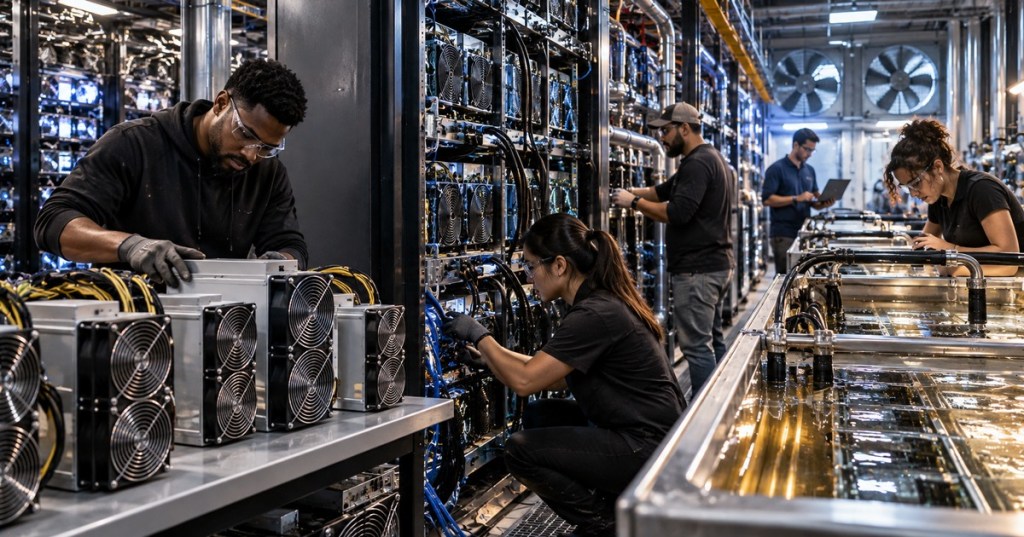
Bitcoin mining’s hardware race has crossed into a new efficiency tier. As of October 10, 2026, the leading full mining systems are no longer fighting over 15 or even 12 joules per terahash. The frontier is now below 10 J/TH, led by BITMAIN’s ANTMINER S23 XP Hyd. at 8.9 J/TH.
This list ranks complete SHA-256 Bitcoin mining machines by manufacturer-rated wall-plug efficiency, not by hashrate, price, profitability, or chip-only laboratory targets. Lower J/TH is better. When two machines have the same efficiency, the higher-hashrate configuration ranks first.
That methodology matters. Bitdeer’s SEAL04 silicon, for example, is listed at roughly 6–7 J/TH at the chip level, but the finished SEALMINER A4 Ultra Hydro is rated at 9.45 J/TH. A chip benchmark is not a mining machine, and a miner’s nameplate J/TH is still not the same thing as site-level J/TH after pumps, fans, dry coolers, transformers and other facility loads are included.
The Top 10 at a Glance
| Rank | Miner | Cooling / Mode | Hashrate | Power | Efficiency |
|---|---|---|---|---|---|
| 1 | BITMAIN ANTMINER S23 XP Hyd. | Hydro | 600 TH/s | 5,340 W | 8.9 J/TH |
| 2 | Bitdeer SEALMINER A4 Ultra Hydro | Hydro | 886 TH/s | 8,372.7 W | 9.45 J/TH |
| 3 | BITMAIN ANTMINER S23 Hyd. 3U | Hydro | 1.16 PH/s | 11,020 W | 9.5 J/TH |
| 4 | BITMAIN ANTMINER S23 Hyd. | Hydro | 580 TH/s | 5,510 W | 9.5 J/TH |
| 5 | Auradine 3rd-gen Teraflux Hydro | Hydro eco mode | 600 TH/s | ≈5,880 W | 9.8 J/TH |
| 6 | Auradine 3rd-gen Teraflux Immersion | Immersion eco mode | 240 TH/s | ≈2,352 W | 9.8 J/TH |
| 7 | BITMAIN ANTMINER S23e U2H | Hydro, 2U | 865 TH/s | 8,650 W | 10.0 J/TH |
| 8 | Auradine 3rd-gen Teraflux Air | Air eco mode | 240 TH/s | ≈2,472 W | 10.3 J/TH |
| 9 | Bitdeer SEALMINER A4 Pro Hydro | Hydro | 680 TH/s | 7,412 W | 10.9 J/TH |
| 10 | Bitdeer SEALMINER A4 Pro Air | Air | 336 TH/s | 3,662.4 W | 10.9 J/TH |
Notes: figures are manufacturer-rated typical specifications or manufacturer-supported operating modes. Auradine eco-mode power is calculated from published hashrate × J/TH. Availability varies by model and batch; several entries are futures, preorder, or recently ramped products.
#1 — BITMAIN ANTMINER S23 XP Hyd.: 8.9 J/TH
The new efficiency leader is BITMAIN’s S23 XP Hyd., rated at 600 TH/s, 5,340 W and 8.9 J/TH. BITMAIN’s current shop lists the machine as a futures product, with November 2026 shipment timing. That makes the 8.9 J/TH figure the current machine-level frontier among clearly specified commercial Bitcoin ASICs.
The significance is bigger than a 0.6 J/TH improvement over the S23 Hyd. generation. At an idealized 1 EH/s of machine load, 8.9 J/TH corresponds to about 8.9 MW before site overhead. Every fraction of a joule now represents meaningful megawatts when fleets scale into exahashes.
#2 — Bitdeer SEALMINER A4 Ultra Hydro: 9.45 J/TH
Bitdeer’s flagship A4 Ultra Hydro is rated at 886 TH/s, 8,372.7 W and 9.45 J/TH. Bitdeer launched the A4 series in April 2026 and has shown the machine operating live in its lab near its target efficiency. The product page currently lists it as preorder/stay tuned, so prospective buyers should verify batch availability rather than assuming immediate delivery.
Bitdeer also says select A4 Ultra units can reach roughly 1 PH/s in a high-performance mode near 10 J/TH. That does not improve its ranking here—the standard 9.45 J/TH mode is more efficient—but it shows how modern ASICs are becoming adjustable operating envelopes rather than one fixed hashrate point.
#3 — BITMAIN ANTMINER S23 Hyd. 3U: 9.5 J/TH
The 3U S23 Hyd. is the hashrate monster of this efficiency class: 1.16 PH/s from 11.02 kW at 9.5 J/TH. BitcoinVersus.Tech first tracked the 1.16 PH/s 3U machine before its 2026 rollout. It is built for dense rack-scale hydro infrastructure, not casual deployments.
Its power draw is enormous at the individual machine level, but efficiency is the ratio that matters for fleet energy density. At 9.5 J/TH, 100 of these units would represent roughly 116 PH/s of hashrate and about 1.102 MW of miner load.
#4 — BITMAIN ANTMINER S23 Hyd. 580T: 9.5 J/TH
The standard S23 Hyd. uses the same 9.5 J/TH efficiency target in a smaller form factor: 580 TH/s at 5,510 W. BITMAIN’s May 2025 product manual specifies the 9.5 J/TH wall efficiency at a 35°C inlet-coolant reference, with normal tolerance around the nameplate values.
That temperature qualification is important. “9.5 J/TH” is not a magical constant under every field condition. Coolant temperature, power quality, firmware, silicon variation and site cooling all affect what an operator measures at the wall.
#5 — Auradine Third-Generation Teraflux Hydro: 9.8 J/TH in Eco Mode
Auradine’s third-generation Teraflux platform gives the market a credible U.S.-engineered alternative. The company’s published next-generation specifications put the hydro system at 600 TH/s and 9.8 J/TH in eco mode, or as high as 900 TH/s at 11 J/TH in normal mode. Auradine announced initial samples for Q2 2026 and volume shipments beginning in Q3.
This should not be confused with the older AH3880, whose published operating efficiency is substantially higher. The 9.8 J/TH claim belongs to Auradine’s newer third-generation Teraflux systems.
#6 — Auradine Third-Generation Teraflux Immersion: 9.8 J/TH in Eco Mode
Auradine’s immersion configuration also reaches 9.8 J/TH in eco mode at roughly 240 TH/s. In normal mode, the same configuration is published at 360 TH/s and 10.7 J/TH. That illustrates a theme increasingly common in mining hardware: efficiency rankings now depend on operating mode, not just chassis model.
For operators, immersion remains a system-level choice. The ASIC can run efficiently, but the facility still needs pumps, heat exchangers, fluid management and electrical infrastructure. Those loads are why a machine-level leaderboard must not be mistaken for total-site efficiency.
#7 — BITMAIN ANTMINER S23e U2H: 10.0 J/TH
BITMAIN’s S23e U2H compresses 865 TH/s into a standard 2U chassis at 8,650 W and 10 J/TH. The current BITMAIN shop has listed November 2026 shipping batches, with some batches already sold out. We previously covered how the 2U form factor shifts the bottleneck toward rack and facility density.
It ranks behind the 9.x J/TH machines, but 10 J/TH at 865 TH/s is still a major density achievement. For modern hydro sites, rack utilization and coolant delivery are becoming as important as the raw efficiency figure.
#8 — Auradine Third-Generation Teraflux Air: 10.3 J/TH in Eco Mode
Auradine’s air-cooled next-generation Teraflux configuration is published at 240 TH/s and 10.3 J/TH in eco mode, while normal mode reaches 310 TH/s at 11 J/TH. That is remarkable because air cooling normally gives up some efficiency to hydro or immersion systems.
Air still has powerful deployment advantages: no coolant loop, no immersion fluid, simpler repair workflows, and easier retrofit into conventional mining buildings. For many operators, a slightly worse J/TH machine can be the better system choice if infrastructure cost and uptime are superior.
#9 — Bitdeer SEALMINER A4 Pro Hydro: 10.9 J/TH
The A4 Pro Hydro is rated at 680 TH/s, 7,412 W and 10.9 J/TH. It gives up about 1.45 J/TH to the A4 Ultra Hydro, but it also targets a different cost and deployment point within Bitdeer’s A4 family.
That 1.45 J/TH gap is not small at scale. For every 1 EH/s of normalized output, 10.9 J/TH requires about 10.9 MW of machine power versus 9.45 MW at 9.45 J/TH—a difference of roughly 1.45 MW before cooling and distribution losses.
#10 — Bitdeer SEALMINER A4 Pro Air: 10.9 J/TH
The A4 Pro Air closes the top ten with 336 TH/s, 3,662.4 W and 10.9 J/TH. Its efficiency matches the A4 Pro Hydro, but the hydro model ranks higher because its hashrate is roughly double.
The fact that an air-cooled production design can sit at 10.9 J/TH is arguably one of the most important developments on this list. Hydro owns the absolute efficiency frontier, but air-cooled miners remain far easier to deploy across the enormous installed base of conventional mining sites.
Why MicroBT and Canaan Miss the Top 10
MicroBT and Canaan are not far behind. MicroBT’s support documentation lists the WhatsMiner M7AS+ at roughly 540–600 TH/s and 12.5 J/TH, while the air-cooled M70S+ is around 244 TH/s, 3,140 W and 12.87 J/TH. Canaan’s Avalon A16XP is rated at 300 TH/s, 3,850 W and 12.8 J/TH.
Those are still elite machines by historical standards. They simply miss a 2026 top-ten list that is now crowded with sub-11 J/TH hardware from BITMAIN, Bitdeer and Auradine. Canaan’s own A16XP launch is especially notable because it reaches 12.8 J/TH with conventional air cooling.
The 11–13 J/TH Near-Miss Tier
- BITMAIN ANTMINER S23 Air: about 11 J/TH.
- BITMAIN ANTMINER S21 XP+ Hyd.: 11 J/TH at 500 TH/s.
- BITMAIN S21 XP Hyd., S21j XP Hyd. and S23 Immersion: around 12 J/TH.
- Bitdeer SEALMINER A3 Pro Air / Hydro: 12.5 J/TH.
- MicroBT WhatsMiner M7AS+: 12.5 J/TH.
- Canaan Avalon A16XP: 12.8 J/TH.
- MicroBT WhatsMiner M70S+: about 12.87 J/TH.
What 8.9 J/TH Means at a 1 EH/s Site
J/TH becomes easier to understand when converted into megawatts. Ignoring facility overhead, 1 EH/s at 8.9 J/TH requires about 8.9 MW. At 12.8 J/TH, that same 1 EH/s requires about 12.8 MW.
That 3.9 MW difference equals roughly 93.6 MWh every day. At an illustrative electricity cost of $0.05/kWh, the lower-efficiency fleet would spend about $4,680 more per day, or roughly $1.71 million more per year per EH/s, before considering cooling and distribution overhead.
That is why efficiency has become existential rather than cosmetic as network difficulty rises. We have already covered how higher Bitcoin difficulty increases the value of every J/TH improvement and why easy efficiency gains may be getting harder as the industry approaches the single-digit frontier.
The Biggest Caveat: These Are Nameplate Rankings
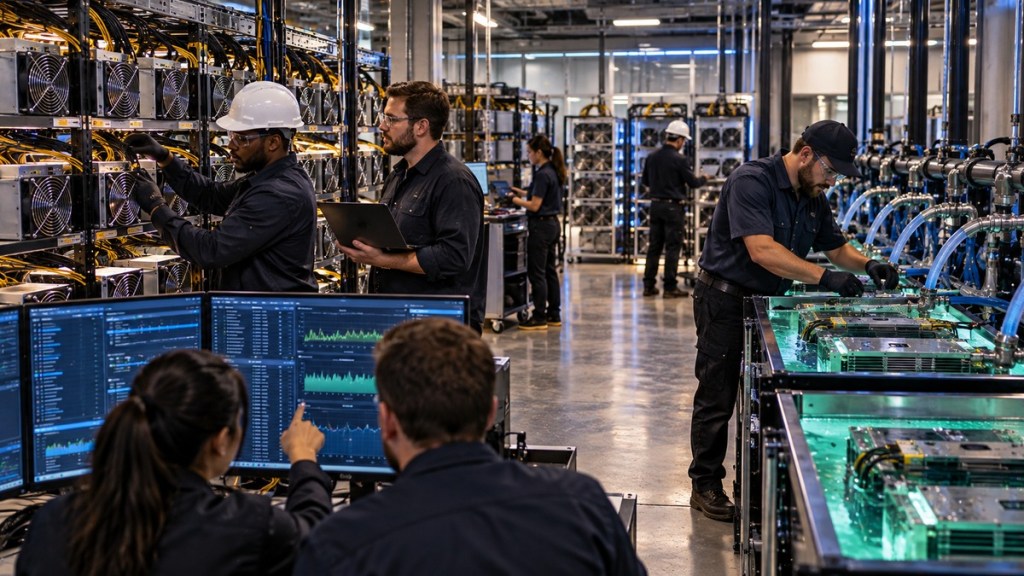
This ranking is intentionally about machine efficiency. It does not rank purchase price, uptime, repairability, firmware quality, warranty service, tariffs, network difficulty, or total facility energy use. A 9.45 J/TH miner with poor uptime can lose to a 12.5 J/TH miner that stays online. A hydro system can also add pumps and heat-rejection loads that an air-cooled machine does not carry in the same way.
There is also an availability gap between “announced,” “preorder,” “futures,” and “sitting on a pallet ready to ship.” Operators should verify the exact batch, firmware, power mode, wall measurement and shipping date before treating any leaderboard as a procurement sheet.
For a companion ranking based on raw computing power rather than efficiency, see BitcoinVersus.Tech’s Top 10 Most Powerful Bitcoin Mining Machines in 2026.
Bottom Line
As of October 10, 2026, BITMAIN’s ANTMINER S23 XP Hyd. is the efficiency leader at 8.9 J/TH. Bitdeer’s A4 Ultra Hydro follows closely at 9.45 J/TH, while BITMAIN’s S23 Hyd. family sits at 9.5 J/TH and Auradine’s third-generation Teraflux enters the sub-10 club in manufacturer-supported eco modes.
The more important trend is that 10 J/TH is no longer a distant engineering target—it is becoming the dividing line for the newest industrial Bitcoin mining hardware. The next fight is not simply who can cross below 10, but who can manufacture, ship, cool, repair and operate those machines reliably at fleet scale.
Editor’s Note
Specifications were checked against manufacturer publications and current mining-hardware databases as of October 10, 2026. Manufacturer-rated J/TH can differ from measured field efficiency because of temperature, silicon variation, operating mode, firmware, power quality and facility overhead. This ranking will change as new batches and machines enter production.
BitcoinVersus.Tech is independently maintained. Support options on the site help fund additional hardware research, verification and open technical publishing.
BitcoinVersus.tech is not a financial advisor. Content is provided for informational purposes.


Leave a Reply