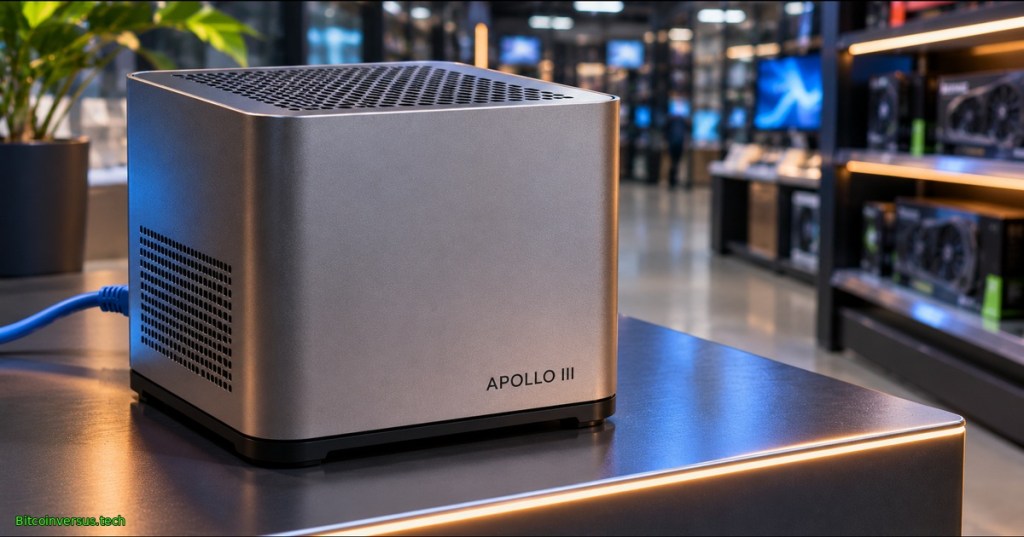
Brooklyn-based FutureBit announced on November 12, 2026, that its Apollo III Full Node Bitcoin miner will go on sale at four Micro Center electronics stores beginning Friday, November 13. The initial locations are Brooklyn, New York; Miami, Florida; Tustin, California; and Austin, Texas. FutureBit previously sold its miners through direct and specialist channels; the new agreement makes a compact, dedicated mining ASIC available to customers shopping in a mainstream electronics store. Actual opening-day inventory remains subject to individual stores.
“Apollo III lands at @microcenter”
FutureBit announced four participating Micro Center locations: Brooklyn, Miami, Tustin and Austin. The quoted opening line and source are from FutureBit’s official X account; the linked post is not an independently tested live X widget.
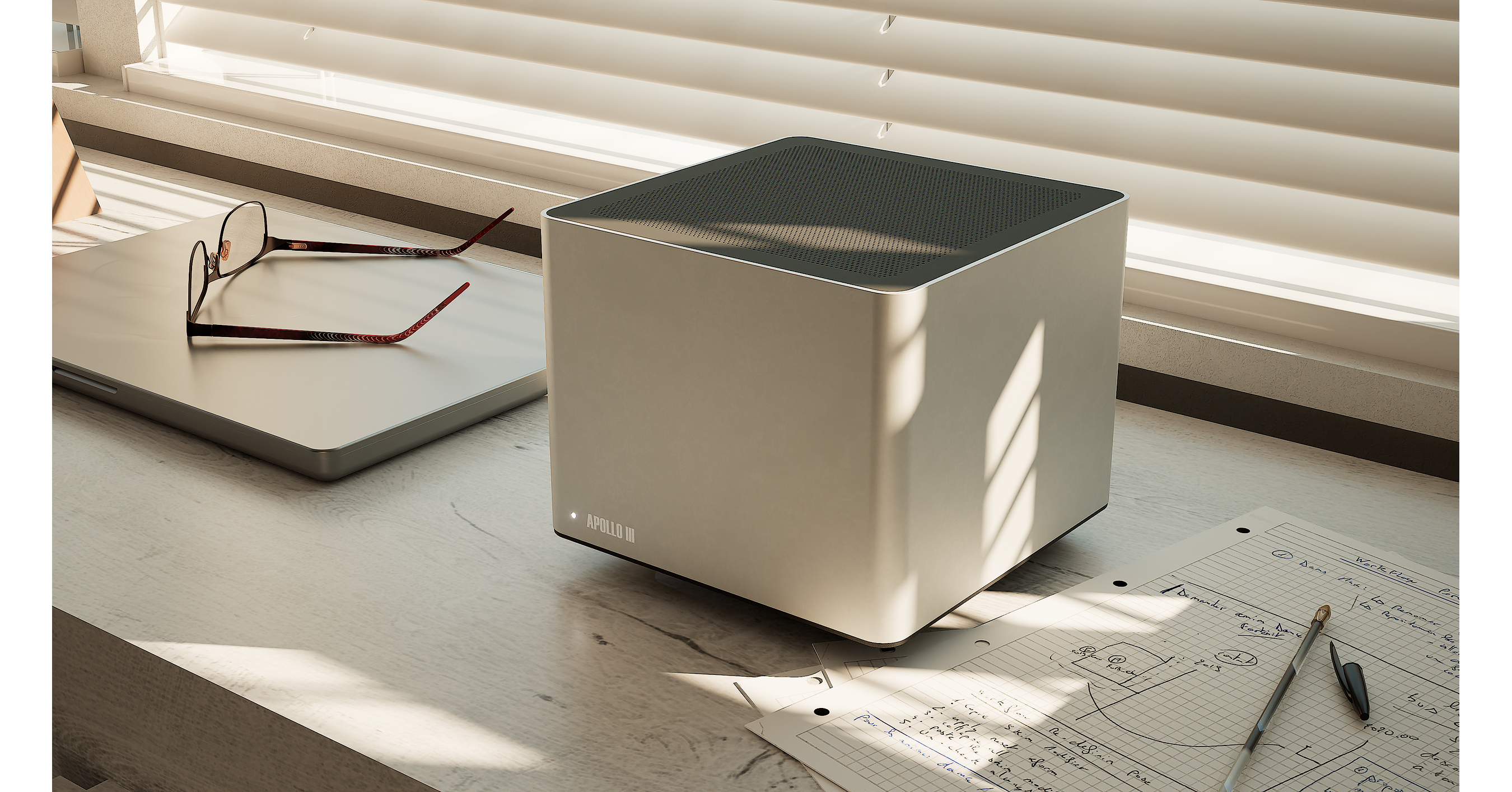
What $1,499.99 buys at Micro Center
Micro Center lists the Apollo III Full Node with a 2TB SSD for $1,499.99 under manufacturer part FBA40012-2TB. Its integrated mining engine uses FutureBit’s third-generation, American-designed 3-nanometer ASICs, with a stated operating range of 10–18 terahashes per second (TH/s). The company has not identified the semiconductor foundry that fabricated the chips; American design does not by itself prove American wafer fabrication.
Unlike a miner-only device, the Full Node edition includes a separate eight-core ARM Cortex-A76 controller, 8GB of LPDDR5 memory, NVMe storage and Apollo OS 2.1, built on Ubuntu. The system can independently validate Bitcoin blocks and transactions while providing its own solo-mining server. Its 2.5-gigabit Ethernet connection, Wi-Fi 6 and dual M.2 storage slots provide local infrastructure without requiring a remotely hosted full node.
FutureBit’s direct website advertises a lower starting price of $1,099.99 for a Full Node configuration without the same included SSD. Comparing that starting figure with Micro Center’s 2TB-equipped retail model without accounting for storage and configuration would be misleading. The miner-only Apollo III Standard is another product with a simpler controller and no integrated Bitcoin full node.
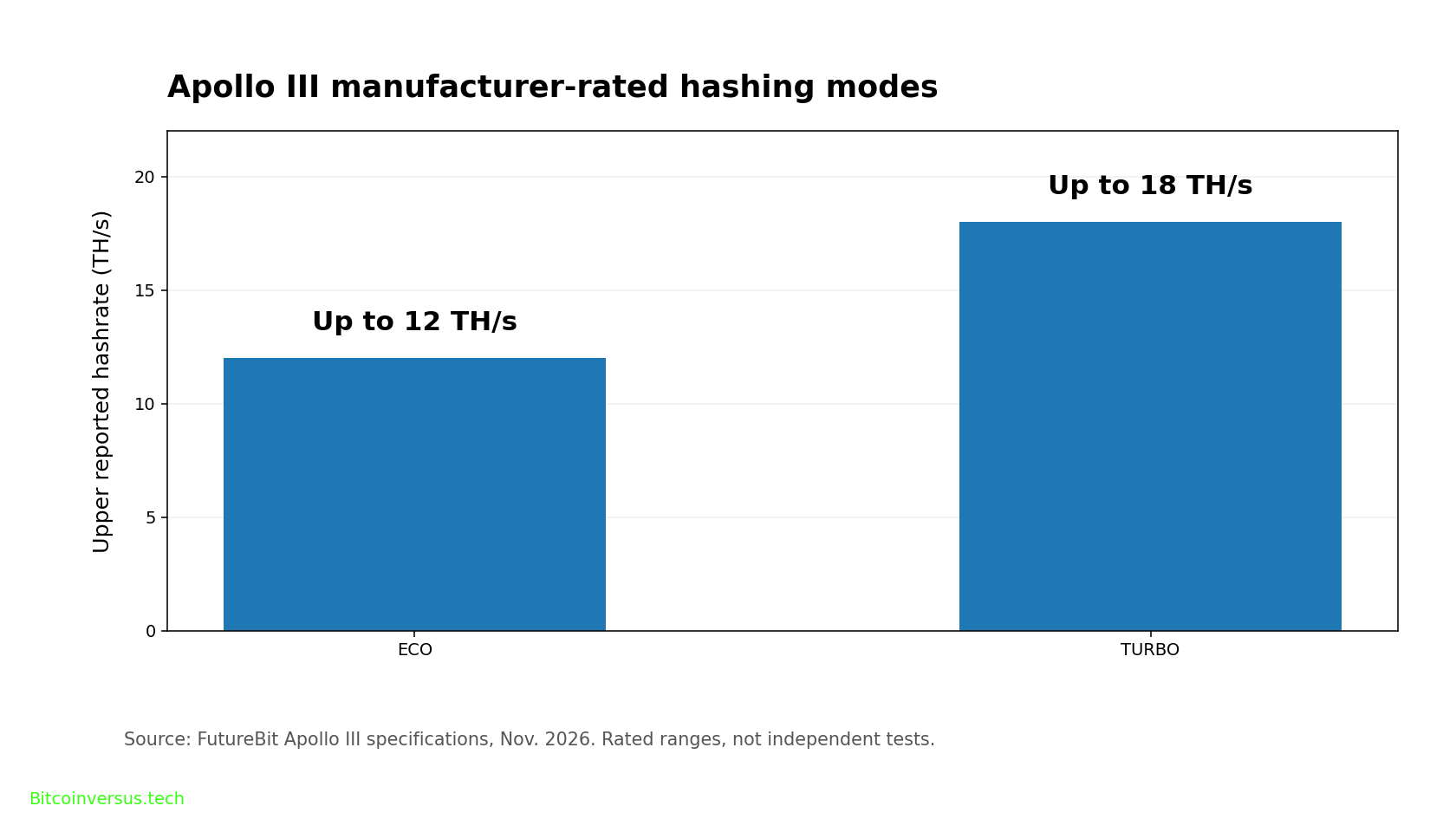
Eighteen terahashes is a maximum, not a home-income forecast
FutureBit describes Eco mode at roughly 10–12 TH/s and Turbo mode at about 16–18 TH/s. Micro Center lists nominal electrical consumption of 150 watts in Eco and 375 watts in Turbo; exact load, cooling noise and efficiency depend on settings and ambient conditions. The built-in 450-watt power supply is a hardware rating, not a claim that the miner continuously draws 450 watts.
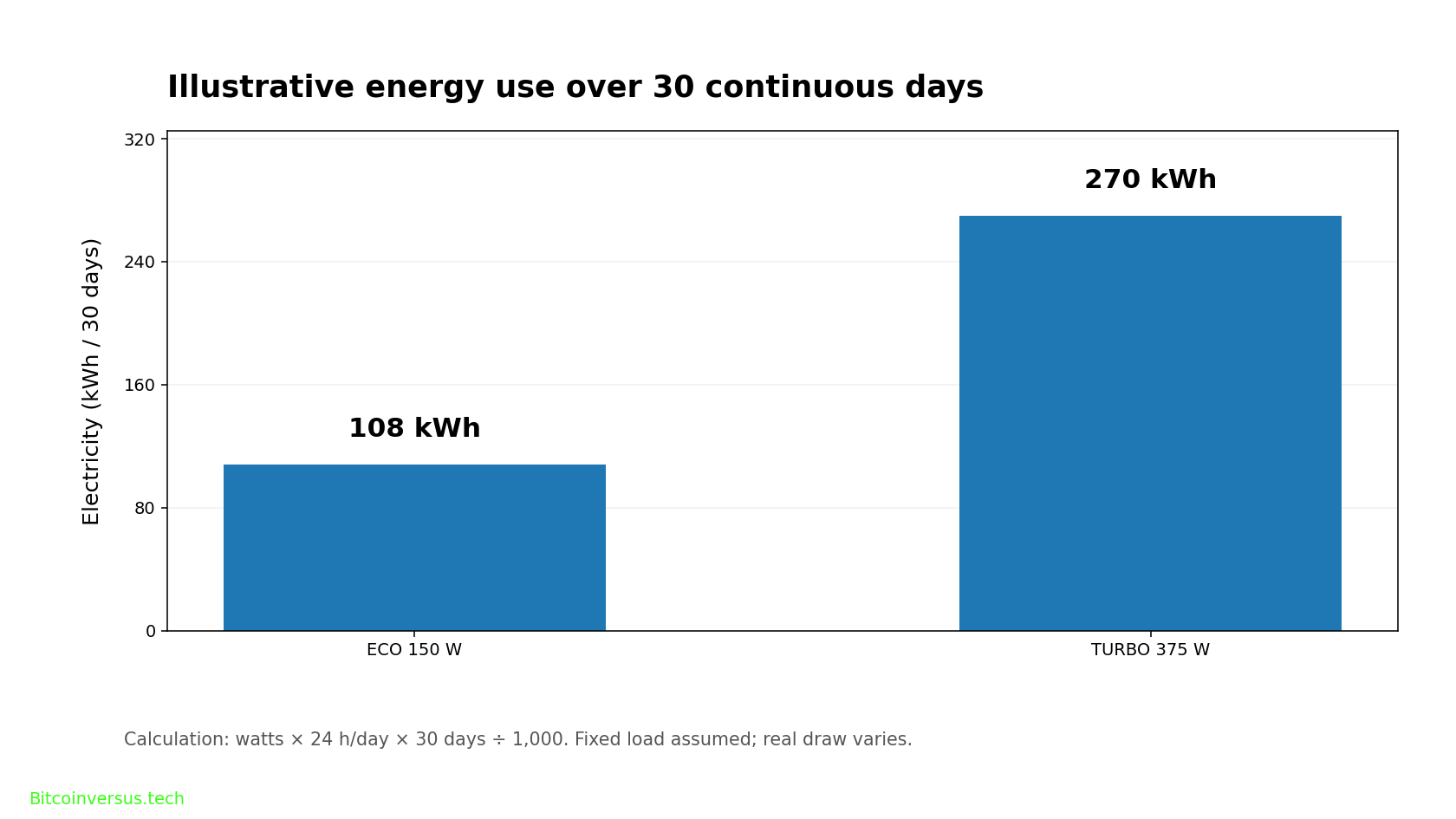
At a hypothetical constant 150 watts for 30 days, consumption would be 0.150 kW × 720 hours = 108 kilowatt-hours. At 375 watts, the result is 270 kWh. At an illustrative electricity tariff of 15 cents per kWh, those cases would cost $16.20 and $40.50 before taxes or other charges. Actual wall-power use may differ from the published nominal settings. A broader compute-per-joule analysis explains why hashrate and energy use must be evaluated together.
Home verification is different from winning Bitcoin blocks
A personal node independently checks consensus rules, whereas mining repeatedly hashes block headers in an attempt to find a valid block. Connecting an Apollo III to its own node improves control over validation and block-template construction; it does not increase the probability of success beyond the miner’s share of total network hashrate. Reported solo-miner block discoveries are real examples of rare outcomes, not reliable forecasts for purchasers.
The device also differs from hobbyist open-hardware systems such as the Bitaxe Naja Duo and the liquid-cooled Gamma Hex. Its advertised efficiency is competitive for a home miner, but industrial hydro units in BitcoinVersus.Tech’s 2026 efficiency rankings use different cooling and infrastructure assumptions. Operating a full node also requires software maintenance, a trustworthy wallet configuration and network security; recent Bitcoin Core security reporting shows why updates matter.
The November announcement establishes a new retail distribution channel, not a newly introduced ASIC architecture or proof of profitable home mining. Store availability, independent wall-power measurements, real acoustic tests and the economics of mining at prevailing Bitcoin difficulty remain the most useful checks once the four-store rollout begins.
Sources and calculations: FutureBit’s official November 10 announcement; FutureBit release listed by PR Newswire, November 12, 2026; Micro Center’s Apollo III Full Node product listing; FutureBit technical overview; FutureBit’s direct-sale configuration and specifications; Bitcoin.com independent coverage, November 12. Calculations: 150 W × 24 h × 30 ÷ 1,000 = 108 kWh; 375 W × 24 h × 30 ÷ 1,000 = 270 kWh; at an assumed $0.15/kWh the costs are $16.20 and $40.50. Prices and store inventory may change.
Editor’s Note: FutureBit and Micro Center confirm plans to introduce the Apollo III Full Node at four electronics stores on November 13, 2026; opening-day availability had not been independently checked at publication. The Apollo III hardware was introduced earlier in 2026. Reported 3nm chip process, operating-mode hashrates and power ratings are manufacturer- or retailer-supplied, not independent laboratory results. American-designed ASICs should not be read as a verified claim about the chip fabrication country. Micro Center’s $1,499.99 2TB configuration is not directly equivalent to FutureBit’s lower-priced base configuration. The original 1200 × 630 cover depicts a conceptual electronics store, while the official product photograph was issued in February. Both original charts use zero baselines and source-labeled data or assumptions. WordPress’s saved and rendered HTML confirms the source-linked FutureBit social quotation, both charts, the official product photograph and the donation footer. It is not a live X widget. No relevant official YouTube video with a verified watch ID was established. External public-browser retrieval was attempted but failed; actual mobile layout and playback were not tested.

BitcoinVersus.Tech is volunteer-run and publishes independent educational technology reporting. An optional 5,000-satoshi donation supports ongoing research. Scan the original QR from a second screen with a compatible Bitcoin wallet; on mobile, use a wallet that supports scanning a saved image. Independently verify the recipient address 3C9o19EH5HSiwEPyCTmEKzxhNCbo2X6TTb and the payment amount before sending. Bitcoin transfers are generally irreversible.
We volunteer daily to ensure information on the BitcoinVersus.Tech platform is Verifiably True. Coverage is educational and informational and does not constitute financial or investment advice.


Leave a Reply