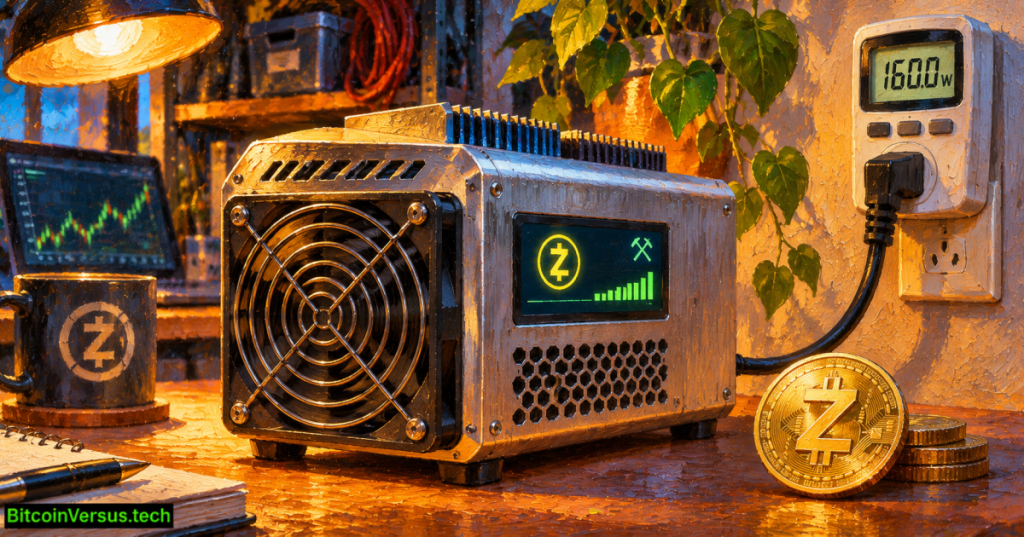
A compact cryptocurrency miner designed for an ordinary household outlet has opened for preorder. California-based retailer 805 Mining lists its ZEC Solo Miner at 49 kSol/s, 160 watts and $1,040. The November 14, 2026 announcement targets people wanting to mine Zcash without buying a multi-kilowatt server. The specifications and price appear on the seller’s product page, but no independent performance test or product-specific shipping date was published. The machine is a Zcash Equihash ASIC, not a Bitcoin SHA-256 miner.
Red Panda Mining’s August 2026 video explains home and team-based solo mining across several cryptocurrencies. Historical educational footage, not a demonstration of the new 805 Mining device.
What the small miner promises
805 Mining describes an air-cooled device roughly comparable in physical size to a QAxe++ hobby miner. The quoted solution rate is 49,000 Equihash solutions per second. Dividing the advertised 160 W wall draw by 49 kSol/s gives 3.27 J/kSol, approximately the company’s rounded 3.3 J/kSol rating. Independent testing of fan noise, output stability, enclosure dimensions, thermal throttling and power at the socket remains unavailable.
The 120-volt specification suits many North American outlets, but buyers should check the actual power-supply label, plugs and certification before connecting anything. A simple 160 W ÷ 120 V ratio equals roughly 1.33 A only under an ideal unity-power-factor assumption; measured input current can differ.
Original seller announcement shared by u/805CryptoServices on r/cryptomining on November 14. Its earnings and machine-performance statements are vendor claims, not independent results.
What would the electricity bill look like?
At a constant 160 W, the miner would consume 3.84 kWh daily and 115.2 kWh over 30 days. A household paying 10 cents per kWh would spend about $11.52 on electricity before ventilation and other costs. Different electricity tariffs change the bill even if consumption stays constant.
| Illustrative residential rate | 30-day electricity cost |
|---|---|
| $0.08/kWh | $9.22 |
| $0.10/kWh | $11.52 |
| $0.15/kWh | $17.28 |
| $0.20/kWh | $23.04 |
Cheap electrical operation does not establish profitability. 805 Mining’s promotional post quoted an estimated $1.97 per day of mining revenue at an earlier market snapshot, using a third-party profitability feed. Actual ZEC earnings depend on network difficulty, price, pool accounting, transaction fees, uptime and mining luck. That revenue projection should not be used as a guaranteed payback schedule for the $1,040 preorder.
Solo mining means unpredictable payouts
The device can reportedly connect to a solo mining pool, where finding a valid block can produce a large but extremely infrequent reward. A regular pool instead allocates smaller payouts according to contributed work and its payout rules. BitcoinVersus.tech previously explained the risk behind home Bitcoin lottery miners; the same basic probability trade-off applies to Zcash, although the algorithms and work units differ.
Crypto Miner Bros’ June 2026 Z15 Pro walkthrough shows the setup of a different Zcash Equihash ASIC. Not an 805 Mining test, product endorsement, or proof of the new preorder specifications.
A recent Zcash network analysis reported growth from roughly 23 to 32 GSol/s between August 18 and November 13, citing a public-company filing. Against 32 GSol/s, a 49 kSol/s miner represents only about 0.000153% of network solution rate. The comparison uses a dated network snapshot and is not a prediction of when, or whether, a solo machine would find a block.
The missing shipping date matters
The product’s details explicitly say preorder only. Generic storefront text referring to California stock and usual week-long shipping must not be interpreted as an item-specific delivery promise. The page does not show a confirmed production unit photograph, an independent test log or a dispatch schedule. Buyers should request the final price, shipment date, refund terms and warranty coverage in writing before paying.
For context, BitcoinVersus.tech has examined ASIC profitability at eight-cent electricity and how changing power conditions affect miners. The new 160-watt proposal is interesting for its residential form factor and Equihash efficiency claim. Commercial readiness and financial returns, however, still require real hardware and independently measured results.
Sources: 805 Mining preorder listing; 805 Mining’s November 14 announcement; ASIC.tools verification and analysis; Cypherpunk Technologies’ November 2026 SEC filing.
Editor’s Note: We volunteer daily to ensure the credibility of the information on this platform is Verifiably True. If you would like to support our work and help further secure the integrity of our research initiatives, please scan the QR code below to donate 5,000 sats.

Disclaimer: BitcoinVersus.tech publishes independent technical journalism, not financial, investment, electrical or purchasing advice. The hardware discussed is a preorder with unverified independent performance. Cryptocurrency mining entails market, operational and hardware-delivery risks.


Leave a Reply