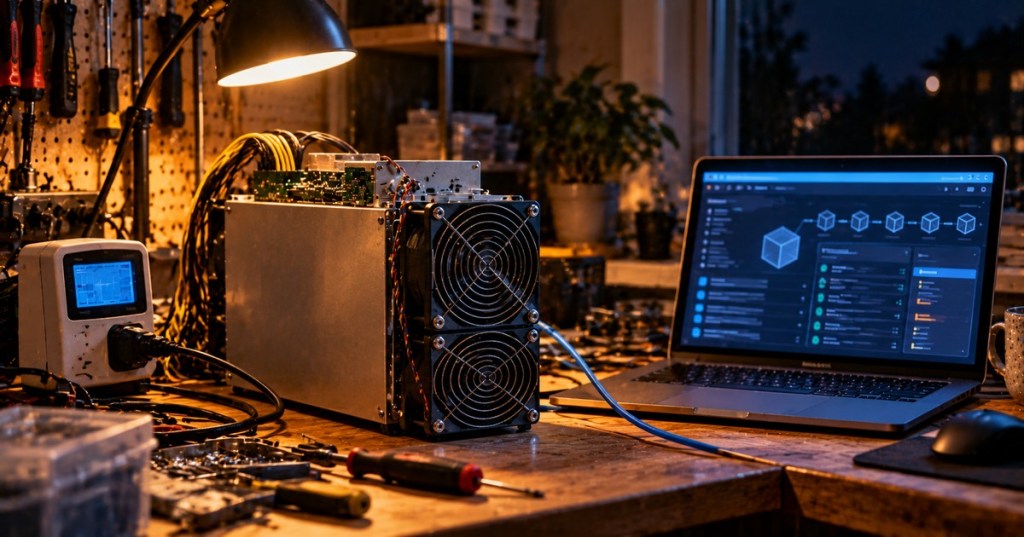
Two independent Bitcoin mining operations found blocks on consecutive days this week, collecting rewards totaling nearly 6.29 BTC before service fees. A block attributed to FutureBit Apollo Solo was mined on October 26, followed by another through Solo CKPool on October 27. The consecutive successes, confirmed in public blockchain records, offer a reminder that individual miners can still win a block without joining a conventional reward-sharing pool.
The first winner found block 973,262 at 17:06 UTC on October 26, receiving 3.15418892 BTC—the 3.125 BTC subsidy plus transaction fees. FutureBit confirmed its Apollo Solo service constructed the winning block, but said the public record cannot identify the particular ASIC or amount of hashrate that solved it. The name of the service does not prove a single desktop Apollo miner did the work.
SerpentX Tech demonstrates solo mining through a FutureBit Apollo node in this March 2025 tutorial. This is background footage, not video of the October 2026 win.
A second solo block—with a 2% fee
The next day, block 973,413 arrived through Solo CKPool at 15:11 UTC. Its total reward was 3.13968422 BTC, including roughly 0.014684 BTC in transaction fees. The coinbase transaction sent about 3.07689 BTC to the winner and 0.06279 BTC to the solo-mining service—a 2% fee. The winner therefore did not pocket the entire block reward.
Reports based on CKPool’s public worker data describe a small mining setup, but the miner’s exact hardware and sustained hashrate have not been independently established on-chain. A later snapshot of reported hashrate is not proof of what device found the winning hash.
Philip D’Ath explains how to configure a personal Bitcoin solo-mining setup with CKPool in a March 2026 tutorial.
Solo mining still means accepting long odds
Unlike a traditional pool, which shares rewards among contributors, a solo miner generally receives a block’s payout only if its own work succeeds. That makes income highly unpredictable, especially as the network competes at roughly a zettahash per second. Even where a small operator wins, the result does not prove solo mining is reliably profitable. Electricity costs and the probability of going years without a reward remain central risks.
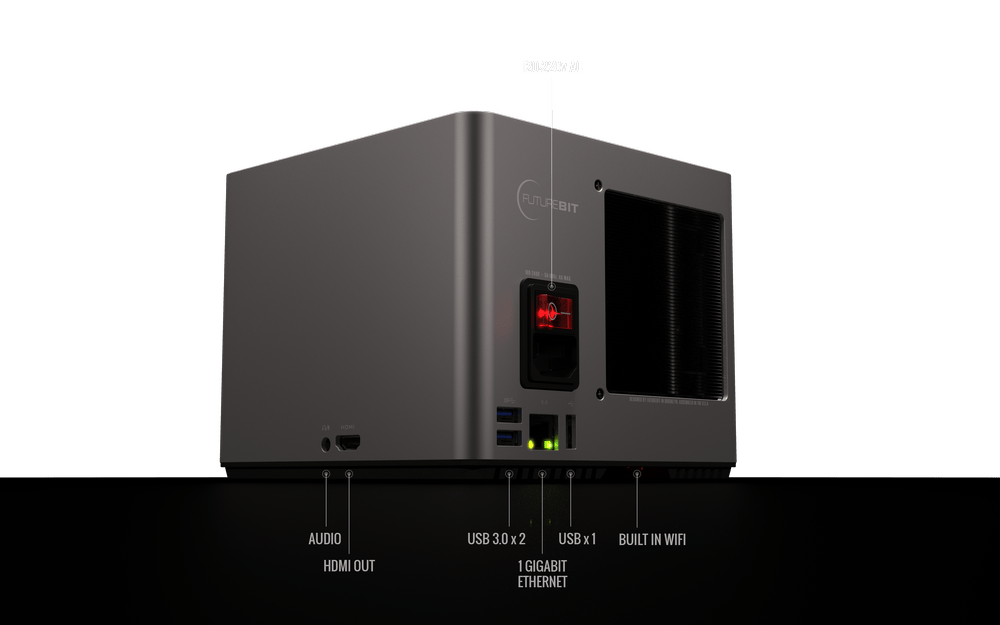
BitcoinVersus.Tech previously examined another October solo block, why reward-sharing mining pools emerged and compact home-mining hardware. The week’s latest wins underscore that Bitcoin’s proof-of-work lottery remains open—but the coinbase transaction, not social-media claims about the machine, is the record of who was actually paid.
Editor’s Note: We volunteer daily to ensure the credibility of the information on this platform is Verifiably True. If you would like to support our work and help further secure the integrity of our research initiatives, please scan the QR code below to donate 5,000 sats.

Scan the QR code using a compatible Bitcoin wallet, preferably while reading on a laptop or larger screen. Donation address: 3C9o19EH5HSiwEPyCTmEKzxhNCbo2X6TTb.
BitcoinVersus.tech is not a financial advisor. This media platform reports on financial subjects purely for informational purposes.


Leave a Reply