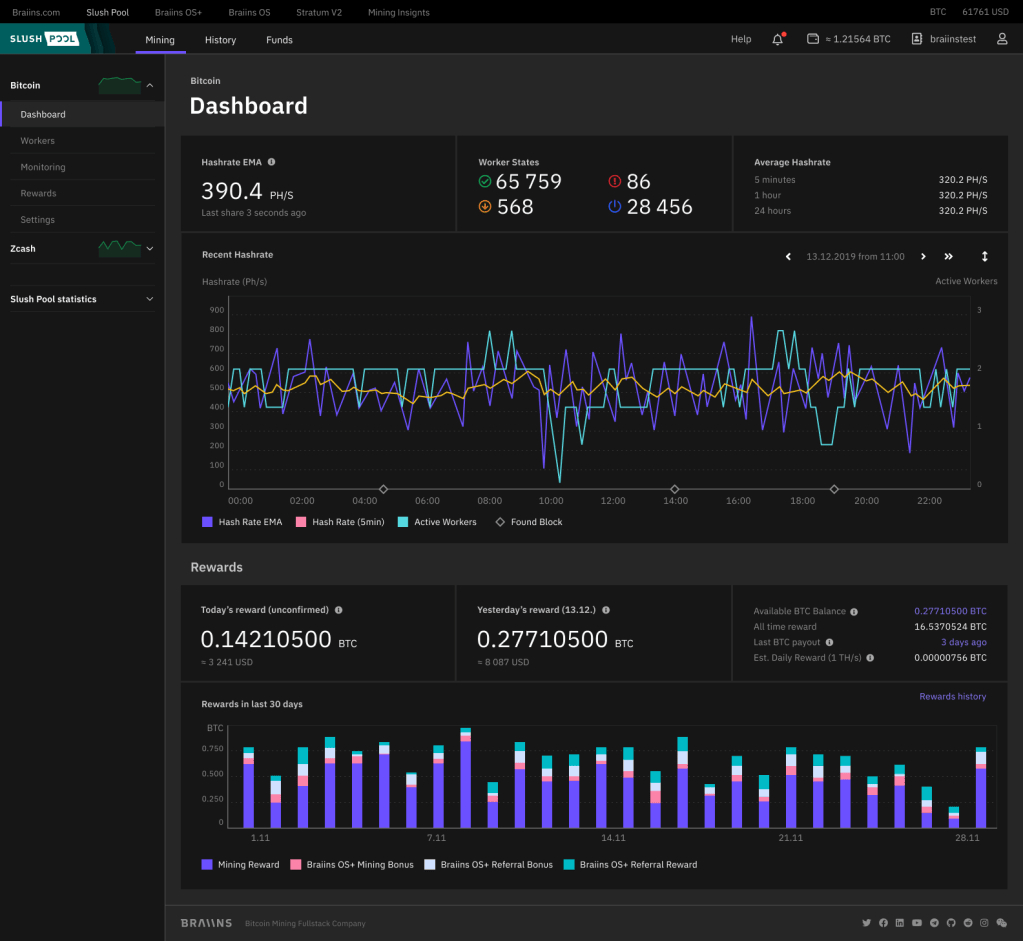
Bitcoin mining began as a solo activity, but rising difficulty quickly made block rewards increasingly unpredictable for smaller miners. The solution was pooled mining: combine many miners’ hashpower, measure each miner’s contribution through lower-difficulty “shares,” and divide rewards when the pool finds a block.
The first public pool arrived in 2010
Marek “Slush” Palatinus announced Bitcoin Pooled Mining on November 27, 2010. Bitcoin Wiki’s pooled-mining history explains why the idea mattered: at late-2010 difficulty, a relatively small miner could wait an extremely long time for a solo block, while a pool could turn that rare payout into smaller, more regular rewards. The first documented pool-mined block followed on December 16, 2010.
Pools changed the economics of mining
The change was not that a pool created more total Bitcoin. It changed payout variance. Instead of one miner winning an occasional full block reward, many miners could receive fractions based on contributed work. This made professional forecasting easier and helped mining scale from the CPU, GPU and FPGA era into ASIC mining.
Pool design also became more sophisticated. Score-based systems, pay-per-share models and later Stratum-style communications improved payout accounting and reduced the limits of early “getwork” connections. Braiins’ historical account traces the original Bitcoin.cz pool through Slush Pool and today’s Braiins Pool.
The tradeoff is coordination
Pools smooth miner income, but they also concentrate block-template coordination in fewer hands. Modern protocol work increasingly tries to preserve pooled payouts while returning more transaction-selection control to individual miners. That tension matters even more as single-machine hashrate climbs toward the multi-petahash range modeled in BitcoinVersus.Tech’s 10 PH/s analysis and efficiency continues toward the Bitcoin Mining Singularity.
Mining pools did not replace proof of work. They changed how miners share its risk and rewards—and that made large-scale Bitcoin mining far more practical.
BitcoinVersus.Tech Editor’s Note:
We volunteer daily to ensure the credibility of the information on this platform is Verifiably True. If you would like to support to help further secure the integrity of our research initiatives, please donate using the QR code provided

For best QR-code scanning results, please scan this donation code from a desktop or larger screen. Mobile screens may prevent camera recognition.
BitcoinVersus.tech is not a financial advisor. This media platform reports on financial subjects purely for informational purposes.


Leave a Reply