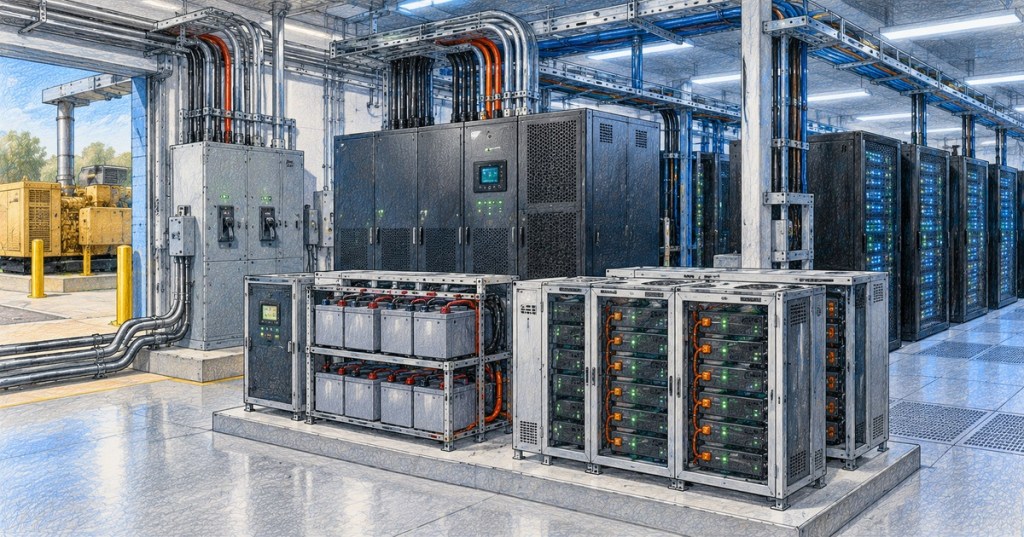
A data-center UPS is not simply a large battery backup. It is a power-conversion system that must keep critical loads stable through utility disturbances, bridge the interval before alternate power is available, coordinate with generators and bypass paths, and manage stored energy without turning the battery system itself into a reliability risk.
This lesson follows OSDCEC.010: Data Center Grounding and Bonding Engineering and builds directly on OSDCEC.004: Data Center Electrical Power Path. Those lessons established the power path and its grounding relationships. OSDCEC.011 focuses on the UPS and stored-energy subsystem inside that path.
RealPars reviews standby, line-interactive, and online double-conversion UPS architectures and the basic rectifier, battery, and inverter power path.
Elementary Overview
A data center cannot wait several seconds for a generator to start every time utility power disappears. The UPS fills that gap immediately. In a double-conversion system, incoming AC power is converted to DC, the DC bus supports the battery connection, and an inverter continuously creates controlled AC power for the critical load. If utility power fails, the battery keeps feeding the DC bus while generators or another source come online.
Learning Objectives
- Explain the role of an online double-conversion UPS in a data-center power train.
- Distinguish UPS power rating from battery energy and runtime.
- Compare VRLA and lithium-ion battery systems at an engineering level.
- Estimate first-order UPS battery autonomy from load and usable stored energy.
- Explain battery strings, series/parallel architecture, BMS functions, and monitoring.
- Identify temperature, aging, cycling, connection resistance, and charger conditions that affect battery life.
- Explain UPS-to-generator transfer and why generator starting time is not the only runtime design input.
- Distinguish a critical-load UPS battery system from a site-level BESS.
- Build a commissioning, maintenance, and fault-isolation strategy.
UPS Topology Comes Before Battery Chemistry
Large data centers commonly use online double-conversion UPS systems because the critical load is continuously supplied through the inverter rather than transferred to the inverter only after a utility failure. The rectifier converts AC to DC, the DC link supports the inverter and stored-energy interface, and the inverter recreates regulated AC. Static bypass provides an alternate path when operating conditions require it, while maintenance bypass allows appropriately designed systems to be isolated for service.
UPS architecture can be centralized, distributed, modular, or arranged in redundant blocks such as N+1 or 2N. The battery subsystem must match that architecture. A perfectly healthy battery string connected to a poorly coordinated or overloaded UPS does not create a resilient system.
Vertiv discusses intelligent UPS operation in data-center environments and the relationship among efficiency, availability, capacity, and operating architecture.
Power Rating and Energy Rating Are Different
UPS capacity is commonly expressed in kVA and kW. Battery capacity is fundamentally an energy question. A battery system may be able to support a very high power level for a short time or a lower power level for a much longer time. Engineers therefore need both the critical-load power requirement and the required autonomy time.
A first-order energy estimate is E = P × t. A 1 MW critical load requiring 10 minutes of ideal ride-through needs 1 MW × 1/6 hour ≈ 167 kWh delivered to the load. Real battery sizing must add inverter losses, battery discharge characteristics, end-of-discharge voltage, aging margin, temperature effects, design growth, and manufacturer-specific discharge data. The simple equation is a starting point, not the final battery schedule.
Why Runtime Is Not Just Generator Start Time
Generators may start in seconds, but battery autonomy is usually designed around more than the crank-and-start interval. The facility may need time for generator stabilization, transfer sequencing, multiple generator starts, bus synchronization, failed-start recovery, load shedding, control-system delays, or an orderly IT shutdown if alternate power cannot be established.
The correct autonomy requirement therefore comes from the site reliability model and sequence of operations. A five-minute battery design and a fifteen-minute design may both be rational depending on source redundancy, generator architecture, contractual requirements, load criticality, and failure scenarios.
VRLA Batteries
Valve-regulated lead-acid batteries have a long history in UPS service. They are familiar, widely available, and supported by mature maintenance practices. Their limitations include weight, floor-space demand, sensitivity to temperature, relatively frequent replacement compared with many lithium-ion systems, and the possibility that one weak jar or connection can reduce string performance.
Eaton’s UPS fundamentals material emphasizes that battery condition depends on age, storage history, ambient temperature, charging conditions, and cycling. “Maintenance-free” does not mean condition-free. VRLA systems still need inspection, monitoring, testing, connection checks, and replacement planning.
Lithium-Ion Batteries
Lithium-ion UPS systems trade higher initial complexity for benefits that can include smaller footprint, lower weight, longer service life, higher cycle capability, and integrated battery-management functions. The term lithium-ion covers multiple chemistries and designs; engineering decisions must use the actual battery system’s certified characteristics rather than assumptions taken from consumer electronics or electric vehicles.
Schneider Electric explains operational reasons data-center operators evaluate lithium-ion batteries for UPS applications.
Eaton reviews the transition from traditional UPS battery systems toward lithium-ion alternatives and the planning implications for data centers.
Series and Parallel Battery Architecture
Cells or battery modules are connected in series to raise DC bus voltage and in parallel to increase current and energy capacity. In an idealized series string, voltages add while the same string current passes through each series element. Parallel strings share load current, subject to cable resistance, internal resistance, connection quality, and control design.
This creates an important reliability principle: the performance of a long series string can be limited by a weak element. A degraded jar, module, fuse, interconnect, or termination can become the bottleneck even when the average string voltage looks normal.
Battery Management Systems
Lithium-ion systems normally include a battery management system that monitors cell or module voltage, temperature, current, state of charge, alarms, and protection limits. The BMS can open contactors or prevent operation when conditions exceed permitted boundaries. It is part of the safety and reliability architecture, not merely a dashboard.
Eaton discusses lithium-ion UPS safety concerns and the engineering differences between modern UPS battery systems and older lead-acid practice.
Continuous Battery Monitoring
Battery systems fail in ways that are not always obvious from total string voltage. Useful monitoring can include cell or jar voltage, string current, temperature, internal or ohmic resistance, charger condition, state of charge, state of health, alarm history, and discharge performance. Eaton’s Cellwatch platform, for example, monitors voltage, ohmic values, current, and temperature across large UPS battery systems.
Trend data matters more than isolated snapshots. A slow increase in internal resistance, one module running consistently warmer than its neighbors, or repeated charge imbalance can provide earlier warning than waiting for a failed discharge test.
A data-center community discussion illustrates the real design questions behind battery selection: runtime, power density, chemistry, generator strategy, lifecycle cost, supply chain, and willingness to adopt newer storage technologies.
Temperature Is a Life Variable
Battery life is strongly temperature-dependent. Excess heat accelerates many aging mechanisms, while low temperature can reduce available discharge performance. The correct operating range comes from the battery manufacturer and the facility design, not a generic room-temperature rule.
Engineers should therefore treat battery-room or battery-cabinet thermal conditions as part of the electrical reliability model. HVAC failure, blocked airflow, local hot spots, enclosure recirculation, or one failed fan can affect stored-energy availability long before the main data hall appears thermally distressed.
State of Charge Is Not State of Health
State of charge estimates how much usable charge remains at the present moment. State of health estimates how much capability remains compared with the battery’s expected healthy condition. A battery can show a high state of charge yet have poor capacity, elevated resistance, or insufficient high-rate discharge capability.
This distinction is why commissioning and maintenance cannot rely only on front-panel percentage values. Engineers need condition data, alarm history, trend data, inspection, and appropriately planned discharge or capacity verification.
UPS and Generator Interaction
When utility power fails, the UPS carries the load while the generator system starts and stabilizes. The generator must then accept the UPS input behavior plus the rest of the connected facility load. Rectifier controls, input power factor, harmonic behavior, generator step loading, transfer sequencing, and battery recharge current all influence that interaction.
After a long battery discharge, an uncontrolled recharge demand can compete with the critical load for generator capacity. UPS systems therefore may limit recharge current or coordinate recovery so the generator is not asked to support a large IT load and maximum battery recharge simultaneously.
A recent 600 kVA Vertiv Liebert EXL S1 installation provides physical context for the scale, cabling, clearances, and infrastructure surrounding a large three-phase UPS system.
AI Loads Change UPS Stress
AI clusters can create rapid changes between high compute power and lower-power states. Modern UPS controls may need to handle fast load steps without repeatedly cycling the battery. Vertiv’s recent AI power research describes advanced UPS controls that can buffer rapid upstream power changes while preserving battery life and maintaining stable output.
The engineering question is no longer only “Can the UPS support the maximum kW?” It is also “How does the complete rectifier, inverter, DC bus, stored-energy system, generator, and utility interface respond to the load’s rate of change?”
UPS Batteries Are Not the Same as a BESS
A UPS battery system exists primarily to protect the critical load with no-break stored energy. A behind-the-meter battery energy storage system usually exists at a broader site level for functions such as energy shifting, peak management, grid services, or longer-duration reserve energy. The two architectures can share battery technology without serving the same electrical role.
Vertiv’s 2026 comparison of BESS and UPS architectures emphasizes this distinction: a UPS is tightly integrated with critical-load power quality and continuity, while a conventional site BESS operates around site-level energy management. A design may use both, but protection boundaries, controls, transfer sequences, and failure modes must be analyzed separately.
Maintenance and Lifecycle Engineering
- Inspect: enclosure condition, ventilation, corrosion, swelling, leakage, cable damage, contamination, and abnormal heat.
- Measure: voltage, temperature, current, resistance or conductance where applicable, charger behavior, and alarm history.
- Trend: compare present measurements with prior baselines instead of relying on a single pass/fail snapshot.
- Verify: breaker, fuse, contactor, monitoring, BMS, bypass, and communications status.
- Test: perform approved discharge, capacity, or system functional tests according to the manufacturer and site procedure.
- Replace deliberately: use compatibility, age, string matching, firmware/BMS requirements, and approved change control rather than replacing parts solely by visual similarity.
- Document: capture serial numbers, installation dates, test results, alarm history, battery chemistry, configuration, and replacement records.
Common Failure Patterns
- Runtime is shorter than expected: inspect load growth, battery aging, temperature, weak cells/modules, inverter efficiency assumptions, and actual end-of-discharge settings.
- One string carries abnormal current: inspect connection resistance, fuse status, string voltage, cable lengths, battery condition, and parallel-string imbalance.
- Frequent battery alarms: inspect charger settings, BMS communications, temperature, cell imbalance, DC breaker status, and alarm thresholds.
- UPS transfers to battery unexpectedly: inspect input voltage/frequency limits, utility events, generator behavior, bypass availability, rectifier alarms, and control settings.
- Generator comes online but UPS stays on battery: inspect generator voltage/frequency quality, UPS input acceptance window, synchronization, transfer logic, and generator loading.
- Battery room runs hot: inspect HVAC capacity, airflow, charger conditions, battery fault indications, enclosure ventilation, and thermal sensor trends.
- Healthy voltage but failed capacity test: distinguish state of charge from state of health and investigate aging or high internal resistance.
Commissioning Sequence
- Verify UPS, battery, bypass, generator, and switchgear one-line diagrams against installed equipment.
- Confirm equipment ratings, protection settings, conductor sizes, battery configuration, communications, and environmental requirements.
- Verify polarity, string configuration, terminations, torque records, breaker/fuse status, and monitoring wiring under approved procedures.
- Confirm charger and BMS configuration match the installed chemistry and manufacturer requirements.
- Verify normal double-conversion operation and bypass availability.
- Test approved utility-loss and generator-transfer scenarios under the commissioning plan.
- Record battery discharge current, DC voltage, inverter output, generator transition, alarms, and recovery behavior.
- Verify recharge behavior after the test and confirm generator or utility capacity is not exceeded.
- Complete capacity or autonomy testing where required by the project.
- Archive baseline values so future maintenance can distinguish drift from normal variation.
Engineering Exercise
A 2 MW critical-load block requires 8 minutes of battery autonomy. First calculate the ideal load energy: 2 MW × 8/60 h. Then assume the inverter/DC path is 96% efficient and the design allows only 80% of installed nominal battery energy to be treated as usable at the required end-of-life condition. Estimate the minimum nominal stored energy before adding project-specific growth or manufacturer discharge-curve corrections.
Next compare two conceptual designs: one with VRLA batteries and one with lithium-ion. Build a trade table for footprint, weight, replacement interval, monitoring, cycle capability, thermal requirements, first cost, maintenance burden, safety controls, and lifecycle cost. The objective is not to declare one chemistry universally superior; it is to show how the design criteria drive the selection.
Knowledge Check
- What is the main electrical difference between a standby UPS and an online double-conversion UPS?
- Why are UPS kW and battery kWh different quantities?
- Why can generator start time be shorter than the specified UPS battery runtime?
- What are two common engineering advantages of lithium-ion over VRLA in UPS service?
- Why can one weak element affect a long series battery string?
- What is the difference between state of charge and state of health?
- Name four useful battery-monitoring measurements.
- Why can battery recharge current matter after generator transfer?
- How is a UPS battery system functionally different from a conventional BESS?
- Why should maintenance rely on trend data as well as instantaneous readings?
Answers
- An online double-conversion UPS continuously feeds the critical load through its inverter, while a standby system transfers to stored-energy operation after an input failure is detected.
- kW measures instantaneous power; kWh measures energy available over time.
- Runtime may include generator stabilization, transfer sequencing, failed-start recovery, operating margin, contractual requirements, or controlled shutdown time.
- Examples include smaller footprint, lower weight, longer service life, higher cycle capability, and integrated BMS functionality.
- All series elements carry the same string current, so a weak or high-resistance element can limit the complete string.
- State of charge estimates remaining charge now; state of health estimates remaining capability compared with a healthy battery.
- Voltage, current, temperature, internal/ohmic resistance, state of charge, state of health, and alarm history are examples.
- Large recharge demand can add substantial load while the generator is already carrying the critical facility load.
- The UPS is designed primarily for no-break critical-load continuity and power conditioning; a conventional BESS is usually designed for site-level energy management or longer-duration storage functions.
- Degradation often appears as gradual drift, imbalance, or temperature/resistance change before a hard failure occurs.
Elementary Conclusion
The UPS keeps the data center alive during the gap between a power problem and a stable alternate source. The battery is the stored-energy part of that system, but battery chemistry alone does not determine reliability. Good engineering matches UPS topology, load, runtime, generator behavior, battery design, temperature, monitoring, maintenance, and failure scenarios into one coordinated system.
Primary References
- Eaton — UPS and Power Management Fundamentals Handbook
- Vertiv — BESS and UPS Roles in Large Data Center Power Architectures
- Vertiv — UPS Solutions for Modern Data Centers
- Eaton — Cellwatch Battery Monitoring
- Schneider Electric — Data Center and Facility 3-Phase UPS
- Vertiv — Lithium-Ion Battery Use: Safety Rules for Critical Facilities
Previous Related Lessons
- OSDCEC.010: Data Center Grounding and Bonding Engineering
- OSDCEC.009: Data Center Network Fabrics
- OSDCEC.008: Data Center Water Systems
- OSDCEC.007: Data Center Reliability Engineering
- OSDCEC.006: Data Center Commissioning
- OSDCEC.004: Data Center Electrical Power Path
BitcoinVersus.Tech Editor’s Note:
We volunteer daily to ensure the credibility of the information on this platform is Verifiably True. If you would like to support to help further secure the integrity of our research initiatives, please donate using the QR code provided

For best QR-code scanning results, please scan this donation code from a desktop or larger screen. Mobile screens may prevent camera recognition.
BitcoinVersus.Tech provides technical education and analysis for informational purposes only.


Leave a Reply