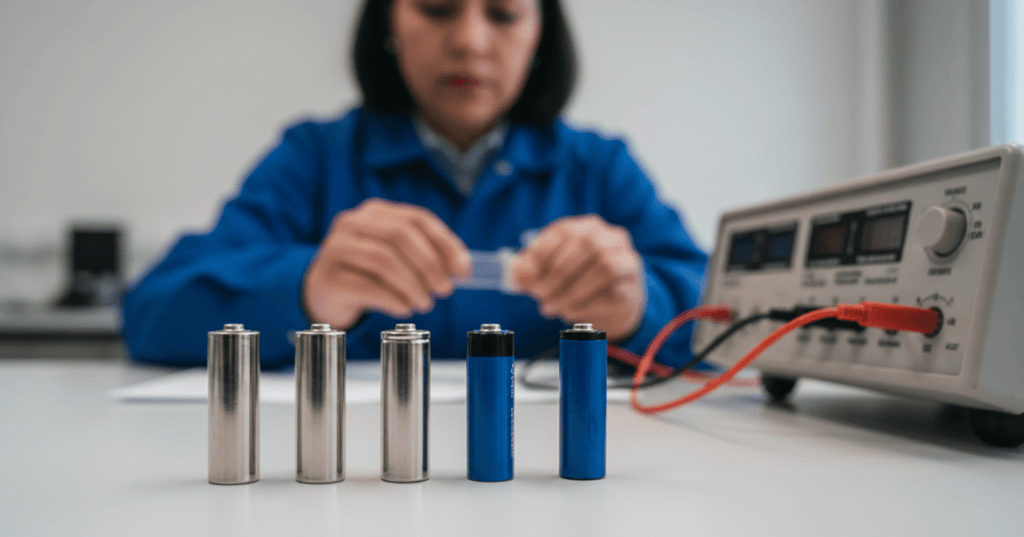
Do premium AA alkaline batteries still justify their price? On October 30, 2026, electronics educator Alec Watson published a 30-minute Technology Connections investigation comparing major and budget brands against older carbon-zinc cells. His conclusion is nuanced: premium alkalines can win under heavy loads, but cheap alkalines can deliver nearly as much usable energy in low-drain devices.
Technology Connections’ original October 30, 2026 battery investigation. The discharge data are from creator Alec Watson’s tests, not a certified multi-laboratory product ranking.
Premium AA batteries win at higher power
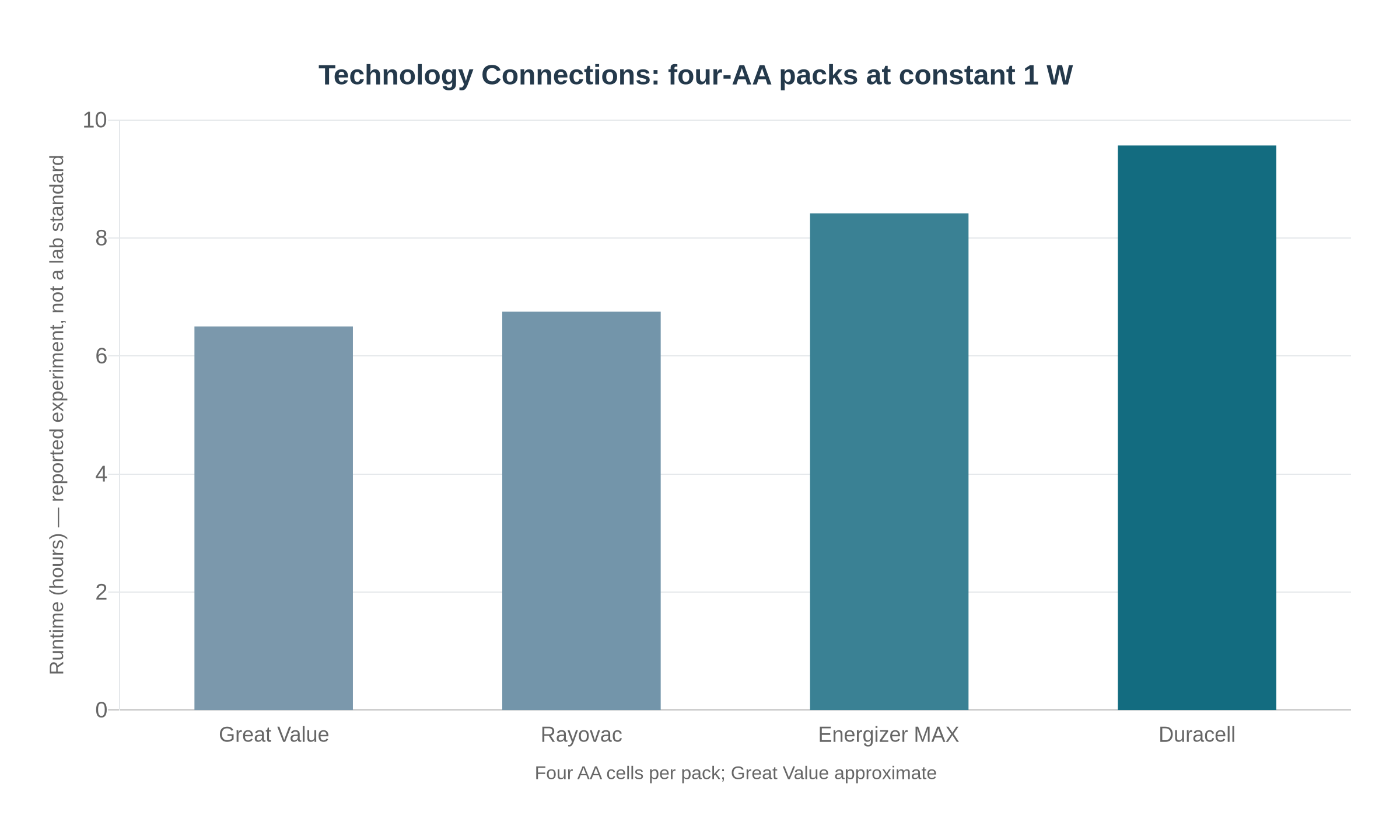
Watson tested four-AA battery packs at a constant 1-watt load. A Great Value set ran roughly 6½ hours, Rayovac High Energy 6 hours 45 minutes, Energizer MAX 8 hours 25 minutes, and Duracell approximately 9 hours 34 minutes. Under this specific test, Duracell lasted longest. The chart compares reported runtimes, not standardized cycle-life, shelf-life or cost per watt-hour.
At gentler discharge rates, the spread narrowed. Watson reported about 3 watt-hours per cell from Duracell and approximately 97% of that from a Menards store-brand alkaline. Higher drain creates greater internal voltage drop, leaving some chemical energy unusable before a device reaches its cutoff voltage. Energizer’s technical guidance independently identifies discharge rate, temperature and cutoff voltage as major variables.
Carbon-zinc is not a universal replacement
The older carbon-zinc chemistry still has a niche in remotes and wall clocks, but should not be mistaken for universally better technology. Watson’s Panasonic carbon-zinc cells lasted only about 1 hour 22 minutes in the demanding 1-watt experiment. Energizer’s application handbook similarly shows their comparative disadvantage grows with increasing drain.
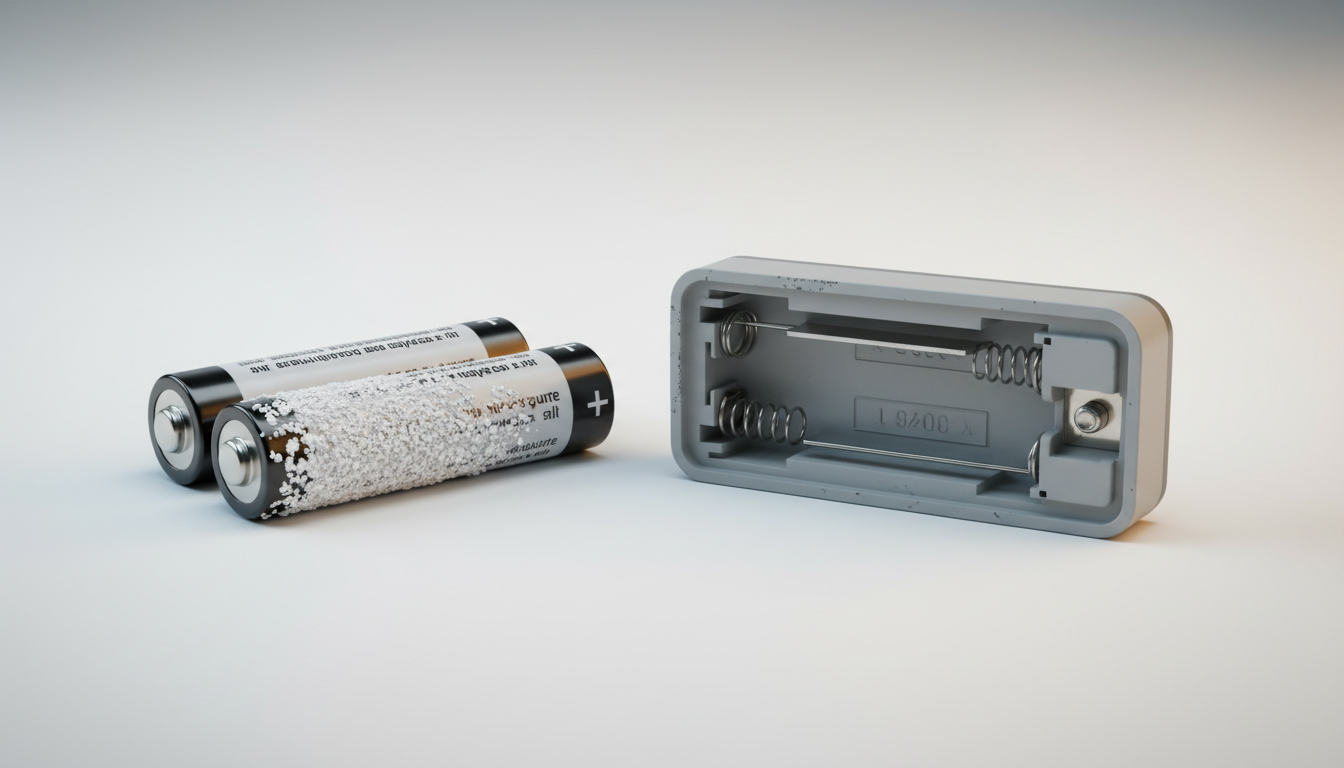
His most provocative argument concerns leakage. Alkaline cells can leak corrosive potassium hydroxide and damage contacts; some carbon-zinc packaging includes barriers intended to contain corrosion. However, an old remote with clean batteries is an anecdote, not proof that carbon-zinc has a lower leakage failure rate. Both chemistries can fail, as the Battery University overview cautions.
What consumers and engineers should take away
For engineers, the lesson is matching battery chemistry to its actual load. Our battery fundamentals and charging primer explain why watt-hours and electrical power are different. Industrial needs also differ: see UPS battery engineering and robot backup-battery maintenance.
The practical next step is repeatable independent testing under real device duty cycles, temperatures and storage ages. For long-lived remotes, inexpensive compatible alkaline cells or rechargeable options may be sensible; remove batteries from equipment stored unused for extended periods. The new video challenges marketing assumptions, not the laws of electrochemistry.
BitcoinVersus.Tech
BitcoinVersus.Tech Editor’s Note: We volunteer daily to ensure the credibility of the information on this platform is Verifiably True. If you would like to support our work and help further secure the integrity of our research initiatives, please scan the QR code below to donate 5,000 sats. For best results, scan the QR code from a laptop or larger screen.

Bitcoin address: 3C9o19EH5HSiwEPyCTmEKzxhNCbo2X6TTb. On a phone, open the QR image on another screen or copy and verify the address in your wallet before sending.
BitcoinVersus.tech is not a financial advisor. This media platform reports on financial subjects purely for informational purposes.


Leave a Reply