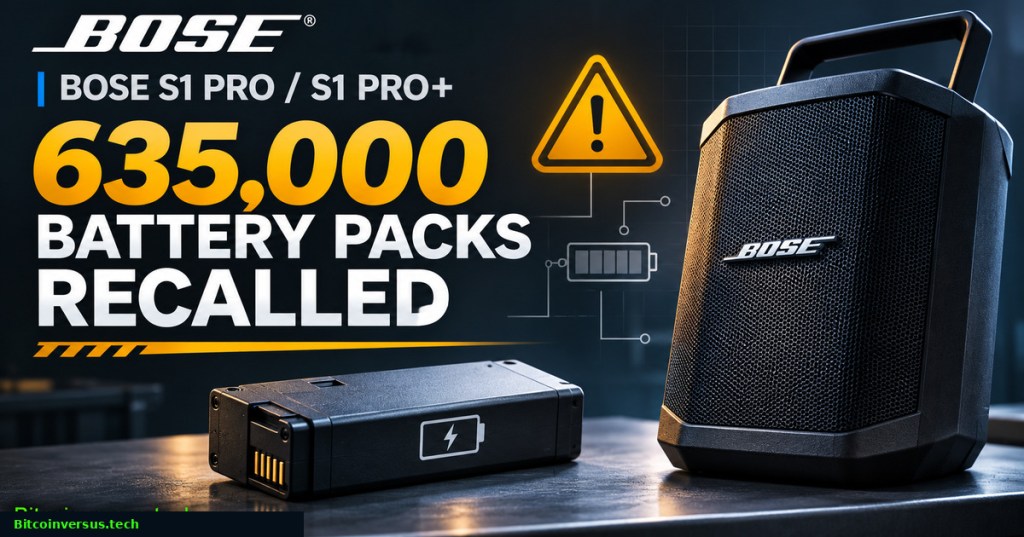
A rechargeable lithium-ion pack allows a portable speaker to operate without mains electricity. The pack contains energy-dense cells, protective electronics and contacts designed to manage charging and discharging. A battery can nevertheless pose a serious hazard if operating conditions damage its cells or protective systems. Bose is now replacing certain battery packs for two of its portable sound systems because they may overheat and ignite.
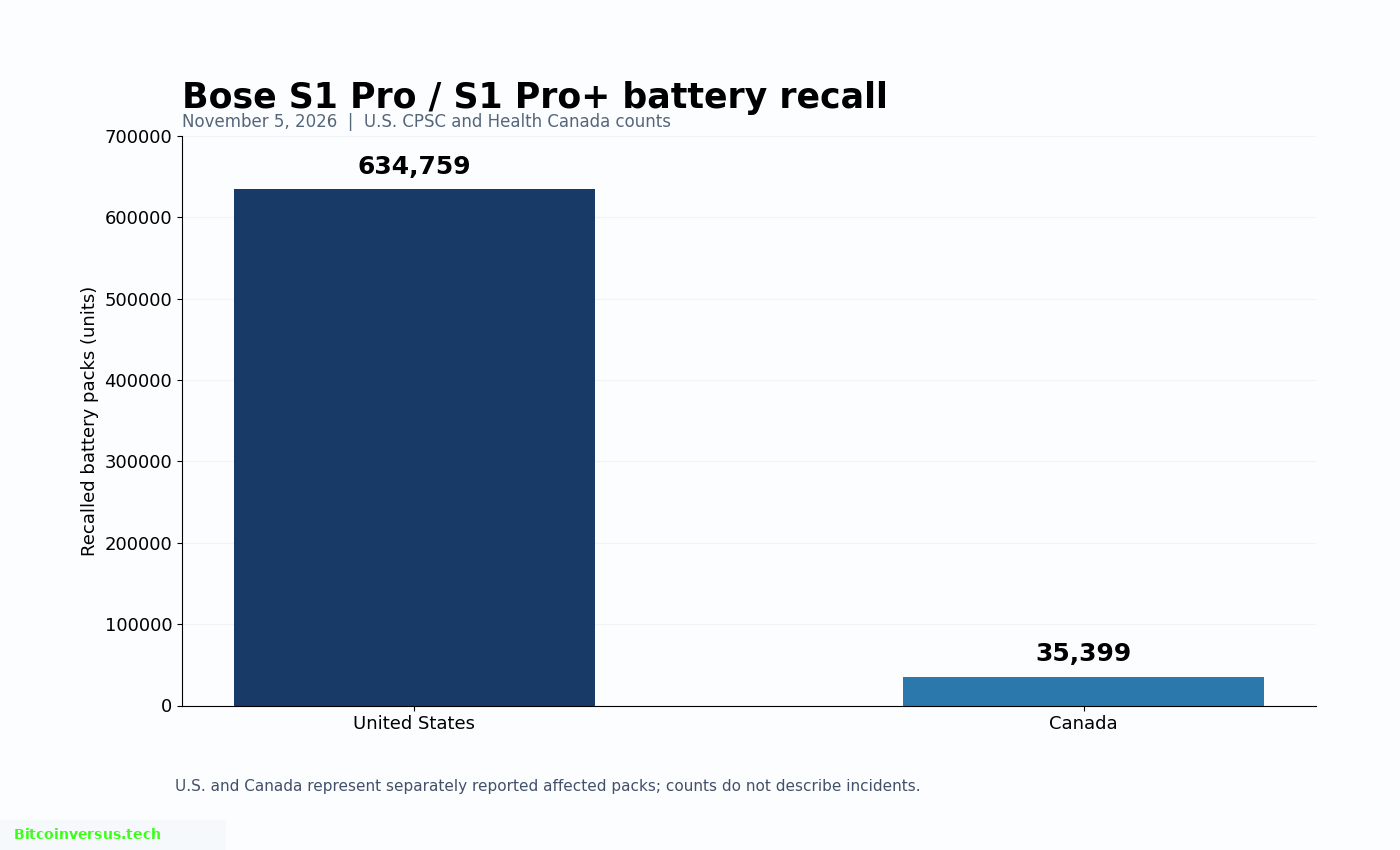
The U.S. Consumer Product Safety Commission announced the recall on November 5, 2026, covering approximately 634,759 battery packs in the United States, plus 35,399 sold in Canada according to Health Canada. The packs were sold with Bose S1 Pro and S1 Pro+ portable speaker systems and as standalone replacement accessories. The recall does not automatically cover every speaker bearing either model name.
Bose Product Support demonstrates the S1 Pro+ system’s setup and charging controls, June 1, 2023. A historical product tutorial—not an explanation of the November 2026 recall. For battery identification and safety, follow the current Bose recall instructions.
Owner action: Immediately stop using an affected battery pack. Switch the speaker off, disconnect AC power and follow Bose’s official battery-removal instructions if the pack is safe to handle. If a pack is damaged, hot or smoking, avoid handling it and seek appropriate emergency or manufacturer guidance. The S1 Pro or S1 Pro+ speaker can still operate from AC power after the recalled battery has been removed.
More than 670,000 packs across two countries
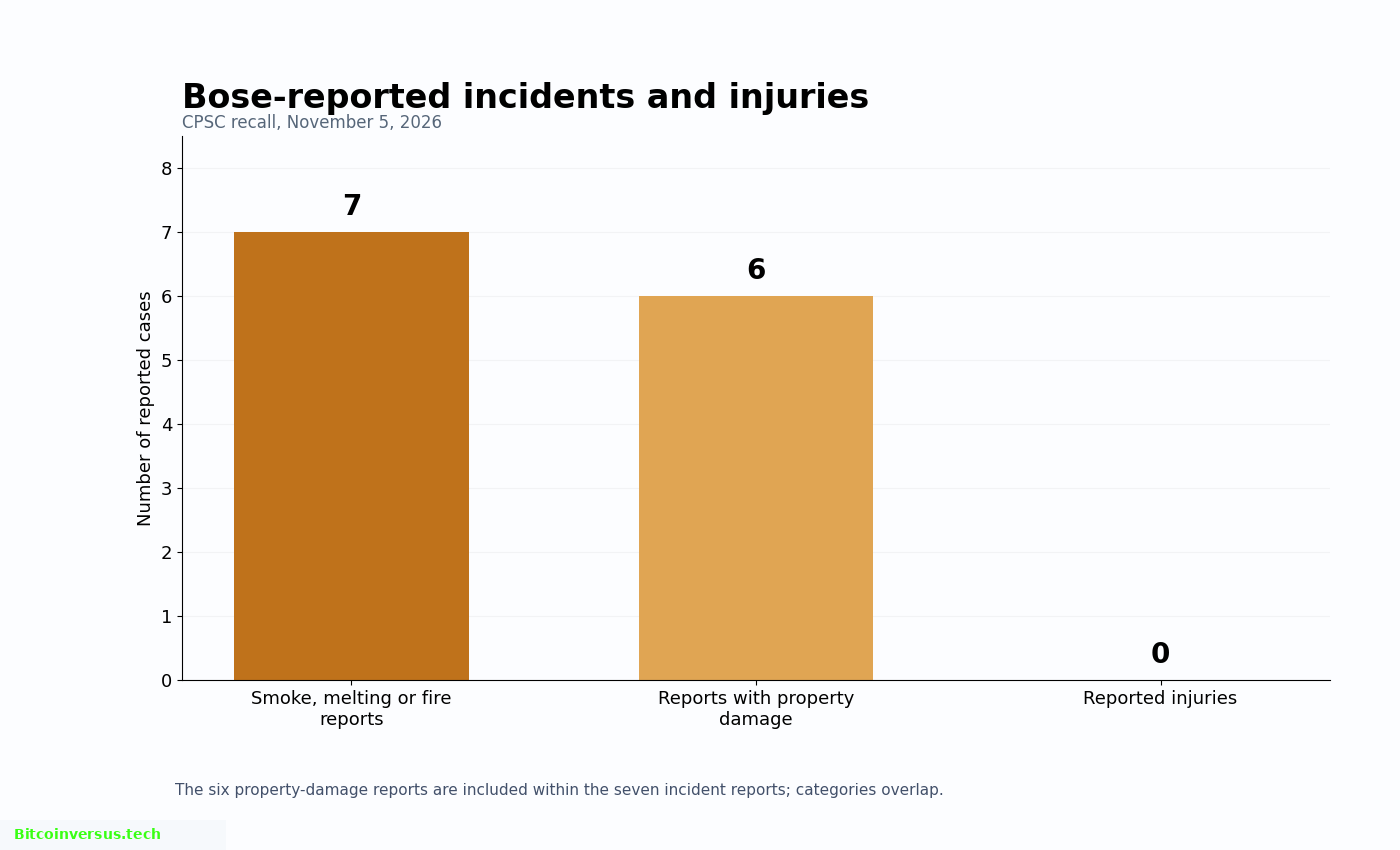
Combining the independently reported U.S. and Canadian counts gives 670,158 affected battery packs, an arithmetic total rather than a separate announced inventory. Bose reports seven cases of packs melting, smoking or catching fire, including six reports of property damage. No injuries were reported when the recall was published. The six property-damage cases are part of the seven incidents, not additional incidents.
Seven incident reports cannot establish a reliable failure rate for every battery sold. Reporting completeness, years in service and actual exposure to the hazardous operating conditions are unknown. Safety recalls act on assessed risk rather than waiting for a statistically large number of injuries. The distinction resembles broader battery-testing challenges, where laboratory validation and real-world operation are separate measurements.
Seven prefixes determine whether a battery is included
Owners should identify the 17-digit serial number printed on the battery-pack label, not the separate serial number printed on the speaker. Bose lists the affected starting sequences as 083723, 078352, 084105, 078591, 078592, 084106 and 086409. The official product page supplies pictures of the speaker underside and the correct access procedure.
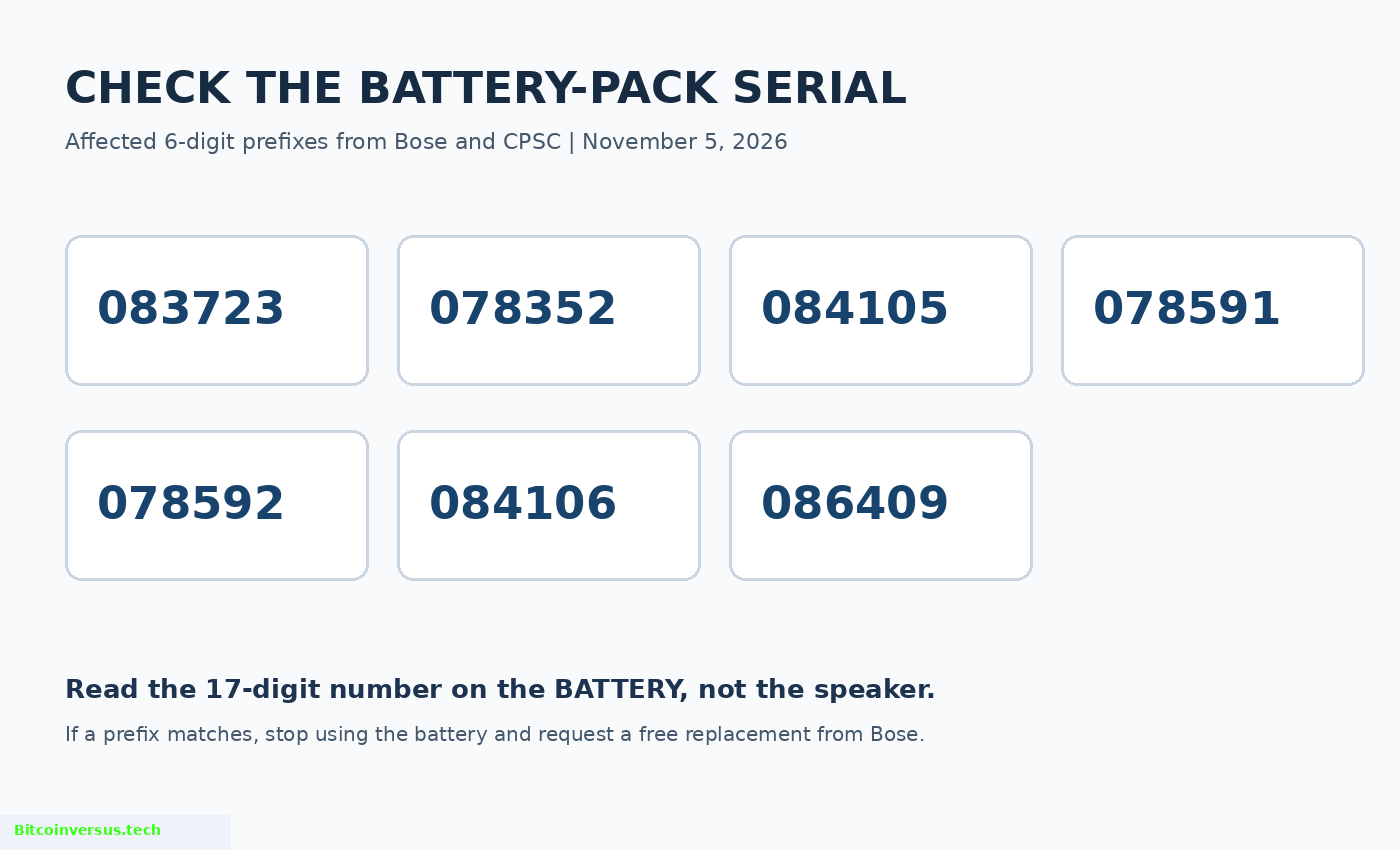
Owners whose packs match should register the battery’s serial number through Bose’s recall portal for a free replacement. U.S. consumers can also call 800-278-1083. A speaker without an affected battery pack may continue to be used; the listed prefixes, rather than product appearance alone, define the affected group.
Do not place recalled packs in ordinary recycling
Bose and the CPSC say the affected packs must not enter household trash, general recycling or the battery-collection bins commonly found in retail stores. Owners should contact their municipal household-hazardous-waste program beforehand and confirm that it accepts recalled lithium-ion packs. Guidance for a damaged or overheating pack may require extra precautions.
The recall underscores a distinction between battery performance and battery safety. Engineering work on higher-density lithium cells explores energy storage potential; established UPS battery engineering emphasizes controlled operation, maintenance and isolation; smoke-detection technology helps warn occupants when a fire develops. None substitutes for complying with an active recall.
The immediate message is practical: identify the battery, stop using it if the serial prefix matches, arrange a free replacement and follow approved disposal instructions. Bose has not disclosed a definitive public root-cause analysis in the recall notice; describing all lithium-ion packs as defective would overstate the evidence.
Primary sources: U.S. CPSC recall 27-065, November 5, 2026; Bose product safety and replacement instructions; Health Canada recall notice; Bose Product Support, S1 Pro+ setup video, June 1, 2023.
Editor’s Note: Recall volumes, reported incidents, affected serial numbers and replacement instructions come from the U.S. CPSC, Health Canada and Bose. The combined U.S.–Canada count is calculated from two reported national totals; incident reports do not establish the incidence rate in all units. The featured image is a conceptual illustration, not a product-identification photograph. The serial-number guide and charts are original sourced visualizations. The 2023 Bose tutorial predates the recall, and users should prioritize the manufacturer’s current safety notice. No battery should be handled if hot, smoking or visibly hazardous.
Support BitcoinVersus.Tech
To support independent technology reporting, scan the original donation QR below for an optional 5,000-satoshi contribution. On a phone, display the code on another screen and scan with a compatible Bitcoin wallet, or import the saved QR image if supported. Verify the destination and amount before confirming payment.

We volunteer daily to ensure the information on this platform is Verifiably True. If you would like to support the research, please scan QR code.


Leave a Reply