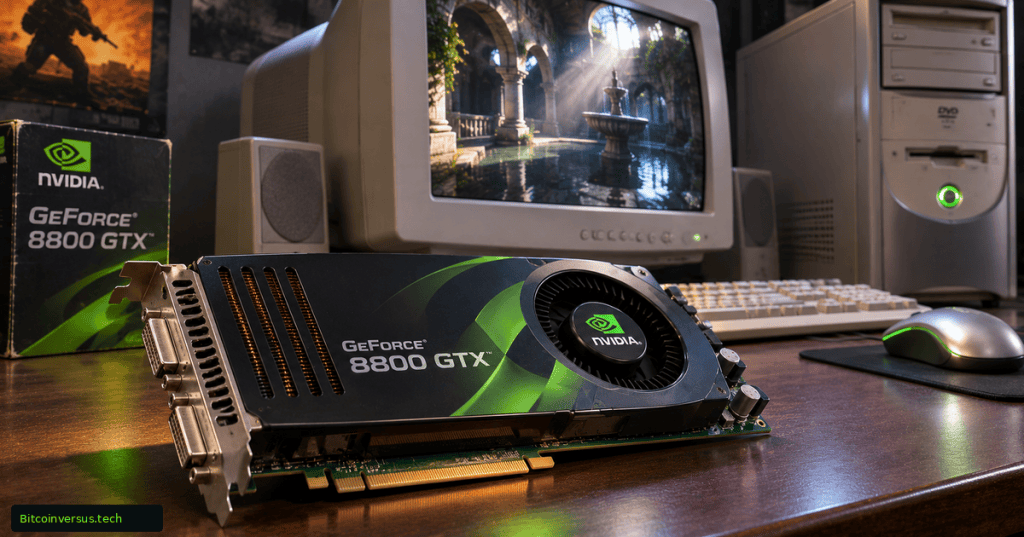
A graphics processing unit (GPU) draws game scenes through parallel calculations involving geometry, textures and light. NVIDIA’s GeForce 8800 GTX helped transform that workload in 2006 with unified shader hardware capable of handling multiple graphics tasks. To mark its twentieth anniversary, the company is backing a free, semi-interactive Steam experience recreating the act of unboxing the historic graphics card. The November 5, 2026, release requires an RTX 4070 graphics card at minimum—a striking contrast with the 20-year-old device inside the simulation.
NVIDIA GeForce — “GeForce 8800 GTX – 20 Years of a Legend” (November 5, 2026), official launch trailer. Promotional footage demonstrates the anniversary recreation, not benchmark-tested performance.
A 2006 PC Room Built With 2026 Graphics
Unreal Engine artist Dylan Browne developed GeForce 8800 GTX – 20 Years of a Legend with NVIDIA’s support. Players enter a period-style computer room, inspect the GPU, install it in a tower and discover details from PC-gaming history. The free release uses path tracing, DLSS 4.5 Ray Reconstruction, Dynamic Multi Frame Generation and RTX Mega Geometry to recreate a setting associated with comparatively primitive rendering hardware.
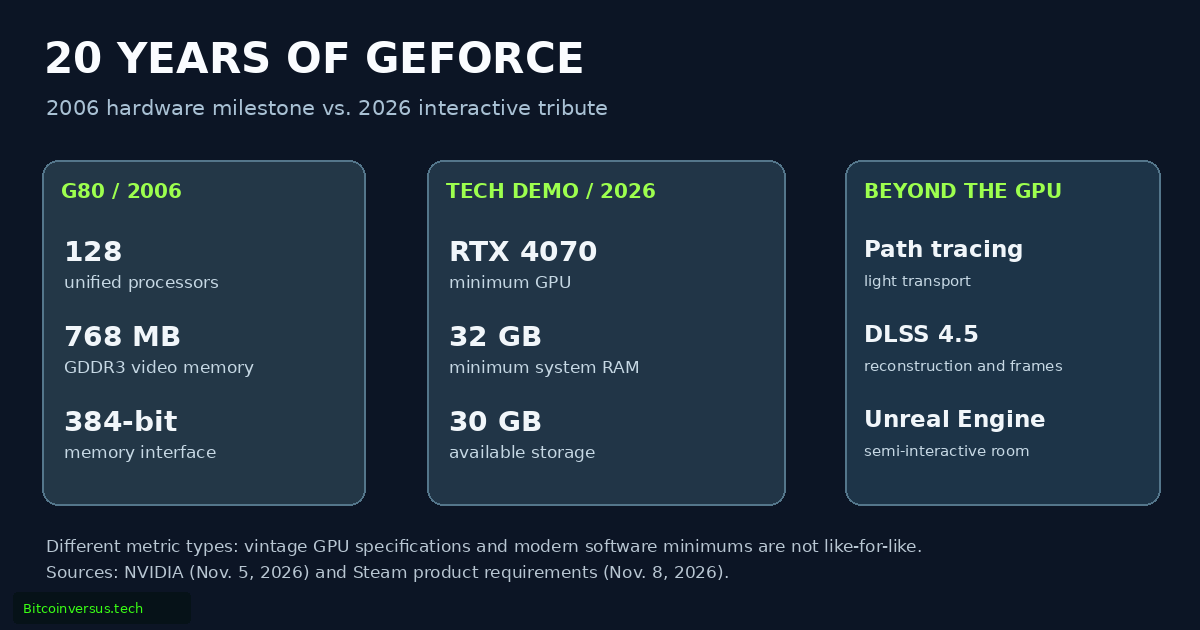
Steam specifies 32 GB of system RAM, 30 GB of available storage, a Windows 10 64-bit system with DirectX 12 support and an RTX 4070 as minimum requirements. It recommends an RTX 5080 for the graphics card. NVIDIA separately instructs users to install GeForce Game Ready Driver 621.14 or newer. The listed requirements apply to the modern tribute, not to the original 2006 card.
Why the 8800 GTX Mattered
NVIDIA launched the GeForce 8800 GTX on November 8, 2006. Its G80 architecture combined 128 unified processors, 768 MB of GDDR3 video memory and a 384-bit memory interface, delivering DirectX 10-era programmable graphics. The architecture also made the 8800 GTX NVIDIA’s first CUDA-capable graphics card, opening a path from game rendering toward general-purpose GPU computing. BitcoinVersus.Tech explains the parallel-computing model in its CUDA technology reference.
NVIDIA — GTC Keynote 2026 (March 16, 2026), official presentation. The segment beginning at 6:02 traces 20 years of CUDA; the keynote predates the November Steam demonstration and is included for historical context.
Modern techniques approach rendering differently. Path tracing simulates light paths and reflections, while neural reconstruction uses machine learning to improve images generated with fewer or noisier samples. Frame generation synthesizes additional displayed frames rather than increasing the underlying game’s input-simulation rate. NVIDIA recently described faster DLSS 5 inference and RTX Remix path tracing in separate releases.
A Free Demo With Expensive Minimum Hardware
The tribute is free, but hardware demands have divided players. Steam’s November 8 listing showed a Mixed user-review classification, with 52% of 163 reviews positive at the observed snapshot; reception figures can change as reviews accumulate. Some players appreciate the nostalgia, while critics question why a virtual unboxing experience needs a contemporary RTX card and substantial memory.
Developer Browne also posted a non-NVIDIA Steam branch on November 6 for AMD and Intel GPU users. The optional build drops NVIDIA-specific Unreal rendering features, including DLSS, Mega Geometry and Ray Reconstruction, and the developer cautions that visual quality and performance will be lower. The alternative expands accessibility but is not a performance-equivalent release.
The project therefore functions as a rendering showcase and piece of GPU history, rather than evidence that an RTX 4070 is ordinarily necessary for simulated product handling. Competing solutions, including AMD’s experimental ray-tracing acceleration and the broader state of game graphics in 2026, illustrate how hardware demands depend heavily on the chosen rendering pipeline.
Primary sources: NVIDIA, November 5, 2026; Steam store specifications and reviews; developer announcements, November 5–6. User-review totals are a time-sensitive snapshot and do not measure GPU rendering performance.
BitcoinVersus.Tech Editor’s Note
Published November 8, 2026. Historical GPU specifications, developer credits and software features were checked against NVIDIA’s anniversary announcement and the Steam listing. Review totals and classifications are dynamic. The feature image is original conceptual artwork, not a photograph of a tested or inventoried 8800 GTX. The in-story graphic separates hardware specifications from system requirements. Both embedded NVIDIA videos supply promotional or historical background, not independent performance verification.
We volunteer daily to ensure the information on this platform is Verifiably True. If you would like to support the research, please scan QR code.

Support independent research with an optional donation of 5,000 satoshis. Scan the original QR code from a second screen using a Bitcoin wallet, or use a compatible saved-image scanner on mobile. Verify destination address 3C9o19EH5HSiwEPyCTmEKzxhNCbo2X6TTb and amount before sending.
BitcoinVersus.Tech is not a financial advisor. Financial coverage is provided purely for informational purposes.


Leave a Reply