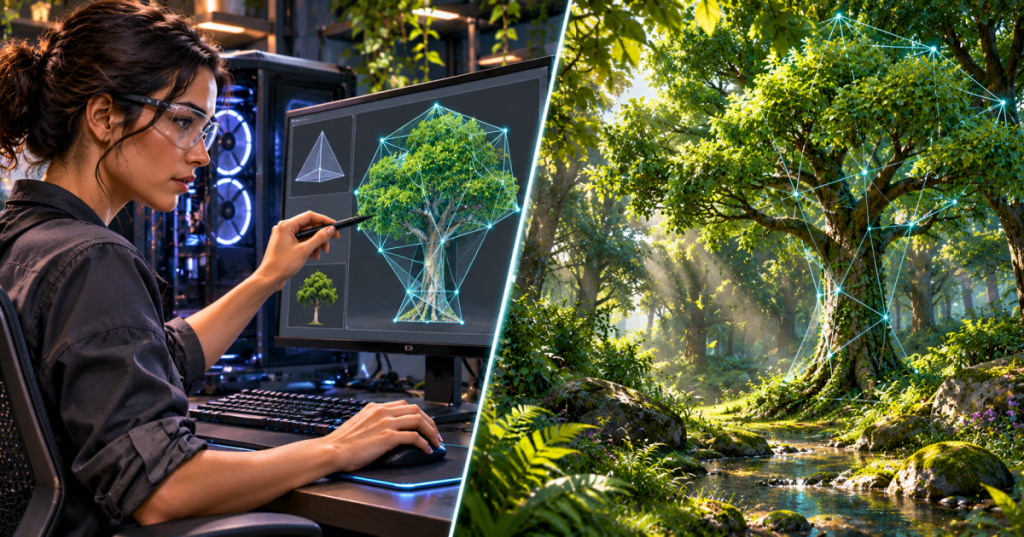
AMD graphics researcher Holger Gruen demonstrated a technique for ray-tracing roughly 500 million independently animated foliage triangles at more than 60 frames per second on a Radeon RX 9070 XT. Highlighted again in an October 29, 2026 graphics analysis, the research could make dense forests and reactive vegetation more practical for future PC games.
In AMD’s September 17 demonstration, about 25,000 plants respond to different wind conditions. The full-detail scene contains roughly 2.8 billion triangles, but level-of-detail selection reduces the ray-traced workload to around 500 million per frame at 1080p. These are research-demo results, not benchmarks from a shipping game.
A 47-Fold Reduction in Ray-Tracing Memory
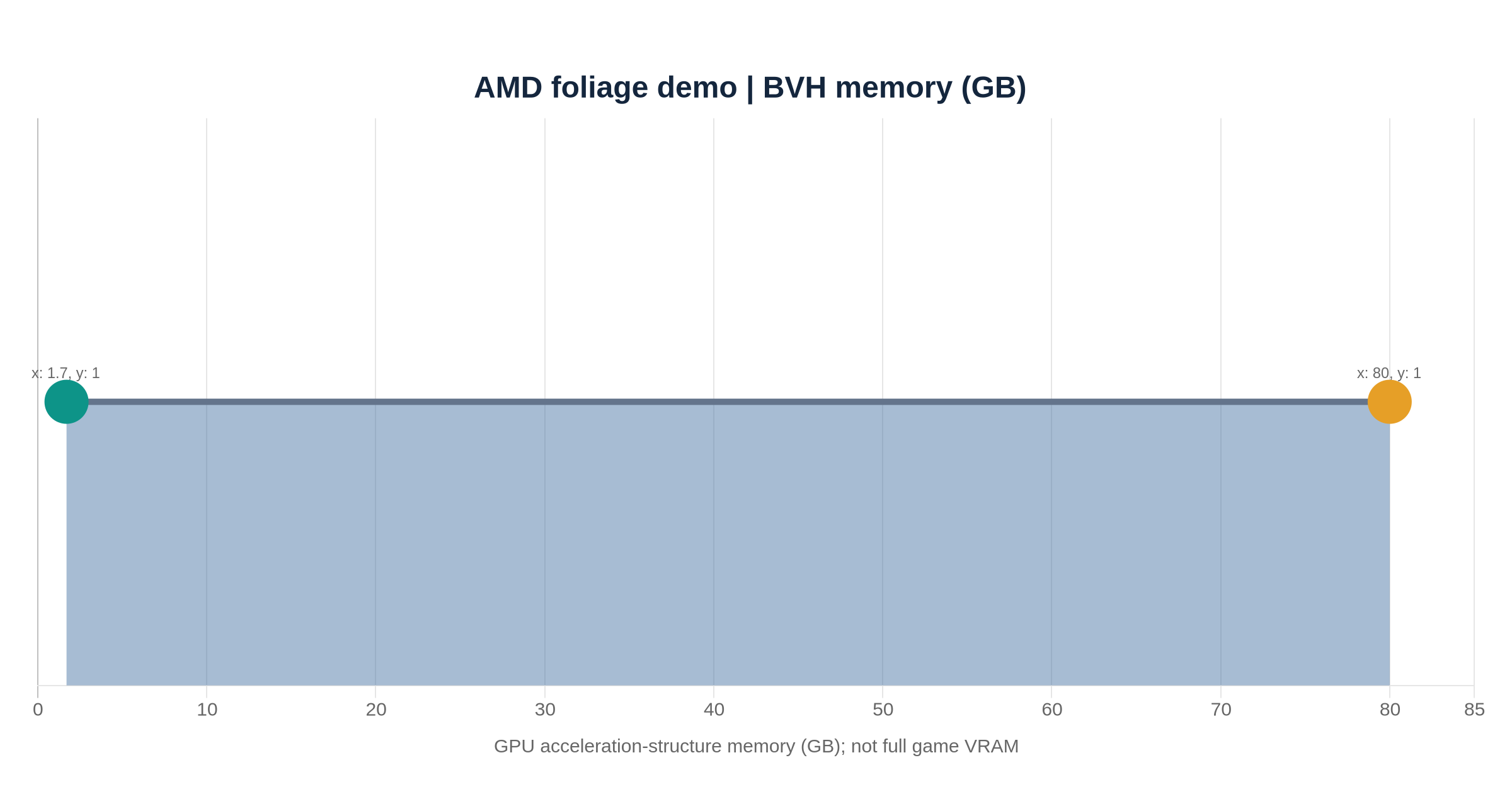
Conventional animation requires updating many bounding-volume hierarchies (BVHs), structures used to accelerate ray intersection tests. AMD estimates that a traditional representation of this foliage scene could need up to 80 GB of BVH memory. Its tetrahedral-cage method used approximately 1.7 GB, a roughly 47-fold difference under the stated comparison.
Rather than move every vertex, the engine deforms a lightweight tetrahedral cage around complex geometry. Rays are mathematically transformed into a reusable reference mesh, reducing acceleration-structure updates. The trade-off is less precise deformation control than full per-vertex animation.
Original High-Performance Graphics 2026 presentation, “Ray Tracing Massive Amounts of Animated Geometry,” published July 30. Researchers explain the technique; the video is not gameplay from a released title.
Why the 60 FPS Budget Matters
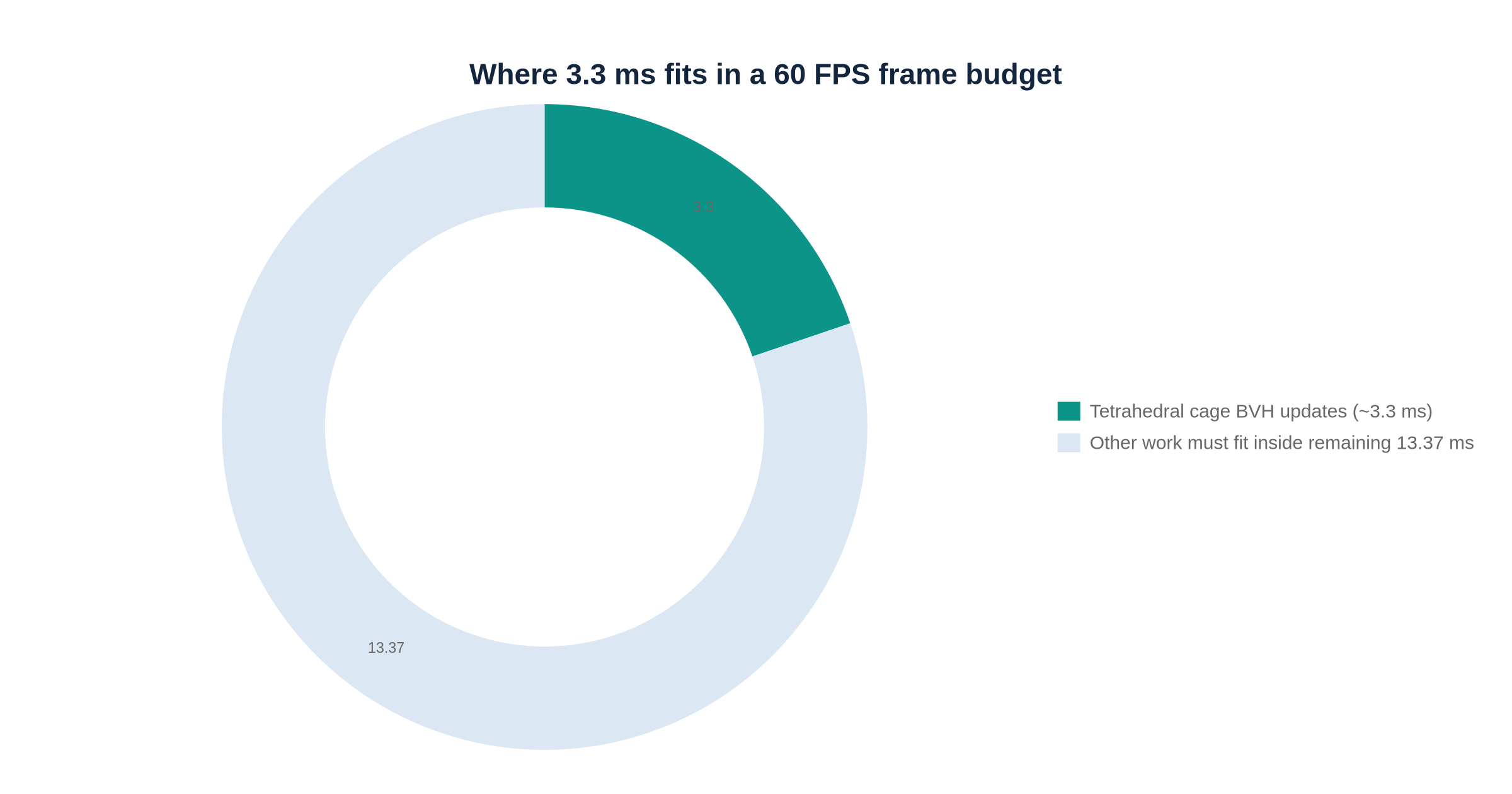
AMD reports BVH updates taking approximately 3.3 milliseconds with cages, compared with more than 300 milliseconds for conventional dense updates. At 60 FPS, each frame lasts about 16.67 milliseconds. The cage’s reported update cost occupies roughly 20% of that nominal budget, leaving time for tracing, shading and other processing—not a guarantee of unused GPU capacity.
AMD has not announced native support in major engines or retail games. Its technical paper describes future developer tooling, including DirectX Raytracing samples and a C++ cage-building library. Unlike NVIDIA’s RTX Remix, this is an experimental geometry-animation method rather than an available game modification package.
For a comparison with today’s highest-fidelity games, the crucial next step is independent testing in real engines, including how much animation quality is lost and whether crowded forests maintain stable frame pacing. It tackles a different bottleneck from shader compilation stutter.
BitcoinVersus.Tech
BitcoinVersus.Tech Editor’s Note: We volunteer daily to ensure the credibility of the information on this platform is Verifiably True. If you would like to support our work and help further secure the integrity of our research initiatives, please scan the QR code below to donate 5,000 sats. For best results, scan the QR code from a laptop or larger screen.

Bitcoin address: 3C9o19EH5HSiwEPyCTmEKzxhNCbo2X6TTb. On a phone, open the QR image on another screen or copy and verify the address in your wallet before sending.
BitcoinVersus.tech is not a financial advisor. This media platform reports on financial subjects purely for informational purposes.


Leave a Reply