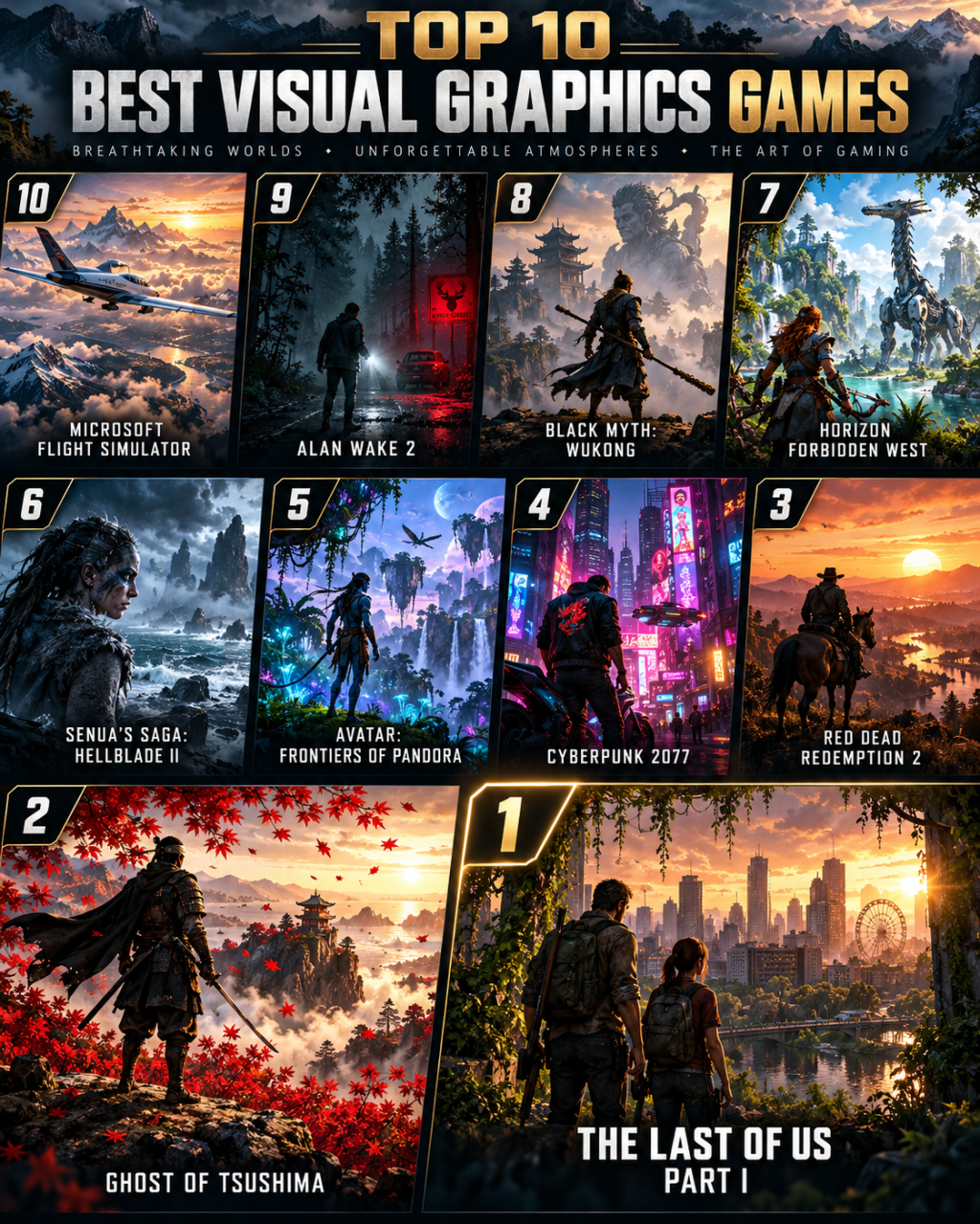
Graphics are no longer just about polygon counts. The best-looking games now combine lighting, animation, material quality, world density, art direction, physics and image reconstruction into something that feels believable—or deliberately beautiful.
This BitcoinVersus.Tech ranking is an editorial countdown of the games that stand out most visually in 2026. It is not a benchmark chart, and the order weighs both technical fidelity and artistic execution. Technologies such as modern upscaling and frame generation, increasingly sophisticated real-time lighting, and the experimental graphics work highlighted by Xbox Labs are changing what developers can put on screen.
10. Microsoft Flight Simulator 2024
Few games attempt visual scale this extreme. Flight Simulator 2024 recreates Earth with satellite imagery, photogrammetry, dense cities, dynamic weather and physically simulated aircraft. At altitude it can look like aerial photography; closer to the ground, its lighting and atmosphere sell an enormous continuous world.
9. Alan Wake 2
Remedy built Alan Wake 2 around darkness, reflections and cinematic lighting. On capable PCs, full ray tracing changes how interiors, wet streets, glass and indirect light behave. The result is less about bright spectacle and more about scenes that feel photographed rather than simply rendered.
8. Black Myth: Wukong
Black Myth: Wukong pairs Unreal Engine 5 detail with full ray tracing on PC. Water caustics, dense foliage, complex temples, giant bosses and physically accurate shadows give its mythological environments unusual depth. NVIDIA describes its highest-end lighting mode as full ray tracing, or path tracing.
7. Horizon Forbidden West
Horizon remains one of the strongest demonstrations of large-scale environmental detail. The machine designs are intricate, vegetation is thick, faces animate convincingly and distant landscapes stay visually rich. The PC release adds unlocked frame rates, ultrawide support and multiple modern reconstruction options.
6. Senua’s Saga: Hellblade II
Hellblade II often blurs the line between real-time gameplay and a pre-rendered cinematic. Ninja Theory recreated locations from Iceland and built around extremely detailed faces, skin, hair, weathered materials and dramatic natural lighting. Its restrained camera work makes those details even harder to ignore.
5. Avatar: Frontiers of Pandora
Massive Entertainment’s Snowdrop engine makes Pandora feel dense rather than merely large. Bioluminescent plants, heavy foliage, wildlife, volumetric effects and detailed terrain stack on top of each other without losing visual coherence. It is one of the strongest examples of a game using color and ecological density as graphics technology.
4. Cyberpunk 2077
Cyberpunk 2077 earns its place because Night City becomes a different visual experience with Overdrive Mode. NVIDIA’s full ray-tracing implementation models lighting from huge numbers of emissive sources, giving neon signs, vehicle lights, reflections and interiors a much more physically grounded look.
Cyberpunk 2077’s official account regularly highlights player photography that shows how far Night City’s lighting and material work can be pushed.
3. Red Dead Redemption 2
Red Dead Redemption 2 is older than most games here, yet its world still feels unusually natural. Weather, mud, snow, animal animation, vegetation, volumetric light and long-distance scenery work together rather than competing for attention. Its realism comes from consistency as much as raw rendering power.
2. Ghost of Tsushima
Ghost of Tsushima is arguably the strongest art-direction pick on the list. Fields bend in the wind, leaves guide movement, sunsets are aggressively composed and color is used almost like a gameplay system. The PC version adds unlocked frame rates and ultrawide support without losing the painterly identity that made the original memorable.
Ghost of Tsushima’s visual identity is strong enough that even its Kurosawa-inspired black-and-white presentation became part of the wider conversation around the game.
PlayStation’s PC features trailer shows Ghost of Tsushima’s expanded display support, graphics options and real-time presentation.
1. The Last of Us Part I
The Last of Us Part I takes the top spot because its visual quality is consistently high at every distance. Naughty Dog rebuilt the game with newer engine technology, dramatically improving facial animation, skin, materials, debris, lighting and environmental density. The PC version supports true 4K output, ultrawide displays and detailed controls for textures, shadows, reflections and ambient occlusion. PlayStation’s PC specifications show how aggressively the remake scales at its highest settings.
PlayStation’s official launch trailer demonstrates the remake’s facial detail, environments and cinematic lighting.
The biggest takeaway is that “best graphics” no longer means one thing. Cyberpunk and Black Myth push physically simulated light. Flight Simulator pushes scale. Hellblade pushes character realism. Ghost of Tsushima wins through composition. The Last of Us Part I combines enough of those disciplines at once to take our #1 spot.
For another visual-tech angle, BitcoinVersus also recently covered Minecraft’s upgraded Switch 2 visuals.
BitcoinVersus.Tech Editor’s Note:
We volunteer daily to ensure the credibility of the information on this platform is Verifiably True. If you would like to support to help further secure the integrity of our research initiatives, please donate using the QR code provided

For best QR-code scanning results, please scan this donation code from a desktop or larger screen. Mobile screens may prevent camera recognition.
BitcoinVersus.tech is not a financial advisor. This media platform reports on financial subjects purely for informational purposes.


Leave a Reply