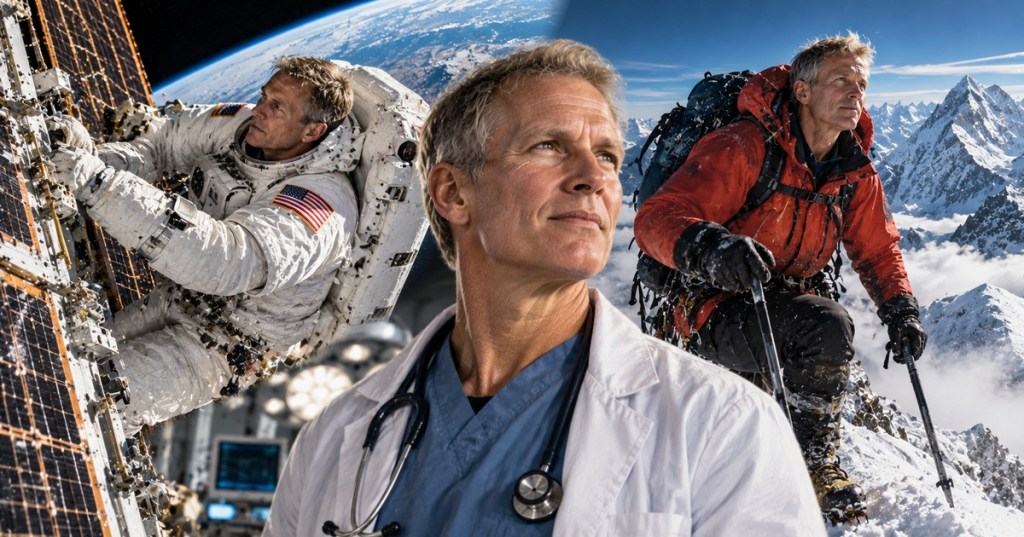
Scott Parazynski trained to save lives in an emergency room. Then he spent 17 years working in an environment where there is no emergency room at all.
Parazynski earned a biology degree from Stanford University in 1983 and graduated with honors from Stanford Medical School in 1989. He completed an internship at Brigham and Women’s Hospital and was deep into an emergency-medicine residency when NASA selected him for the astronaut corps in 1992. NASA’s biography also documents his research in space physiology, high-altitude acclimatization and human adaptation to extreme environments.
Parazynski discusses the combination of medicine, spaceflight and mountaineering that shaped his career.
He ultimately flew on five Space Shuttle missions: STS-66, STS-86, STS-95, STS-100 and STS-120. Across those flights, Parazynski accumulated 58 days in space and performed seven spacewalks totaling 47 hours and 5 minutes.
His medical background became especially fitting during STS-120 in 2007. A solar array on the International Space Station tore while being deployed. Mission Control developed an improvised repair, and Parazynski was positioned at the end of an extended robotic-arm-and-boom arrangement to reach the damaged section. NASA’s spacewalking history describes how he effectively “sutured” the array with improvised stabilizers called cufflinks. The repair worked, allowing the array to deploy fully.
Archive footage shows the STS-120 solar-array repair, one of the defining spacewalks of Parazynski’s NASA career.
Parazynski belongs to the same remarkable physician-astronaut tradition as Story Musgrave and Jonny Kim: careers built around technical competence when mistakes can have immediate consequences.
Then he pursued another extreme environment.
Parazynski first attempted Mount Everest in 2008 but had to abandon the climb after suffering a severe back injury. He returned the following year. On May 20, 2009, he reached the summit, becoming the first person to both travel in space and stand on top of Everest.
A NASA community discussion highlights a long-form interview covering Parazynski’s spaceflight, medicine and mountaineering career.
After NASA, he moved into technology and entrepreneurship, applying lessons from medicine, robotics and human-machine control to new products. That makes his career more than a sequence of adventures. Each chapter builds on the same specialty: performing complicated work in environments where preparation matters enormously.
That theme also connects him with explorers such as Sian Proctor, whose career moved from Earth science and field expeditions to piloting a spacecraft.
Parazynski became a physician, astronaut, spacewalker, inventor and Everest summiter.
Few careers demonstrate more clearly that expertise developed in one demanding environment can become preparation for the next one.
BitcoinVersus.Tech Editor’s Note:
We volunteer daily to ensure the credibility of the information on this platform is Verifiably True. If you would like to support to help further secure the integrity of our research initiatives, please donate using the QR code provided

For best QR-code scanning results, please scan this donation code from a desktop or larger screen. Mobile screens may prevent camera recognition.


Leave a Reply