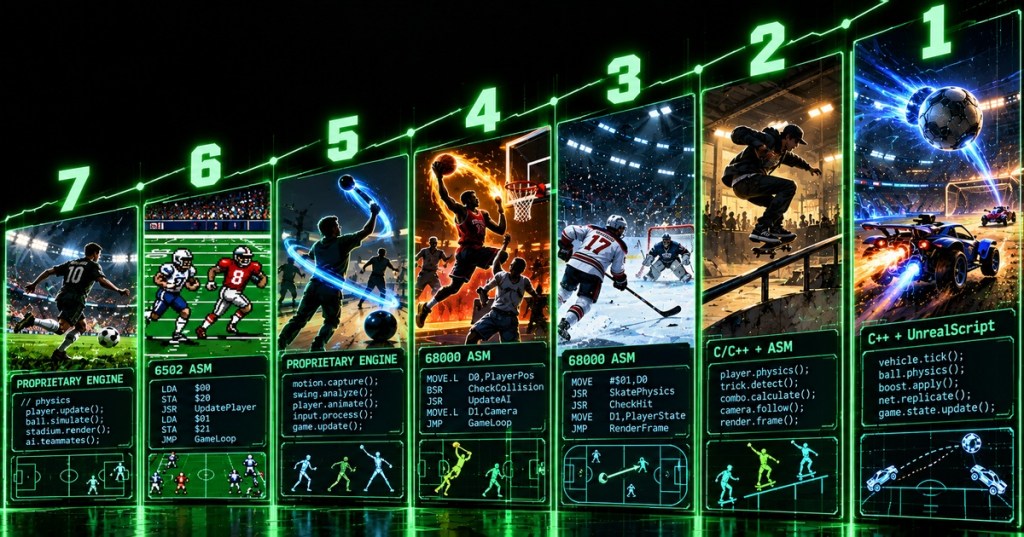
Great sports games translate timing, momentum, spacing and physics into code that feels natural. This BitcoinVersus.Tech countdown ranks seven all-time standouts and looks at the software underneath them. Where source or tooling is public, we name it; where studios kept the production language private, we say so instead of guessing.
The engineering progression is as interesting as the games themselves—from assembly on 8-bit and arcade hardware to C/C++, scripting layers and full commercial engines. For more on the visual side of game technology, see our Top 10 graphics countdown, Xbox Labs, and AMD FSR 4 coverage.
7. FIFA 14
FIFA 14 captured football’s global scale while arriving at a major engine transition. PS4 and Xbox One used EA SPORTS Ignite, a sports-focused engine spanning rendering, animation, locomotion, physics and AI.
Code stack: EA SPORTS Ignite. EA documented the engine but not FIFA 14’s exact production-language mix, so calling the whole game “C++” would overstate the public evidence.
EA SPORTS’ official Ignite engine trailer shows the technology that powered FIFA 14 on PS4 and Xbox One.
6. Tecmo Super Bowl
Tecmo Super Bowl made football fast, readable and deep enough for season-long statistics and editable playbooks. Code stack: 6502 assembly on NES. A modern byte-for-byte rebuildable disassembly exposes the game loop, playbooks, simulation logic and player data. It is reverse-engineered code—not Tecmo’s original commented source release.
Original-hardware gameplay shows how much football Tecmo packed into 8-bit code.
5. Wii Sports
Wii Sports changed who could play by turning physical gestures into tennis swings, bowling releases, punches, golf shots and baseball motions. Code stack: proprietary Nintendo EAD software and Wii development tools. Nintendo’s developer interviews describe separate Wii Remote prototypes becoming the final collection, but Nintendo never published a definitive language breakdown.
Zebra Gamer demonstrates the original Wii Sports tennis controls and the motion-input design that made the game immediately readable.
4. NBA Jam
NBA Jam turned basketball into arcade language: two-on-two play, monster dunks, secret characters and “on fire” streaks. Code stack: assembly language for Midway’s TMS34010-based arcade hardware. Preserved NBA Jam source files contain thousands of lines of .ASM for game logic, player sequences and display routines.
The original arcade game remains a masterclass in simple controls and tuned timing.
3. NHL ’94
NHL ’94 made hockey readable with skate, pass, shoot, check and switch-player controls, then added the one-timer for extra timing depth. Code stack: assembly-level Sega Genesis development targeting the Motorola 68000. Programmer Mark Lesser built the Genesis version largely himself; the original production source is not public, while the community works from assembly representations and disassemblies.
Sega Genesis gameplay shows the one-timer, compact controls and fast pacing that made NHL ’94 a template for sports games.
2. Tony Hawk’s Pro Skater 2
Tony Hawk 2 transformed skateboarding into a programmable scoring loop: trick, balance, link, multiply, land. Code stack: Neversoft’s proprietary Big Guns technology. Reverse-engineering of the Windows version exposes C++ class structures, while later Neversoft tooling includes its qScript scripting system. The original PlayStation production source has not been publicly released, so C++ and qScript are the defensible public evidence—not a complete source-language inventory.
A full THPS2 playthrough shows how consistently its combo physics behave across radically different levels.
1. Rocket League
Rocket League takes the top spot because its rules fit in a sentence while its skill ceiling still feels nearly unlimited. Positioning, rotation, aerial control, prediction and teamwork all emerge from a car, a ball and a tightly tuned physics model.
Code stack: the original 2015 Rocket League shipped on Unreal Engine 3. Public UE3 documentation shows that generation of Unreal used native C++ engine code alongside UnrealScript for gameplay scripting, but Psyonix has not published a complete source-language breakdown for Rocket League itself. The important engineering story is the physics tuning: the car, ball, boost and collision behavior were iterated for years until the game produced a predictable competitive skill ceiling.
Rocket League’s official current trailer shows how the car-and-ball physics formula has evolved while preserving the game’s competitive identity.
The Code Changed With the Games
Tecmo Super Bowl and NBA Jam lived close to the hardware in assembly. Tony Hawk 2 mixed higher-level C/C++ with optimized assembly. Rocket League used a commercial engine, native code and scripting to support a decade-long competitive platform. Wii Sports shows another lesson: sometimes the breakthrough is translating a new input device into rules anyone can understand.
BitcoinVersus.Tech Editor’s Note:
We volunteer daily to ensure the credibility of the information on this platform is Verifiably True. If you would like to support to help further secure the integrity of our research initiatives, please donate using the QR code provided

For best QR-code scanning results, please scan this donation code from a desktop or larger screen. Mobile screens may prevent camera recognition.
BitcoinVersus.tech is not a financial advisor. This media platform reports on financial subjects purely for informational purposes.


Leave a Reply