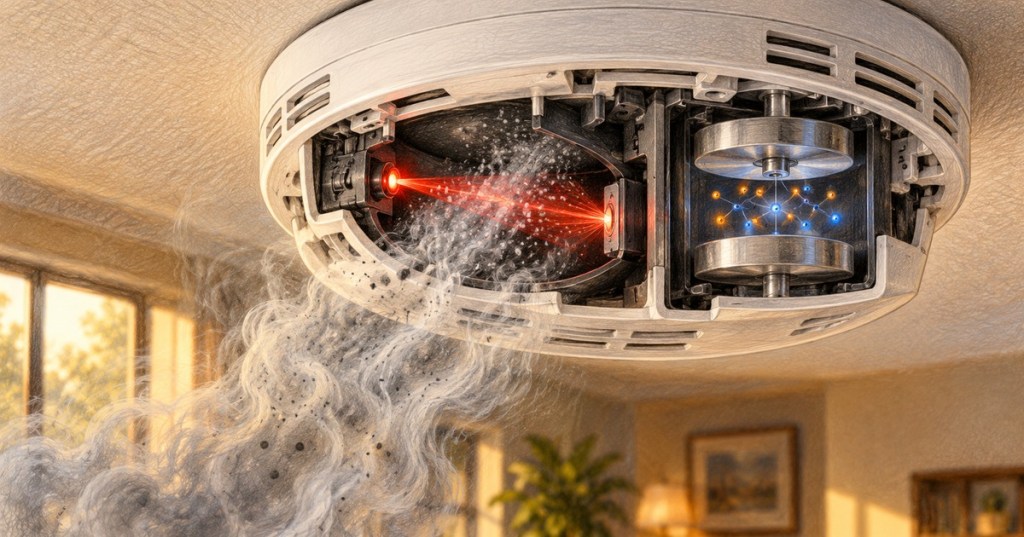
A smoke alarm does not actually see flames or understand that a room is on fire. It watches the air for particles that should not be there. When enough of those particles enter its sensing chamber, the alarm’s electronics decide that the pattern is consistent with smoke and trigger the loud warning sound.
That basic idea sounds simple, but it has to solve a difficult engineering problem. A useful smoke alarm must react quickly to dangerous fires while ignoring ordinary dust, steam and cooking aerosols often enough that people do not become frustrated and disable it. Modern alarms are therefore small sensing systems built around airflow, optics or ionization, threshold detection, power management and a very loud output device.
Smoke is a cloud of tiny particles and gases
When material burns or smolders, it releases a complex mixture of gases, droplets and solid particles. The exact mixture depends on what is burning, how much oxygen is available and whether the fire is flaming or slowly smoldering.
According to the National Institute of Standards and Technology, residential smoke alarms most commonly detect those airborne particles using one of two sensing approaches: photoelectric detection or ionization detection. Both are trying to answer the same question—has enough unusual particulate matter entered the chamber to justify sounding the alarm?—but they measure that change differently.
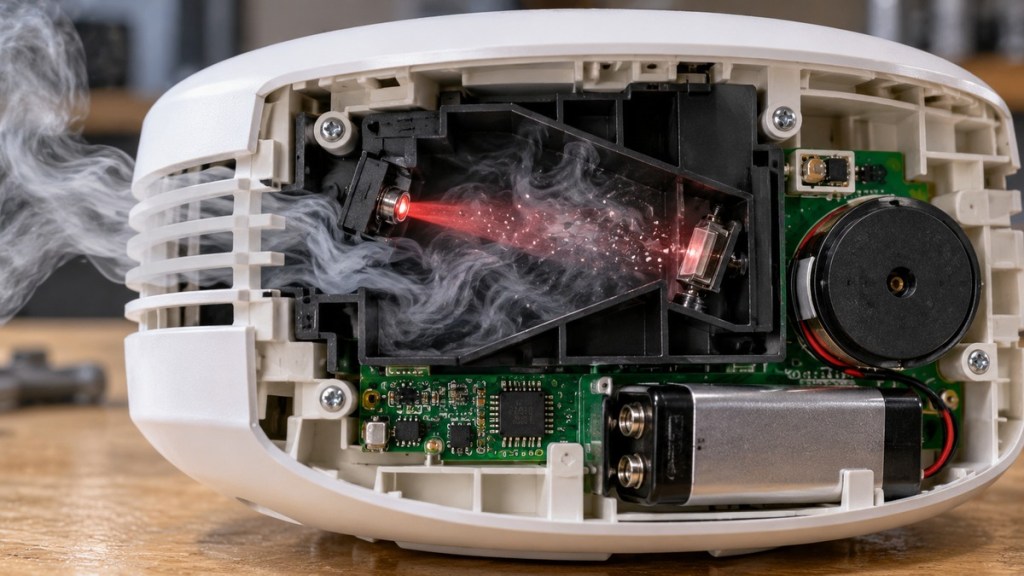
Photoelectric alarms look for scattered light
A photoelectric smoke alarm contains a small light source and a light-sensitive detector arranged so the detector normally does not receive much direct light. The chamber is intentionally shaped to keep ordinary room light out while still allowing air to circulate through it.
When smoke particles enter the chamber, some of the light bounces—or scatters—off those particles and reaches the detector. If the measured light rises above the alarm’s designed threshold, the control circuit activates the sounder.
The light-sensitive component is commonly based on semiconductor technology. A photodiode converts incoming light into an electrical signal, which is one practical use of the same semiconductor physics behind the PN junctions and semiconductor devices used throughout modern electronics.
Photoelectric alarms have traditionally been especially effective at detecting larger, lighter-colored particles produced by many slow, smoldering fires. NIST notes that these particles tend to scatter light efficiently, which is exactly what the optical chamber is designed to notice.
Ionization alarms watch a tiny electrical current
An ionization smoke alarm uses a very small amount of radioactive material—typically americium-241—inside a shielded sensing chamber. The radiation ionizes some of the air molecules between two electrodes, allowing a tiny electrical current to flow.
When smoke particles enter, they attach to some of those charged ions and reduce the current. The alarm electronics watch that current continuously. If it changes enough, the circuit interprets the drop as smoke and sounds the alarm.
NIST explains that ionization alarms have traditionally responded especially quickly to the smaller particles common in fast, flaming fires. The radioactive source is tiny and contained inside the device, but an ionization alarm is still a safety product, not a science kit: do not dismantle or modify one, and follow local disposal guidance when replacing it.
EngineerGuy demonstrates the operating principle of an ionization smoke detector and shows how a very small current changes when smoke enters the chamber.
Why two sensor types exist
There is no single particle size or fire pattern called “smoke.” A sofa that smolders for a long time can create a different aerosol from paper or cooking oil that transitions quickly to open flame. That is why the two classic alarm technologies developed different strengths.
Historically, photoelectric alarms have tended to respond faster to many smoldering fires, while ionization alarms have tended to respond faster to many flaming fires. Dual-sensor alarms combine both approaches, and newer products increasingly use more sophisticated signal processing to meet modern performance standards across a wider range of fire conditions.
A 2024 NIST review of newer smoke-alarm standards described a major engineering goal: alarms should become better at detecting both flaming and smoldering fires while becoming less likely to trigger from normal cooking. That second part matters more than it may seem. A perfect sensor that people disable after too many nuisance alarms is not a useful safety system.
Why toast can fool a smoke alarm
Smoke alarms cannot chemically identify “house fire” versus “overcooked bacon.” They measure physical effects caused by particles in the air. Cooking can produce particles similar enough in size or optical behavior to fire smoke that a sensitive alarm may react.
Steam, dust, insects and aerosols can create similar problems depending on the alarm design and location. Manufacturers therefore use chamber geometry, filtering, timing logic and increasingly advanced algorithms to distinguish likely fires from nuisance events.
At the electronics level, the sensor continuously produces a signal and the control circuit decides whether that signal has crossed the alarm condition. That event-driven idea is similar in spirit to the hardware interrupts computers use to demand immediate attention: something important changed, so normal operation stops and the system responds.
The loud sound is a separate subsystem
Detecting smoke is only half the job. The device also has to wake people who may be sleeping in another room. Once the sensor and control electronics declare an alarm state, they drive a high-output sounder—often a piezoelectric device—using a distinctive temporal pattern designed to be recognizable as an emergency warning.
Interconnected alarms add another layer. A hardwired or wireless network can let one alarm tell the others to sound, so smoke detected in a basement can trigger the bedroom alarms upstairs. That is one reason smoke alarms increasingly overlap with the wider smart-home ecosystem, although life-safety functions still need to work even when an app, router or cloud service is unavailable.
Battery powered, hardwired, or both?
Smoke alarms can run from replaceable batteries, sealed long-life batteries, household wiring with battery backup, or combinations of those approaches. The sensing electronics use little power most of the time because the device is expected to sit quietly for years while continuously watching the air.
The U.S. Fire Administration notes that hardwired alarms typically include backup batteries so a power outage does not also remove fire detection. Sealed 10-year battery designs reduce one common failure mode: a missing or dead replaceable battery.
Why pressing the test button matters
The test button does more than prove that the plastic button moves. It checks important parts of the alarm’s electronics and sounder. Depending on the design, it may electronically simulate a sensor condition rather than creating real smoke.
The U.S. Fire Administration recommends testing smoke alarms monthly and replacing residential alarms when they reach 10 years from their manufacture date. Sensors, electronics and sounders age even if the alarm has never experienced an actual fire.
Placement matters because smoke has to reach the sensor
A brilliant detector in the wrong location can still provide poor warning. Smoke must physically travel through the room and into the sensing chamber before the alarm can react.
USFA guidance calls for smoke alarms inside every bedroom, outside each separate sleeping area and on every level of the home, including the basement. Alarms are normally mounted on the ceiling or high on a wall, following the manufacturer’s placement instructions. Interconnected alarms provide stronger coverage because one detection event can warn the entire home.
Cooking areas deserve special care because routine aerosols can create nuisance alarms. USFA guidance also emphasizes that disabling an alarm or removing its battery because it sounds during cooking is dangerous; using the hush feature, ventilation and correct placement is the better solution.
Essex Fire Service described a real incident in which a resident’s smoke alarm sounded and revealed a fire started by concentrated sunlight. The technology is simple, but early warning is the entire point.
Smoke alarms are not carbon-monoxide alarms
Smoke and carbon monoxide are different hazards. A smoke alarm looks for airborne particles associated with combustion. A carbon-monoxide alarm detects a specific poisonous gas that can be present even when there is no visible smoke.
Combination products can contain both functions in one enclosure, but internally they use separate sensing methods. The distinction matters because a home needs protection from both visible fire products and invisible combustion gases where applicable.
The engineering challenge is false alarms versus missed fires
Every detector has to balance sensitivity. Set the threshold too low and harmless particles may trigger frequent alarms. Set it too high and a real fire may grow longer before the warning begins.
NIST’s testing work illustrates why modern standards use several fire and nuisance scenarios rather than one laboratory smoke source. A home contains synthetic furniture, cooking appliances, dust, airflow, closed doors and many possible ignition sources. The alarm has to make a good decision across that messy range of conditions.
This makes the smoke alarm a surprisingly rich example of everyday engineering: a sensor, analog electronics, semiconductor components, signal processing, an embedded decision system, power management, acoustic output and human-factors design all packed into a device people usually notice only when it chirps.
The practical takeaway
The easiest way to think about a smoke alarm is this: air enters, particles change a measurable physical signal, electronics recognize the change, and the alarm turns that measurement into a warning you can hear.
- Photoelectric alarms detect light scattered by smoke particles.
- Ionization alarms detect a change in a tiny ionized-air current.
- Different fires produce different particles, which is why alarm technology and standards continue to evolve.
- Placement, testing, interconnection and replacement age matter just as much as the sensing technology.
- A nuisance alarm is a reason to improve placement or use the hush feature—not to disable the device.
A smoke alarm is one of those technologies that succeeds by disappearing into the background. For years it may do almost nothing visible. But every second, it is quietly sampling the air and waiting for a physical change large enough to justify interrupting everything.


Leave a Reply