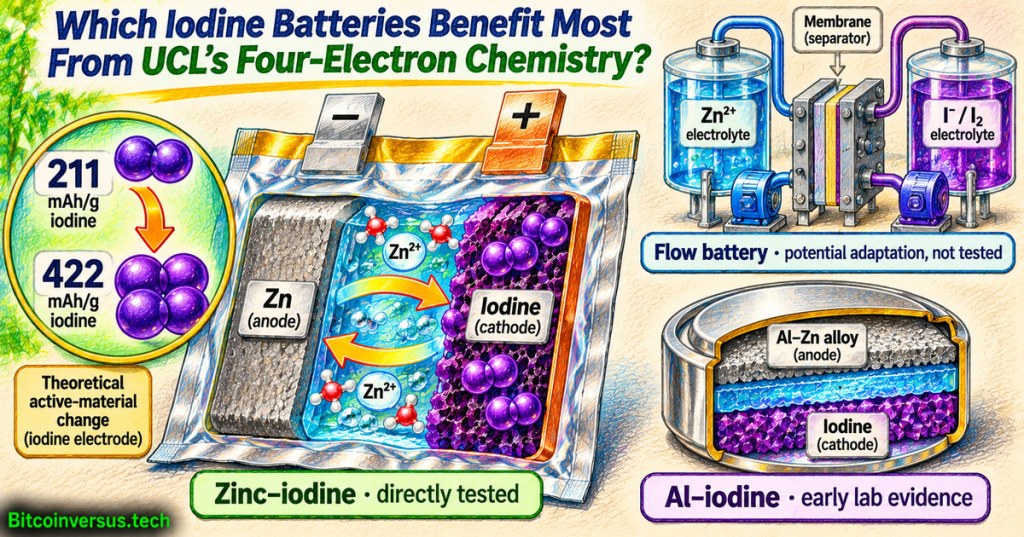
The battery designs with the strongest direct evidence for University College London’s four-electron iodine chemistry are rechargeable zinc–iodine cells, followed by laboratory aluminium–iodine systems. Zinc–iodine flow batteries represent a potentially valuable stationary-storage application, but researchers have not yet demonstrated UCL’s November 2026 electrolyte in a flow battery. Existing lithium–iodine pacemaker batteries use a separate, nonrechargeable chemistry and are not direct beneficiaries.
The November 11 Nature study increases iodine’s theoretical active-material capacity from 211 to 422 mAh per gram by enabling four-electron conversion. The result is not a demonstrated doubling of complete battery-pack energy; zinc, electrolyte, current collectors, separators, enclosures and other inactive components still occupy mass and space. The original BitcoinVersus.Tech coverage explains the electrolyte reaction.
Zinc–iodine sealed cells have the strongest evidence
UCL directly tested rechargeable aqueous zinc–iodine cells and assembled a 1.1-Ah laboratory pouch cell. Its coin-cell experiments reported 96% capacity retention after 1,000 cycles at 1 A/g and 94% after 2,000 cycles at 2 A/g. Different current conditions mean the results are not consecutive checkpoints from one identical test. The researchers also evaluated a separate aluminium–iodine configuration.
Sealed rechargeable cells are the immediate development pathway because the new chemistry was actually operated in such configurations. If manufacturers eventually achieve competitive cost, durability and safety, potential uses include stationary utility battery installations and industrial backup systems. Neither a commercial product nor a measured container-scale energy-density improvement was announced.
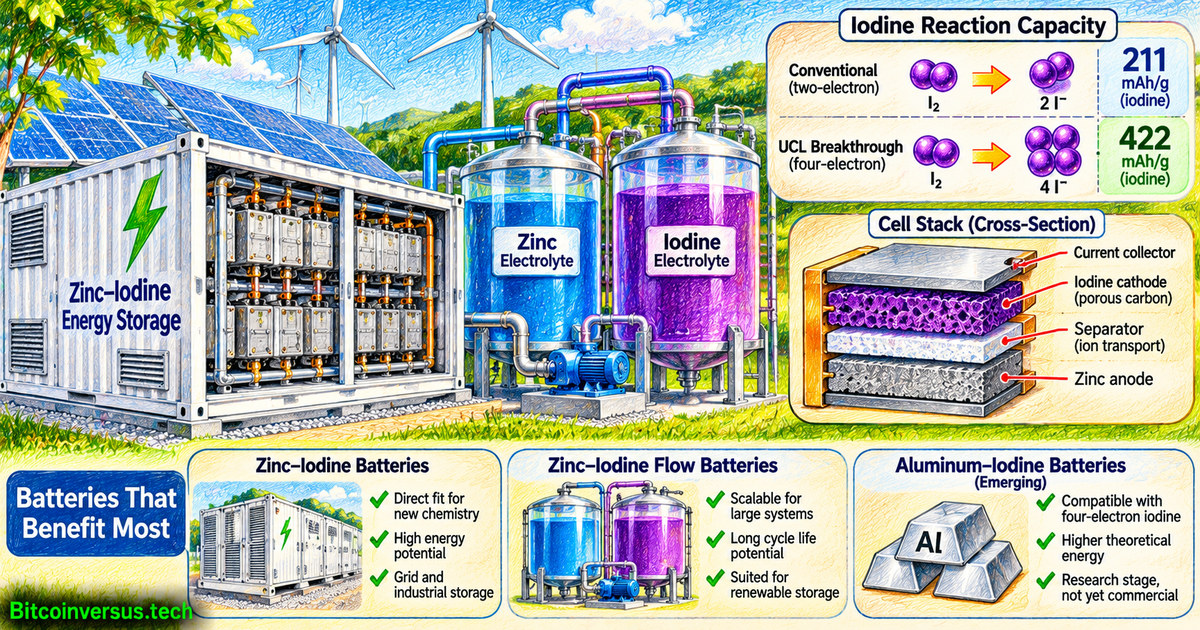
Zinc–iodine flow batteries offer a larger-scale possibility
A flow battery pumps liquid electrolytes between reservoirs and an electrochemical cell stack. Tank volume and stack power can be sized partly independently, making the architecture interesting for longer-duration grid storage. A 2025 Nature Communications study demonstrated a different zinc–iodine flow system operating for 2,000 hours and 500 cycles, using a membrane designed to limit water migration and iodine crossover.
Those findings establish that zinc–iodine flow batteries are a genuine research category—not that UCL’s new electrolyte works in one. Compatibility with circulating electrolyte, membranes, pumped volumes and system-level iodine utilization would all require new testing. The approach could eventually support long-duration storage, but the benefit remains a technical hypothesis.
Aluminium–iodine remains an experimental alternative
The UCL-led team also showed the four-electron electrolyte framework in aqueous aluminium–iodine research cells, using aluminium–zinc alloy negative electrodes. Such experiments establish chemical compatibility but not commercial readiness. The research does not provide a basis to rank aluminium–iodine above zinc–iodine for cost, lifetime or practical energy density.
Lithium–iodine pacemaker cells are a different battery
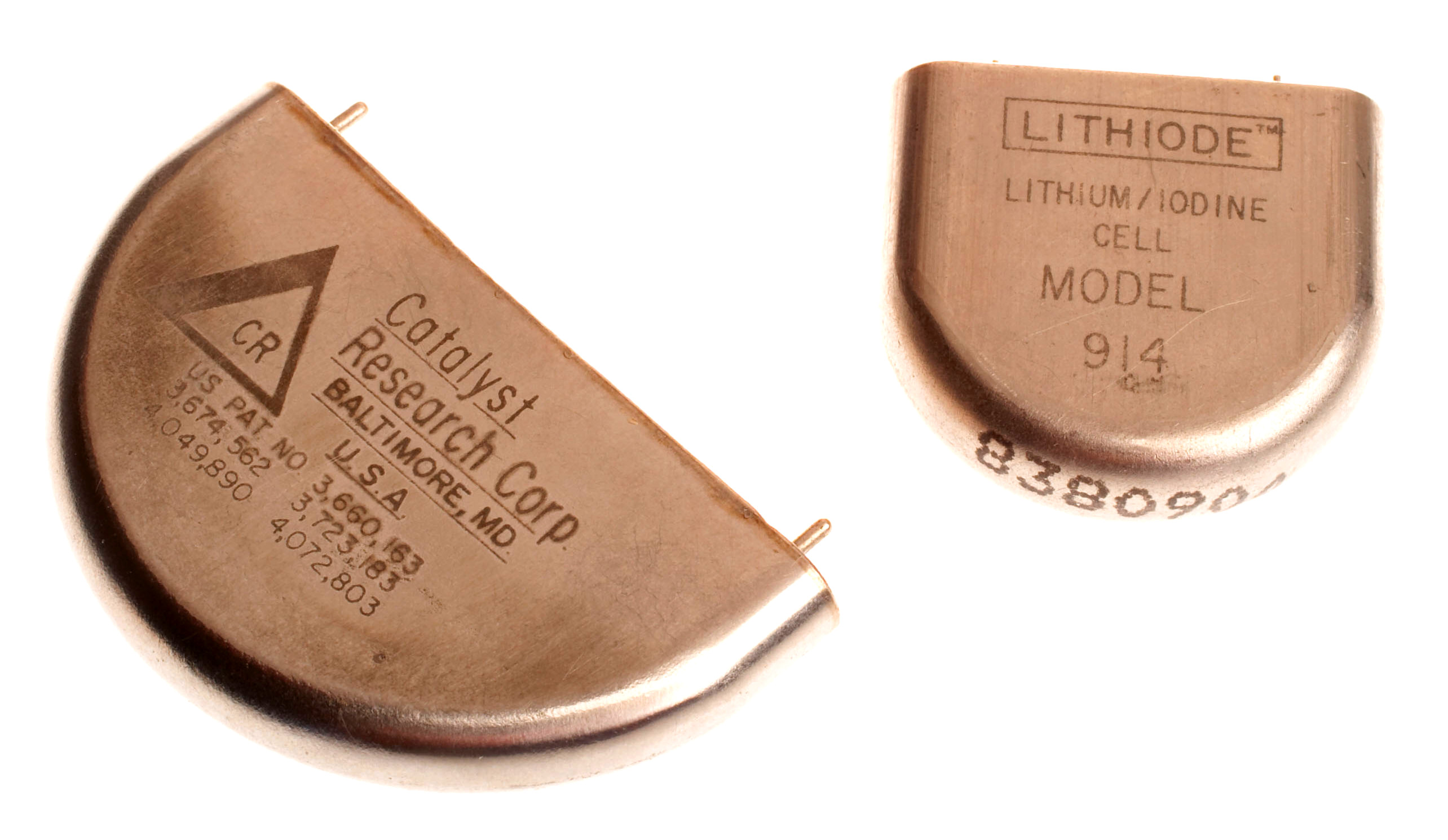
Historical lithium–iodine cells were designed for extremely long-lived, low-power medical use and are generally primary, nonrechargeable batteries. An electrolyte meant for reversibly cycling water-based zinc–iodine chemistry cannot simply be substituted into them. The presence of iodine in a product name does not imply that the new chemistry transfers to its operating mechanism.
Industrial adoption still faces the lithium-ion benchmark
No current iodine category dominates battery farms. The International Energy Agency’s 2026 review says lithium iron phosphate accounted for approximately 90% of global battery-storage deployments in 2025. Zinc–iodine would need to demonstrate reliable large-format manufacturing, good usable energy density, long calendar and cycle life, appropriate maintenance costs and competitive installed dollars per kilowatt-hour before challenging existing systems or entering data-center backup designs.
The priority is therefore clear: sealed zinc–iodine cells have direct experimental evidence; flow designs have a plausible but untested system pathway; aluminium–iodine has early laboratory compatibility. None currently demonstrates a twofold increase in complete industrial battery capacity. Related sodium-ion batteries use different cathode chemistry and gain no automatic benefit.
Editor’s Note: Follow-up analysis to the November 13, 2026 BitcoinVersus.Tech report on UCL’s four-electron iodine research. The 211-to-422 mAh/g comparison refers only to theoretical iodine active-material capacity, not measured whole-cell or pack energy. UCL’s zinc–iodine cycling tests, aluminium–iodine experiments and the independent 2025 zinc–iodine flow-battery paper are separate evidence categories. The cover and industrial-storage illustration are original colored-pencil concepts, not depictions of deployed UCL equipment. The separate 2025 flow-battery paper is cited without reproducing its more restrictively licensed figures (CC BY-NC-ND 4.0); the historic CIA photograph is public domain. No study-specific official video was verified for embedding; actual physical battery tests, player playback and public mobile-view inspection were not performed.

To scan from a phone, show the original donation QR on a different screen and use a compatible Bitcoin wallet camera. Some wallets can read the QR from an image saved on the same device. Verify the destination before sending 5,000 sats: 3C9o19EH5HSiwEPyCTmEKzxhNCbo2X6TTb.
We volunteer daily to ensure the credibility of the information on this platform is Verifiably True. If you would like to support our work and help further secure the integrity of our research initiatives, please scan the original QR code above to donate 5,000 sats.
BitcoinVersus.tech is not a financial advisor. This media platform reports on financial subjects purely for informational purposes.


