
Applied Materials’ semiconductor manufacturing-equipment business recorded $7.996 billion in revenue in Q4 FY2026, up 63.9% year over year, as chipmakers spent heavily on DRAM, advanced packaging and the machines used to make increasingly complex processors. The Santa Clara company released results November 12 for the quarter ended October 25, reporting record consolidated revenue of $10.409 billion, up 53.1%. The largest share of the company’s additional sales came from its Semiconductor Systems division, rather than services.
Applied Materials, “DRAM Master Class: High-bandwidth memory (HBM),” September 1, 2026. Official manufacturer explanation of DRAM stacking and fabrication challenges, not footage of Q4 earnings. Watch the original video on YouTube.
The corrected 64% growth calculation
According to the November 12 company earnings release, Semiconductor Systems generated $7,996 million during Q4 FY2026, compared with a recast $4,879 million in Q4 FY2025. The calculation is (7,996 − 4,879) ÷ 4,879 × 100 = 63.9%. The increase was $3,117 million. For the full company, (10,409 − 6,800) ÷ 6,800 × 100 = 53.1%, an increase of $3,609 million.
The comparison base matters. At the start of fiscal 2026, Applied moved its 200-millimeter equipment business from Applied Global Services into Semiconductor Systems and reallocated corporate support costs. It recast prior-period segment figures to match the new presentation. Comparing the current $7,996 million figure with an older, unrecast $4.76 billion segment figure would misleadingly suggest roughly 68% growth instead of the properly comparable 63.9%.
Nearly 86% of the revenue increase came from chip equipment
The $3,117 million Semiconductor Systems gain accounted for 86.4% of consolidated quarterly revenue growth ($3,117 million ÷ $3,609 million). Applied Global Services rose from $1,506 million to $1,896 million, up 25.9%; the remaining other-business residual rose from $415 million to $517 million. Those measures use the same fiscal quarters and the same unit: US dollars. Semiconductor Systems represented about 76.8% of consolidated Q4 revenue, compared with 71.8% a year earlier.
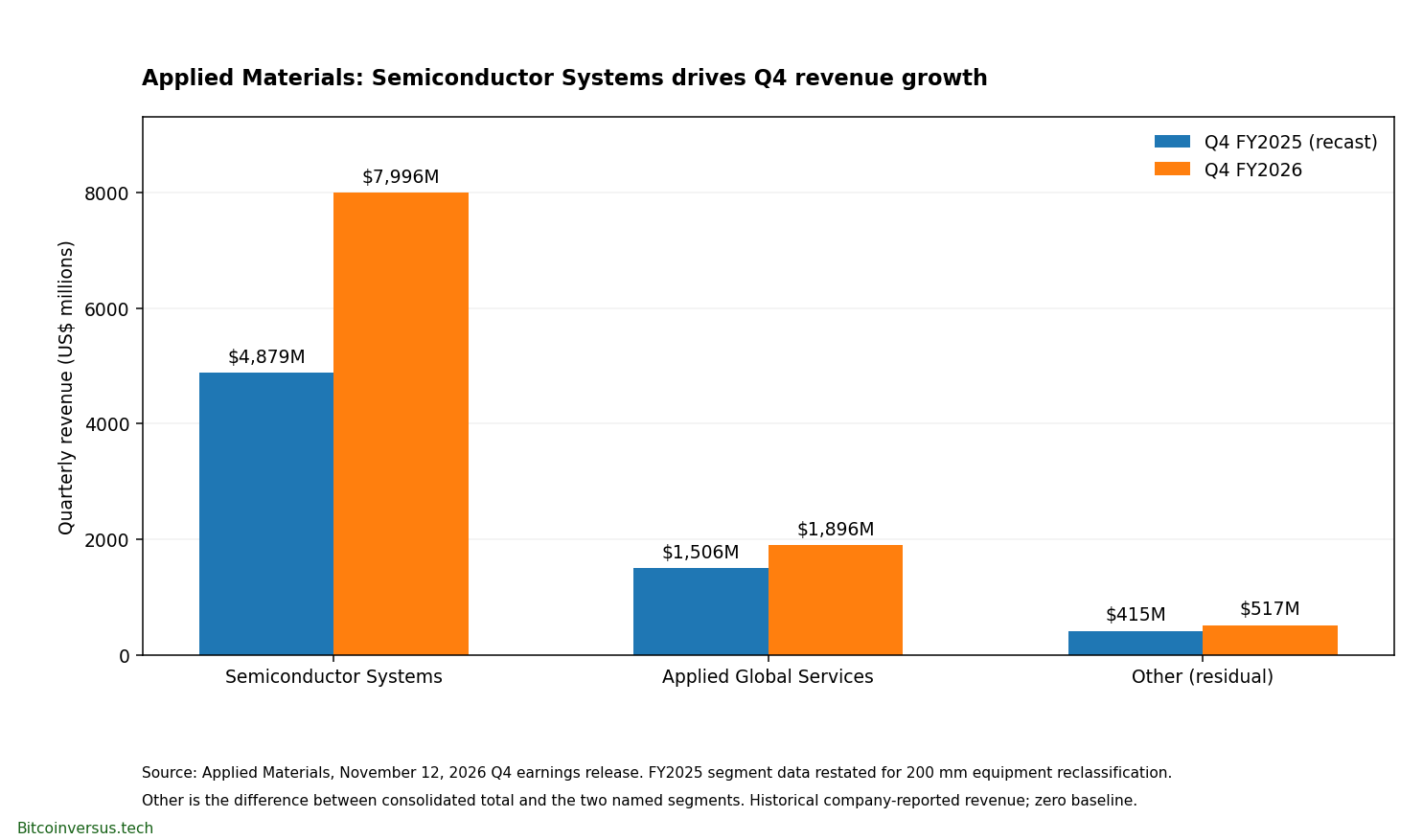
Product strength extended across the manufacturing chain. In the company’s prepared earnings remarks, management reported records in DRAM, advanced packaging, deposition, etch, chemical-mechanical polishing and process control. The business mix shifted as well: DRAM represented 33% of Semiconductor Systems revenue, up from 28%, while foundry and logic fell from 66% to 58% of the segment mix. The percentages describe revenue composition, not wafer shipment growth or physical factory output.
Why memory and packaging tools matter to AI
Memory demand increasingly depends on high-bandwidth DRAM and precise stacking, interconnect and inspection steps. Applied’s deposition-equipment primer explains how thin films are formed, while a separate advanced-packaging capital-spending analysis examines the wider investment cycle. Applied’s figures also follow Lam Research’s record quarter, reinforcing the importance of tooling suppliers in the semiconductor ecosystem.
Applied Materials, “The World of Advanced Packaging,” April 16, 2021. Official animated engineering overview of chiplets and memory stacking, not a report of Q4 FY2026 results. Watch the original video on YouTube.
Profitability improved, but AI sales are not separately disclosed
Companywide GAAP operating margin reached 35.1%, versus 25.2% in Q4 FY2025, a gain of 9.9 percentage points. Applied reported $3.30 billion in quarterly cash from operations and non-GAAP EPS of $4.16; adjusted earnings must be distinguished from GAAP EPS of $3.40. Chipmaking-equipment revenue is not identical to AI-specific revenue. Applied does not assign every dollar of the Semiconductor Systems segment to AI workloads, and sales growth cannot be converted directly into wafer starts, chip output or energy use.
For fiscal Q1 2027, management forecast revenue of approximately $11.1 billion, plus or minus $500 million. That remains forward-looking, unlike the reported fiscal fourth-quarter results. The central question is whether demand across foundry, DRAM and advanced packaging persists as fabs expand production and test the company’s longer-term equipment-market expectations. Future disclosures will need to separate equipment orders, recognized revenue and actual manufacturing capacity.
Sources and methods: Applied Materials Q4 FY2026 and FY2026 results, Nov. 12, 2026; company earnings prepared remarks, Nov. 12, 2026. Growth rates and contribution shares are independently calculated from the released figures, rounded to one decimal place. The fiscal 2025 segment numbers are recast for comparability. Original chart uses historical company-reported data, not forecast sales.
Editor’s note: The featured colored-pencil artwork is illustrative and is not a photograph of an Applied Materials facility. Both manufacturer videos are archival context. Coverage is informational, not investment advice.


Leave a Reply