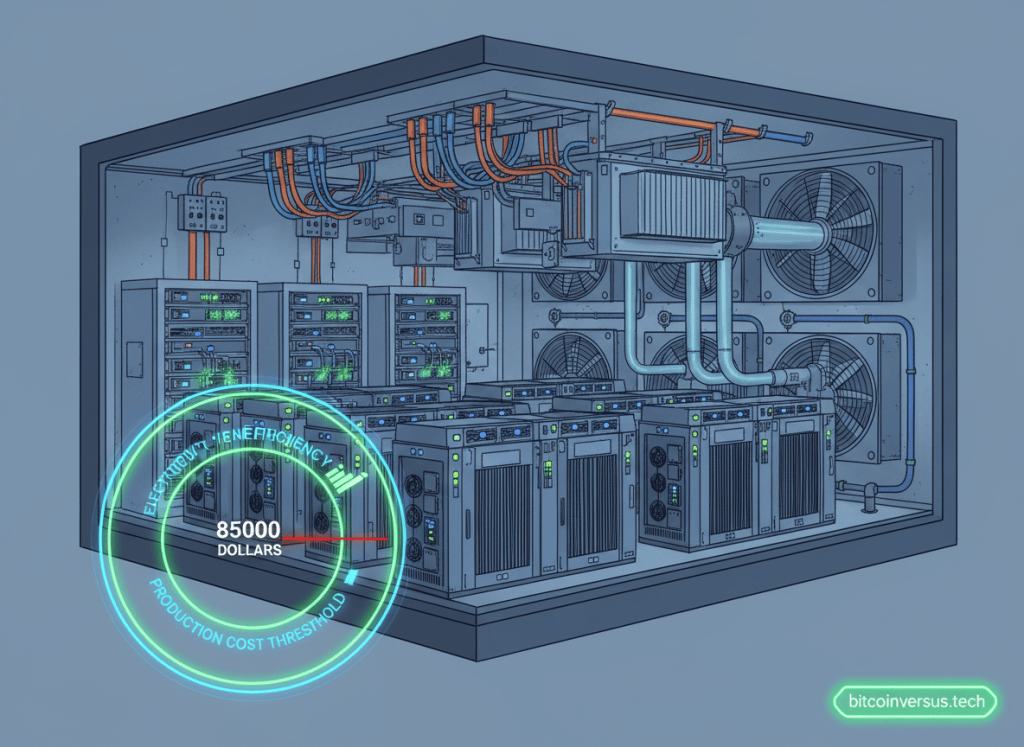
Bitcoin mining difficulty jumped 4.16% on September 19 to 132.76 trillion, tightening machine-level economics just as operators continue deploying more efficient ASIC fleets.
According to Hashrate Index, the adjustment lifted difficulty from roughly 127.45T to 132.76T. Its September 21 snapshot put the seven-day network hashrate average near 946 EH/s and the 30-day average near 934 EH/s.
Difficulty directly squeezes ASIC output
Difficulty determines how much hashing work is required, on average, to find a Bitcoin block. When difficulty rises while Bitcoin price and transaction fees remain unchanged, each terahash earns less BTC.
The September increase therefore raises the importance of joules per terahash. New-generation machines can produce more hashrate from each megawatt than older S19-era hardware, giving efficient fleets more room to absorb a difficult revenue environment.
Hashprice remains near $40 per PH per day
Live mining dashboards on September 25 showed hashprice around $40 per PH/s per day, although the figure moves continuously with Bitcoin price, fees and network conditions. Hashrate Index’s six-month forward market on September 21 was pricing an average near $38.96 per PH/s per day.
At $40/PH/day, 1 PH/s produces about $40 of gross daily mining revenue before electricity, pool fees, cooling, maintenance, downtime, financing and other operating costs.
Efficiency decides how much power that revenue consumes
A 20 J/TH fleet needs roughly 20 kW to produce 1 PH/s before facility overhead. A 10 J/TH fleet needs roughly 10 kW for the same hashrate. At a $0.05/kWh energy price, those machine-level electricity costs are approximately $24 and $12 per PH per day respectively.
That simplified comparison illustrates why the industry’s newest sub-10 J/TH hydro machines matter. BitcoinVersus.tech recently covered Bitdeer’s 9.45 J/TH SEALMINER A4 Ultra Hydro and the continuing migration toward S21-generation fleets.
The next retarget could give miners some relief
Early estimates for the next adjustment point toward a modest decline, but difficulty forecasts remain noisy until more of the 2,016-block epoch has elapsed. The protocol will ultimately set the adjustment from actual block production rather than forecasts.
For operators, the September retarget reinforces a basic mining reality: Bitcoin price can improve revenue, but fleet efficiency determines how much of that revenue survives the power bill.
BitcoinVersus.Tech Editor’s Note:
Support BitcoinVersus.tech with Bitcoin: 3C9o19EH5HSiwEPyCTmEKzxhNCbo2X6TTb
Follow BitcoinVersus.tech on X: https://x.com/BitcoinVersus
BitcoinVersus.tech is not a financial advisor. This media platform reports on financial subjects purely for informational purposes.


Leave a Reply