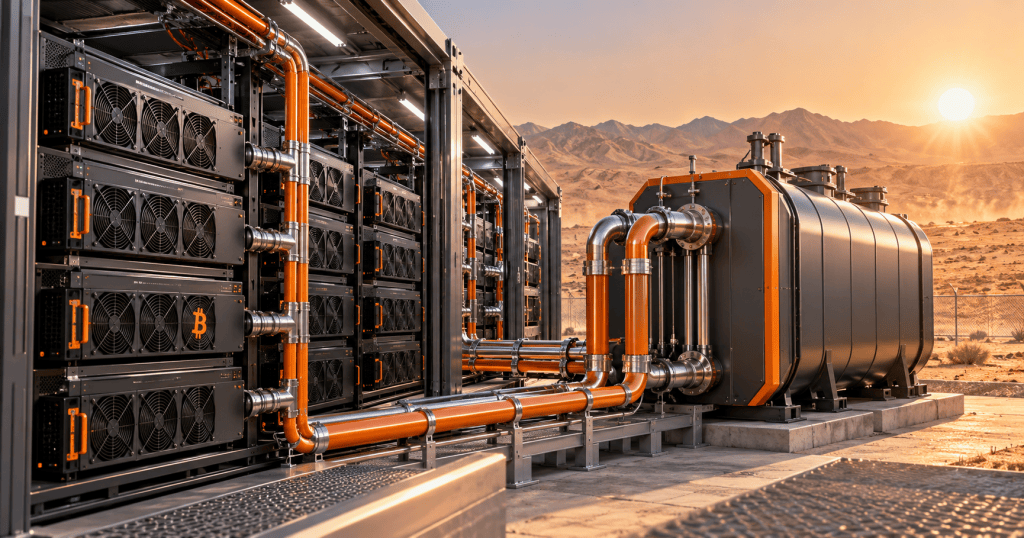
BITMAIN is adding thermal storage to its hydro-cooling stack, positioning ANT COLD STORAGE as a way to keep dense Bitcoin mining hardware online in extreme heat without routine operating-water consumption.
The system appeared in BITMAIN’s September 25 X update, where the manufacturer paired ANT COLD STORAGE, or ACS, with the rack-mounted ANTMINER S23e U2H. BITMAIN says ACS provides 8 GJ of cold-storage capacity, supports ambient temperatures up to 55°C and uses zero operating water.
The miner itself remains a high-density hydro platform. BITMAIN’s current product page lists the S23e U2H at 865 TH/s, 8,650 W and 10 J/TH in a standard 2U server form factor, with Q4 2026 futures shipping.
Thermal storage becomes part of the mining stack
Hydro mining normally moves heat from ASIC hashboards into a liquid loop and then rejects that heat through a larger cooling system. ACS adds a thermal-storage layer to that architecture. Instead of treating the cooling plant only as a real-time heat-removal system, stored cooling capacity can provide a buffer when outside conditions become difficult.
That matters because the next generation of hydro miners is packing more compute into standardized racks. BitcoinVersus.tech recently examined how BITMAIN’s AR30 cabinet reduces a hydro deployment to a 20-miner rack-scale footprint. ACS extends the same systems approach beyond the miner and cabinet into site-level thermal management.
BITMAIN’s earlier September deployment post described three scales around the S23e U2H: the ANTSPACE HW7 container for megawatt-class sites, ANTRACK AR30 and AR31 cabinets for smaller facilities, and separate thermal-storage support through ACS.
865 TH/s changes the cooling problem
At 865 TH/s per machine, a relatively small number of S23e U2H units can create a large thermal load. An independent hardware listing corroborates the 865 TH/s, 8,650 W and 10 J/TH specifications and identifies the machine as a 2U hydro-cooled SHA-256 miner.
The efficiency figure is important, but it is not the entire infrastructure story. BitcoinVersus.tech has tracked the performance frontier down to 8.9 J/TH with the S23 XP Hydro. As joules per terahash improve, operators still have to move several kilowatts of heat away from every chassis continuously.
Heat and water are becoming design constraints
The most consequential part of BITMAIN’s ACS claim is not another hashrate increase. It is the attempt to make hydro infrastructure usable where high ambient temperatures and water availability would otherwise limit deployment.
“Zero operating water consumption” should not be read as meaning the system contains no liquid. Hydro miners still require a coolant loop. The practical distinction is that a closed-loop thermal system can avoid continuously consuming fresh water during operation, which can matter in dry regions or sites where water rights and treatment infrastructure are expensive.
The timing also fits a broader shift in mining economics. As network difficulty makes ASIC efficiency increasingly important, facility design is becoming just as critical: power distribution, cooling density, thermal storage and environmental limits determine whether nameplate efficiency can actually be sustained in the field.
For operators evaluating the S23e U2H, ACS therefore represents a different kind of upgrade. It does not create hashes. It is infrastructure intended to protect the conditions under which 865 TH/s machines can keep creating them.
BitcoinVersus.Tech
Advertisement
BitcoinVersus.Tech Editor’s Note:
We volunteer daily to ensure the credibility of the information on this platform is Verifiably True. If you would like to support to help further secure the integrity of our research initiatives, please donate here: 3C9o19EH5HSiwEPyCTmEKzxhNCbo2X6TTb
BitcoinVersus.tech is not a financial advisor. This media platform reports on financial subjects purely for informational purposes.


Leave a Reply