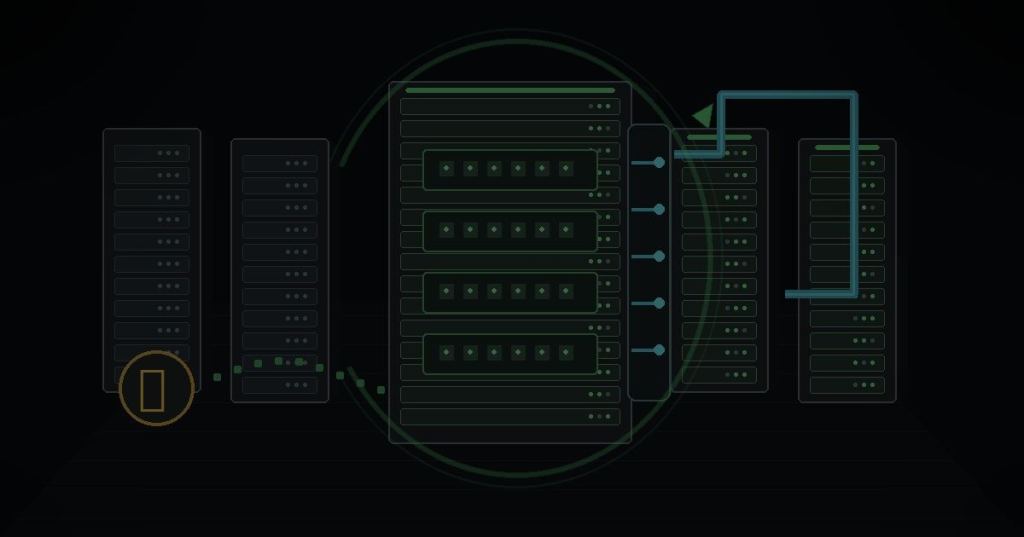
CoreWeave used its Fully Connected conference on September 30 to push beyond raw GPU capacity and deeper into the software layer of AI infrastructure. The company announced CoreWeave Forge, a development layer designed to connect the cycle of running, observing, curating, improving and evaluating AI models and agents in one environment.
The timing matters because CoreWeave is pairing that software layer with NVIDIA’s newest rack-scale hardware. Instead of selling access to accelerators as an isolated resource, the company is trying to connect model development, inference, reinforcement learning, evaluation and production operations to the same infrastructure loop.
Forge turns the AI lifecycle into one loop
Forge is built around a repeated production cycle: run a model, observe how it behaves, collect useful data, improve the model, evaluate the result and repeat. CoreWeave says the layer is open across models, frameworks and infrastructure, so customers are not limited to a single model family or a single development toolchain.
That makes the launch more than a new cloud dashboard. It is an attempt to make the expensive compute layer and the software-improvement loop operate as one system, reducing the handoffs between training, post-training, inference and agent development.
Barron’s reported that CoreWeave also opened access to NVIDIA Vera Rubin NVL72 and named Cognition as the first customer running production workloads on the system. The company also plans to offer NVIDIA’s Vera CPU, extending the stack beyond GPU clusters as agentic workloads become more CPU-intensive.
The hardware rollout also connects with the wider Rubin supply chain. BitcoinVersus recently covered Supermicro beginning Vera Rubin NVL72 rack shipments, showing that the platform is moving from launch-stage demonstrations toward deployable systems across multiple infrastructure vendors.
Why the shift matters for Bitcoin mining infrastructure
For BitcoinVersus readers, CoreWeave is especially relevant because its expansion has repeatedly intersected with mining infrastructure. The CoreWeave and Core Scientific relationship became an early example of power-rich mining facilities being repurposed for higher-value AI workloads.
That pattern has since spread across the industry. BitcoinVersus has also tracked how miners have redirected infrastructure toward AI when power, land, interconnection and cooling assets can earn more from accelerated computing than from marginal mining capacity.
CoreWeave’s own Vera Rubin update on X said the company expected to be among the first cloud providers to bring up NVL72 and emphasized performance, efficiency and lower token costs at scale. The September production rollout gives that earlier hardware roadmap a concrete customer endpoint.
The value is moving up the stack
The larger infrastructure lesson is that access to power and accelerators is becoming only one layer of the business. As more operators can deploy dense GPU clusters, differentiation shifts toward how quickly those clusters can be brought online, how reliably they can stay utilized and how tightly the development software is integrated with the physical compute.
Forge is CoreWeave’s answer to that shift. The company is trying to capture more of the AI lifecycle around the rack rather than competing only on available GPU-hours. That is similar to what mature Bitcoin-mining operators learned with fleet management: raw hardware matters, but orchestration, telemetry, tuning and uptime determine how much economic value the hardware actually produces.
The first production customer is an important milestone, but it does not by itself prove that every AI workload will benefit equally from Rubin or that Forge will become the default development layer. What September 30 does establish is a more complete CoreWeave stack: new-generation rack-scale compute underneath, a connected model-and-agent development layer above it, and live customer workloads beginning to test the combination.
BitcoinVersus.Tech
Advertisement
Editor’s Note:
We volunteer daily to ensure the credibility of the information on this platform is Verifiably True. If you would like to support our research initiatives, please donate here: 3C9o19EH5HSiwEPyCTmEKzxhNCbo2X6TTb
BitcoinVersus.tech is not a financial advisor. This media platform reports on financial subjects purely for informational purposes.


Leave a Reply