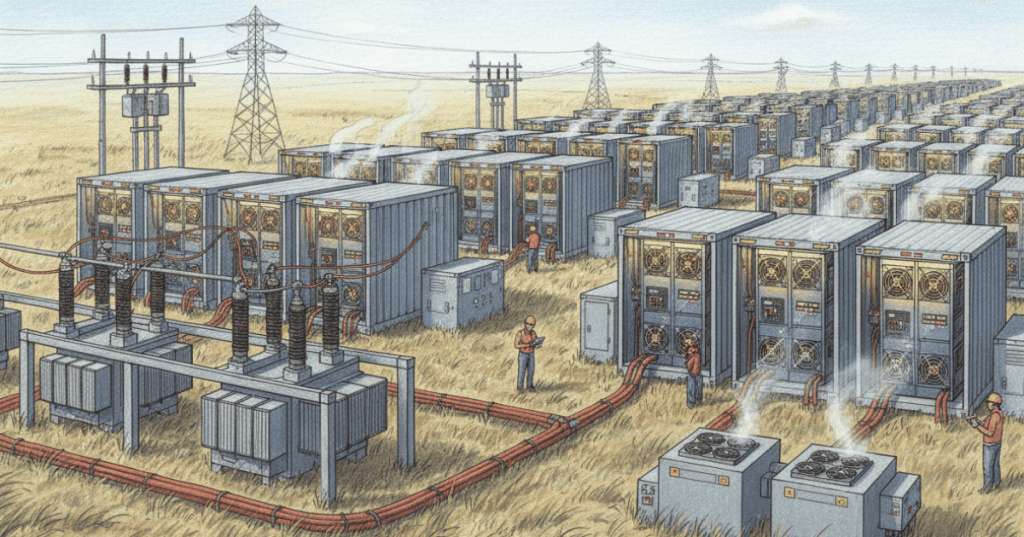
American Bitcoin energized about 11,298 additional Bitcoin mining ASICs at its Drumheller, Alberta site in April, adding roughly 3.05 EH/s of operating hashrate in one deployment.
The expansion is a useful snapshot of the 2026 mining race: operators are not simply adding more machines. They are trying to add hashrate with newer ASICs that produce more computation from each unit of electrical power.
11,298 ASICs Added About 3.05 EH/s
According to American Bitcoin’s April 22 operating announcement, the newly energized miners contributed about 3.05 exahashes per second at approximately 13.5 joules per terahash. The company said those machines had been purchased earlier in 2026 and were fully deployed at Drumheller.
After the deployment, American Bitcoin reported an owned fleet of roughly 89,242 miners producing about 28.1 EH/s, with average fleet efficiency near 16.0 J/TH.
Why 13.5 J/TH Matters
Joules per terahash measures how much electrical energy a miner needs to perform a unit of hashing work. Lower is better. At the same electricity price, a lower-J/TH fleet can generally produce more hashrate for the same power envelope than an older, less efficient fleet.
The 13.5 J/TH figure for this deployment was therefore stronger than American Bitcoin’s reported fleet average of roughly 16.0 J/TH. Adding the new machines did not merely increase total hashrate; it also added hardware operating below the fleet’s average energy intensity.
The Fleet Reached About 28.1 EH/s
Hashrate measures the number of SHA-256 hash calculations miners can attempt each second. One exahash per second equals one quintillion hashes per second. At 28.1 EH/s, American Bitcoin’s reported owned fleet was performing roughly 28.1 quintillion hash attempts every second.
More hashrate increases a miner’s statistical share of Bitcoin block rewards, but it does not guarantee higher profit. Revenue still depends on network difficulty, Bitcoin price, transaction fees, uptime and the metric miners often summarize as hashprice.
Efficiency Becomes More Important As Difficulty Rises
Bitcoin mining is competitive by design. When more hashrate joins the network, the protocol periodically adjusts mining difficulty so blocks continue arriving near the intended average interval. That makes old machines progressively harder to justify when revenue per unit of hashrate falls.
BitcoinVersus.Tech has tracked this pressure as rising Bitcoin difficulty makes ASIC efficiency increasingly important. A machine can still function perfectly and become economically obsolete because newer hardware produces the same hashrate with less electricity.
A Simple Power Estimate Shows The Scale
Using the company’s reported 3.05 EH/s and 13.5 J/TH figures, the newly deployed hashrate implies roughly 41.2 MW of ASIC-level electrical demand at full rated operation: 3.05 million TH/s × 13.5 J/TH ≈ 41.2 million joules per second, or 41.2 MW. Actual facility draw can differ because fans, transformers, networking, environmental conditions, curtailment and other infrastructure add losses or change operating conditions.
That calculation shows why efficiency improvements compound at industrial scale. Saving even one joule per terahash across millions of terahashes per second translates into megawatts of difference.
The Bigger Story Is Hashrate Per Megawatt
The Drumheller deployment is not the newest mining announcement of October, but it falls well inside the last 180 days and had not previously received a dedicated BitcoinVersus.Tech story. More importantly, it captures a durable trend: miners increasingly compete on how much useful SHA-256 computation they can extract from constrained electrical infrastructure.
American Bitcoin’s April expansion added thousands of machines and several exahashes, but the number to watch is the combination of the two: 3.05 EH/s at about 13.5 J/TH. As network competition increases, raw machine count matters less than efficient hashrate delivered from each megawatt.
BitcoinVersus.Tech
Advertisement
Editor’s Note
We volunteer daily to keep the technical information on this platform verifiable.
BitcoinVersus.tech is not a financial advisor. This media platform reports on financial and technology subjects purely for informational purposes.


Leave a Reply