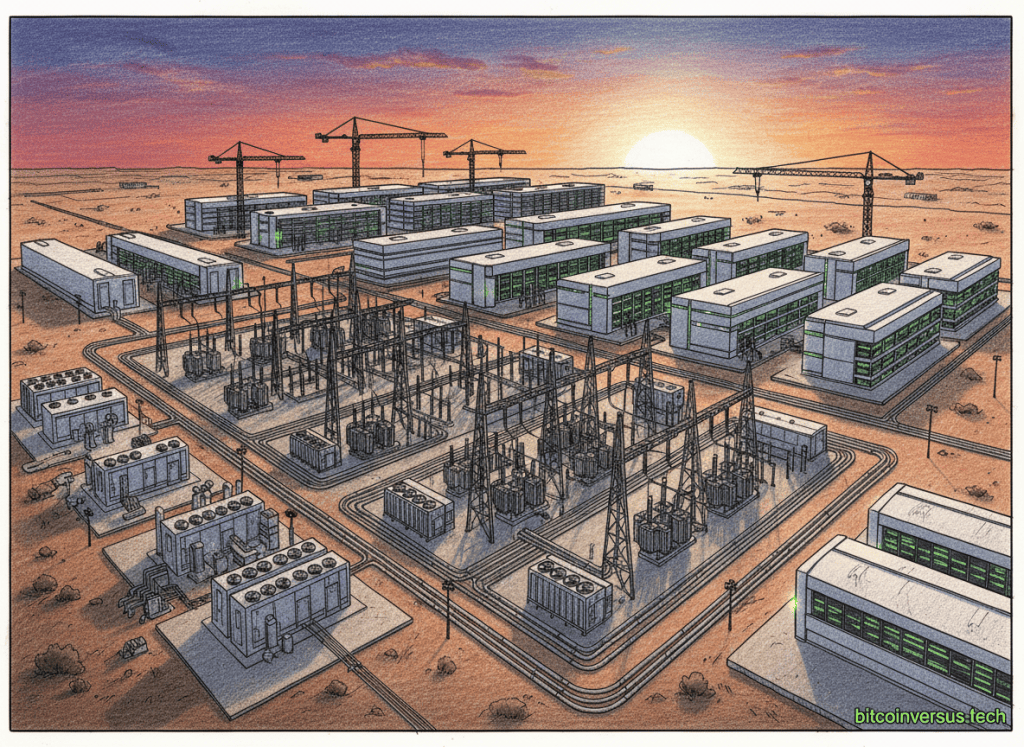
Cipher Digital has extended the contracted life of its 300 MW Barber Lake data center in Colorado City, Texas from 10 years to 20 years, adding approximately $5.2 billion of contracted revenue and taking the site’s total above $9 billion.
The September 25 agreements pair an amendment to Cipher’s existing Fluidstack lease with a binding commitment from a leading AI lab for an additional 10-year term after that lease ends. The development is another major example of infrastructure originally assembled by a Bitcoin mining company being monetized for hyperscale AI and high-performance computing.
A 300 MW computing campus with a 20-year contract horizon
Cipher’s announcement says Barber Lake’s total contracted revenue rises from $3.8 billion to more than $9 billion. The additional AI-lab commitment is expected to generate roughly $5.2 billion over its 10-year term on economic terms substantially consistent with the Fluidstack lease.
Barber Lake has 300 MW of gross capacity. Cipher’s infrastructure portfolio lists the site as energized, while its annual filing describes 244 MW of gross capacity allocated to Fluidstack in Phase I and the remaining 56 MW in Phase II.
Delivery now runs into early 2027
The amended agreement establishes phased delivery of individual data halls from the fourth quarter of 2026 through the first quarter of 2027. Rent begins separately as each hall is delivered, with the first rent commencement expected during Q4 2026.
The project also illustrates the capital intensity of converting power-rich sites into AI infrastructure. Cipher will absorb the first $359.3 million of costs above the initial Barber Lake budget. The tenant will reimburse 50% of costs beyond that threshold across the 20-year contracted period, with the reimbursement structured to provide Cipher a contracted return.
Bitcoin mining built the power-development skill set
Cipher emerged as an industrial Bitcoin miner, where site development revolves around securing large blocks of electricity, interconnection rights, substations, transformers, switchgear, networking and cooling. Those same capabilities are increasingly valuable to AI tenants that need hundreds of megawatts of reliable compute infrastructure.
BitcoinVersus.tech recently examined the broader shift in Bitcoin Miners Shift Megawatts From ASICs to AI. Barber Lake shows how far that transition can go: instead of monetizing the power connection with SHA-256 ASICs, Cipher is securing multi-decade contracted revenue from AI/HPC tenants.
Cipher still operates a major Bitcoin mine
The company’s infrastructure page continues to list its 207 MW Odessa site as operating at approximately 11.6 EH/s. That makes Cipher a useful example of the hybrid direction emerging across the mining industry: Bitcoin mining remains an operating business while the development pipeline increasingly targets hyperscale compute.
Barber Lake’s expanded contract reinforces a central infrastructure trend for miners. The most strategically valuable asset may no longer be the ASIC itself. Long-lived access to land, high-voltage power and grid interconnection can support whichever compute workload offers the strongest economics.
BitcoinVersus.Tech Editor’s Note:
Support BitcoinVersus.tech with Bitcoin: 3C9o19EH5HSiwEPyCTmEKzxhNCbo2X6TTb
Follow BitcoinVersus.tech on X: https://x.com/BitcoinVersus
BitcoinVersus.tech is not a financial advisor. This media platform reports on financial subjects purely for informational purposes.


Leave a Reply