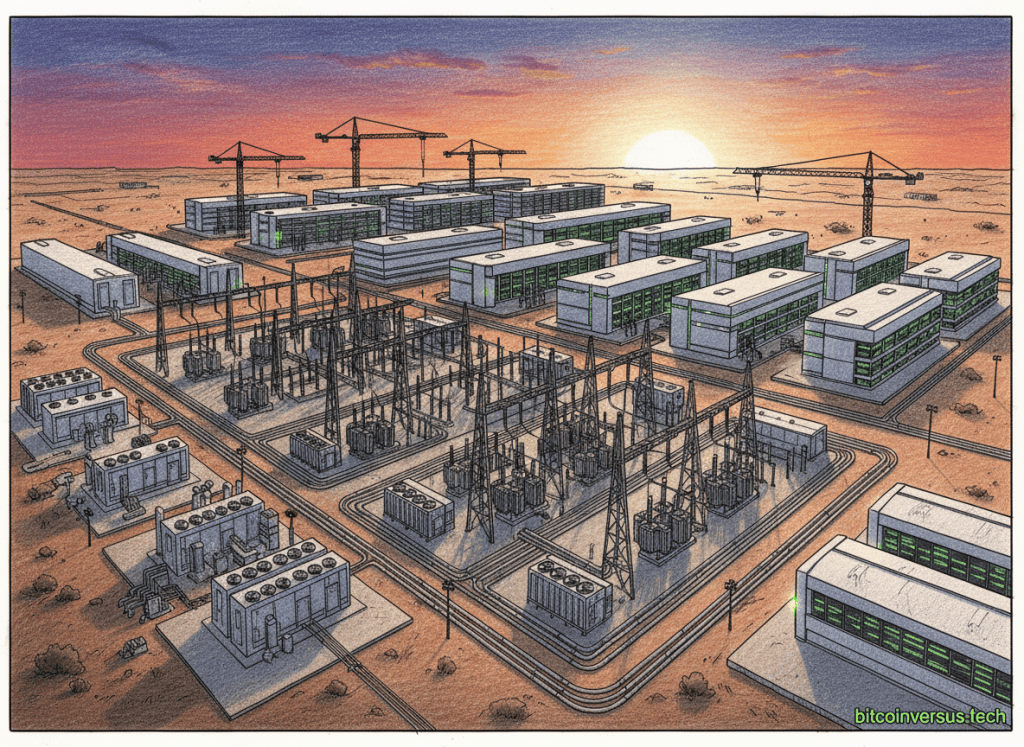
Cipher Digital reported its first high-performance computing (HPC) leasing revenue on November 2, 2026, marking a measurable step in the company’s transition from Bitcoin mining toward AI data-center infrastructure. Its third-quarter financial statements recorded $5.852 million in HPC leasing revenue, alongside $20.849 million from Bitcoin mining, for total quarterly revenue of $26.701 million.
The HPC revenue began after rent commenced at Cipher’s Black Pearl campus in August. Unlike announcements of future leases, this revenue is recognized in the company’s filed financial results. HPC leasing represented 21.9% of quarterly revenue, calculated from the reported figures.
Bitcoin Mining Versus HPC Leasing
| Q3 2026 segment | Revenue | Cost of revenue |
|---|---|---|
| Bitcoin mining | $20.849 million | $14.638 million |
| HPC leasing | $5.852 million | $0.726 million |
Revenue less direct cost of revenue was approximately 29.8% for mining and 87.6% for HPC leasing. These calculations are not operating profit margins: depreciation, financing, compensation and general expenses materially affect the company’s overall economics. The initial HPC figures also reflect a partial campus delivery, so they cannot yet establish a stable long-term margin.
What Has Actually Changed?
Cipher says its Black Pearl facility has begun delivering leased computing infrastructure, while additional data halls at Black Pearl, Barber Lake and Stingray are scheduled to enter service in phases. This is distinct from the company’s previously reported Barber Lake lease extension and its earlier ERCOT power-queue expansion.
Its latest update also describes a conditional 1 GW base-load classification at Colchis and 1.6 GW of additional conditional studied load classifications. Those designations are not equivalent to energized power capacity. Cipher separately began developing gas pipeline connections that could support up to 2.5 GW of potential on-site generation, but those projects are not operating plants.
The company reports approximately 5.9 GW in its development pipeline. This represents future opportunities rather than completed, revenue-generating data centers. Its results demonstrate why Bitcoin mining operators with power access and large sites are attracting AI tenants, while also illustrating the capital and grid-access risks of conversion.
Next, investors and engineers can track additional energized halls, recurring lease revenue, construction spending and final grid classifications. The company’s November 2 business update provides the original operational disclosures; its SEC-filed quarterly financial statements provide the revenue breakdown.
Editor’s Note: We volunteer daily to ensure the credibility of the information on this platform is Verifiably True. If you value this reporting, consider donating 5,000 sats using our Bitcoin donation QR code; for best results, scan it from a laptop or larger screen using your phone’s Bitcoin wallet.
Bitcoin donation address: 3C9o19EH5HSiwEPyCTmEKzxhNCbo2X6TTb
Disclaimer: This report is for informational purposes only and is not financial or investment advice.


Leave a Reply