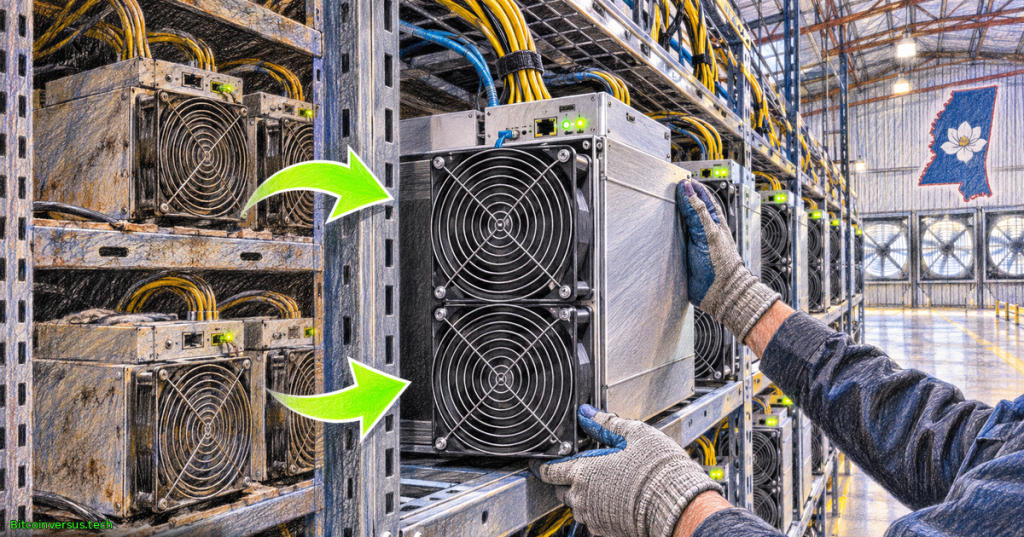
PowerCompute has paid approximately $1 million for 600 Bitmain Antminer S21++ Bitcoin miners, according to its November 13, 2026, earnings announcement. The company plans to replace older equipment at its Columbus, Mississippi, facility, increasing the output of the same 600 mining positions without adding power capacity. Delivery is expected in late November, with installation targeted for mid-December; neither milestone had been confirmed as complete at publication.
Independent S21+ hardware review by Red Panda Mining, published April 16, 2025. The featured test covers the related S21+ model, not PowerCompute’s purchased S21++ units. Credit: Red Panda Mining / YouTube.
More hashes from the same rack positions
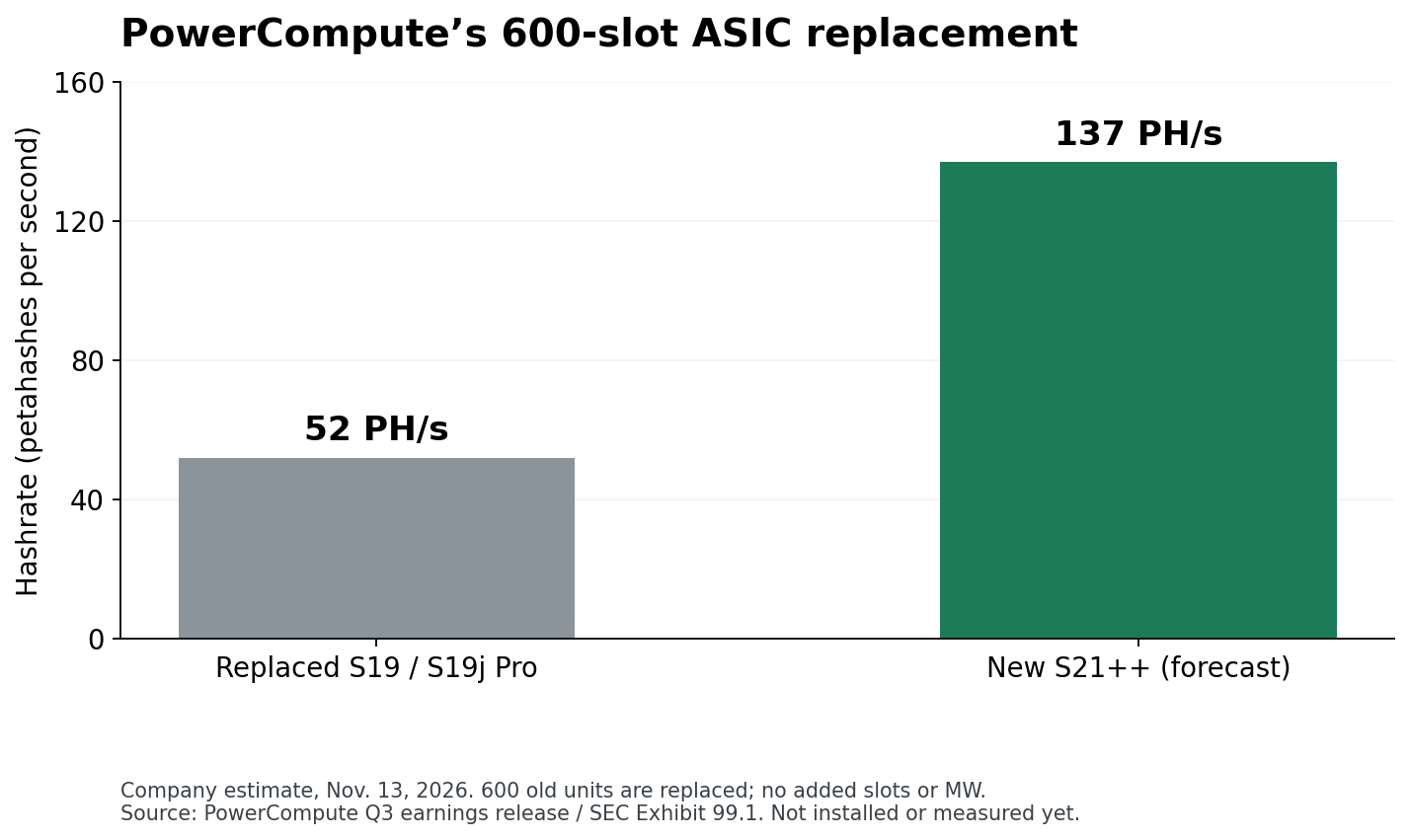
The new fleet will replace roughly 500 Antminer S19 machines and 100 S19j Pro machines. PowerCompute expects the retired units to supply approximately 52 petahashes per second (PH/s) in aggregate. At an average projected 228 terahashes per second (TH/s) per replacement miner, 600 S21++ units would supply 136.8 PH/s, rounded by management to about 137 PH/s. The difference is 84.8 PH/s, within the company’s forecast range of 80–85 PH/s.
Based on the rounded figures, the output of the replaced slots would rise approximately 163%: (137 − 52) ÷ 52 × 100. The whole company, however, would move from roughly 800 PH/s at October 31 to about 880 PH/s, or approximately 10% more. Machine-level gains and company-wide gains describe different denominators. Actual throughput will depend on delivered units, firmware, thermal conditions, uptime, and network operations.
The company previously outlined an order of 1,940 S19 XP miners and reported a 39% per-machine improvement during earlier replacements. Its latest investment adds another hardware tier to an ongoing fleet modernization effort. Compared with the most efficient machines in current-generation ASIC efficiency comparisons, S21-series equipment also illustrates the trade-off between acquisition cost, electrical efficiency, cooling requirements, and available infrastructure.
Why the electricity contract matters
The refresh is designed to use slots already served by the Mississippi site’s electrical infrastructure. PowerCompute previously reported increasing contracted demand there from 8.5 MW to 11 MW under a new utility rate. The present 600-miner swap is distinct from a separate 3.5 MW expansion assumed in an older 964 PH/s forecast. Management expressly replaced that earlier company-wide projection with its lower, approximately 880 PH/s target.
At an approximately $1 million acquisition price, the implied equipment payment is around $1,667 per S21++ unit, before considering installation, maintenance, any disposal proceeds, or operating savings. Gross extra hashrate is not equivalent to gross extra profit. Higher network difficulty can dilute revenue per terahash; the electricity price used in mining-profitability models can overwhelm differences between ASIC generations.
Q3 production increased while revenue fell
PowerCompute mined 23.9 BTC in Q3 2026, up 35.8% from a year earlier, while revenue declined to $1.9 million from $2.2 million. Management attributed the revenue decline to a lower average realized value per Bitcoin mined. Mining margin improved to 50.7% from 29.0% in the preceding quarter, a company-defined measure after mining costs and net curtailment or electricity sales.
The company reported a blended net power cost of about 2.4 cents per kWh for Q3, along with roughly $304,000 in energy-sales and curtailment proceeds. Those economics are specific to its sites, rates, and operating periods, not a transferable promise for other miners. A positive quarterly net result also reflected fair-value and financing-related accounting items rather than mining revenue alone.
PowerCompute’s purchase provides a clear test of hashrate density: delivering significantly more computational work from existing physical and power infrastructure. Confirmation requires receipt, installation and a subsequent fleet-level operating report. Until then, the 137 PH/s replacement output and 880 PH/s company target remain forecasts.
Primary sources and calculations: November 13 SEC Exhibit 99.1; PowerCompute Q3 2026 release; retailer S21++ photo and model listing; Red Panda Mining S21+ video. Calculations: 600 × 228 TH/s = 136,800 TH/s = 136.8 PH/s; 136.8 − 52 = 84.8 PH/s; (137 − 52) ÷ 52 = 163.5%; $1,000,000 ÷ 600 ≈ $1,667 per unit. The company rounds its forecast and actual machine performance may differ.
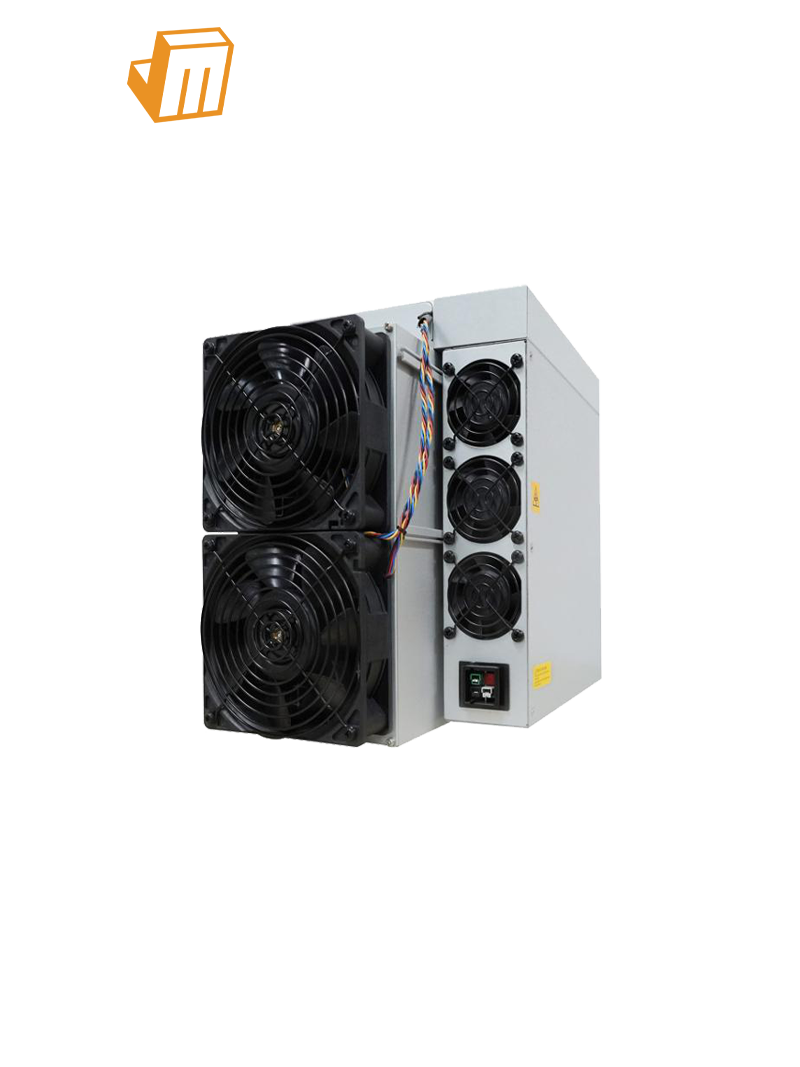
Editor’s Note: Reporting is based primarily on PowerCompute’s November 13, 2026 SEC exhibit and company announcement. The miner purchase and cash payment are reported as completed, while delivery, installation, individual miner output, total replacement-fleet hashrate, and the company’s 880 PH/s target are forward-looking estimates. The vendor photograph illustrates an S21-family miner on an S21++ sales page, not a machine verified at PowerCompute’s Columbus facility. The independent YouTube review examines S21+ rather than S21++ hardware and predates the reported purchase. The original 1200 × 630 colored-pencil featured cover is a conceptual depiction, not a photograph of an operating PowerCompute facility. The vertical chart begins at zero and depicts forecasts. Playback, social previews, and mobile rendering require direct browser verification after publication.

BitcoinVersus.Tech is volunteer-run and publishes independent educational technology reporting. An optional 5,000-satoshi donation supports ongoing research. Scan the original QR from a second screen with a compatible Bitcoin wallet; on mobile, use a wallet that supports scanning a saved image. Independently verify the recipient address 3C9o19EH5HSiwEPyCTmEKzxhNCbo2X6TTb and the payment amount before sending. Bitcoin transfers are generally irreversible.
We volunteer daily to ensure information on the BitcoinVersus.Tech platform is Verifiably True. Coverage is educational and informational and does not constitute financial or investment advice.


Leave a Reply