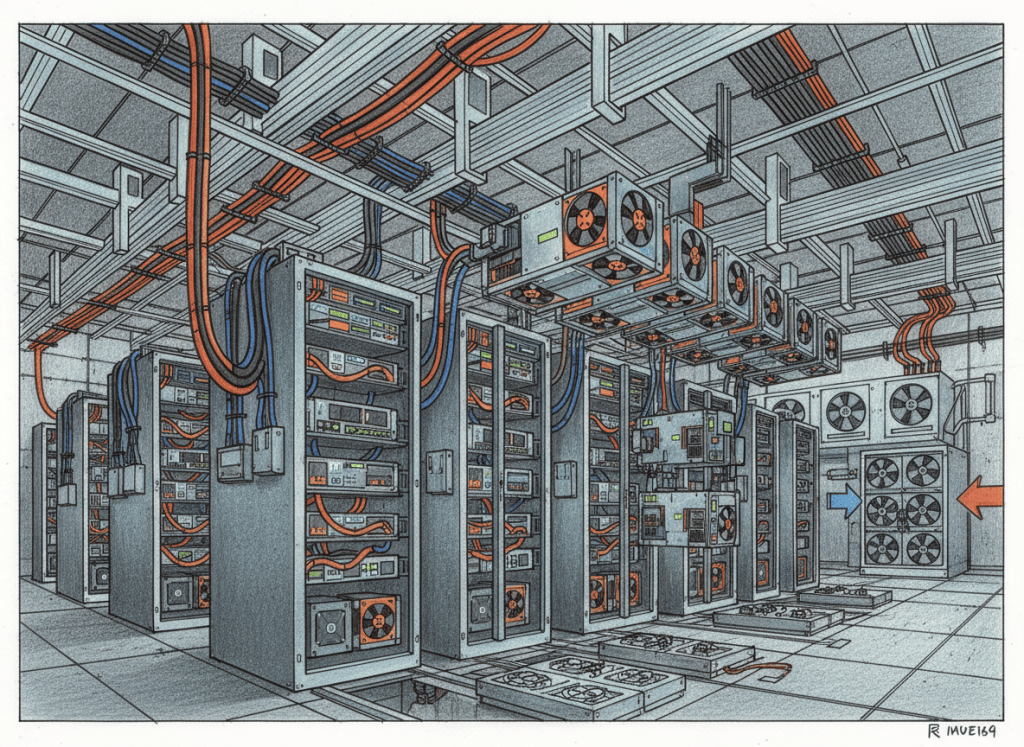
PowerCompute is demonstrating one of the simplest ways a Bitcoin miner can expand without first securing a much larger electrical footprint: replace older ASICs with machines that produce substantially more hashrate at comparable machine-level power.
The company said September 23 that its current miner-refresh program is expected to deliver nearly 39% more hashrate per machine ultimately replaced. The plan uses Bitmain Antminer S19 XP hardware to displace older S19-generation equipment across PowerCompute’s Oklahoma and Mississippi operations.
1,940 S19 XP miners are moving into the fleet
According to PowerCompute’s September 23 operational update, the company expects to install 1,000 additional S19 XP miners at its Oklahoma facility by September 30. Those machines are averaging approximately 132 TH/s.
The Oklahoma deployment replaces S19j Pro units rated at 100 TH/s or below. Rather than immediately retiring those machines, PowerCompute plans to move them to Mississippi, where they will replace older S19 units averaging about 95 TH/s.
PowerCompute also ordered another 940 S19 XP miners on September 22 for delivery and installation in October. Those units are intended to replace additional 95 TH/s S19 machines in Mississippi.
771 PH/s could become 862 PH/s
The company reported 771 PH/s as of June 30, 2026. After the first phase and internal redeployment, it expects approximately 822 PH/s. Once the additional 940 miners are operating, PowerCompute forecasts approximately 862 PH/s.
That would represent an approximately 11.8% increase in total hashrate from the June baseline.
The more interesting engineering number is at the machine level. PowerCompute says each new unit ultimately replaces a machine producing approximately 95 TH/s with one averaging 132 TH/s. That is roughly 38.9% more hashrate per replaced machine.
More SHA-256 compute from comparable power
PowerCompute reports the incoming miners at approximately 21.5 J/TH, compared with approximately 34 J/TH for the machines ultimately being retired. The company says the newer units draw comparable total power.
That distinction matters at an industrial site. Electrical capacity is often the harder asset to acquire. Utility service, transformers, switchgear, conductors, cooling equipment and energized rack positions can constrain expansion long before an operator runs out of ASICs to buy.
A fleet refresh can therefore increase production density without requiring the same percentage increase in site megawatts. PowerCompute says its power infrastructure and per-unit power cost are not expected to change as a result of this replacement program.
$400,000 refresh targets $1.2 million in incremental annual capacity
The total cost of the 1,000 September machines and the additional 940-machine order is approximately $400,000, according to the company. PowerCompute says it funded and expects to fund the purchases from cash on hand and Bitcoin holdings.
Using a hashprice of $40 per PH/s per day as of September 21, PowerCompute estimates the combined refresh could provide approximately $1.2 million per year in incremental revenue capacity. That estimate is explicitly before curtailment and downtime, and actual Bitcoin production economics will move with network difficulty, Bitcoin price, transaction fees and operating availability.
Why an S19 XP refresh can still make sense in the S21 era
The purchase is also an interesting counterpoint to the industry’s move toward S21-generation machines. As BitcoinVersus.tech reported in its S21 fleet analysis, customer demand and modern industrial deployments increasingly favor the newer S21 family.
But fleet economics are not determined by generation name alone. Acquisition cost matters. PowerCompute’s approximately $400,000 stated cost for 1,940 machines works out to roughly $206 per miner before considering any other transaction or deployment costs. For an operator with energized infrastructure and older 34 J/TH equipment already running, inexpensive S19 XP hardware can still produce a large efficiency and density improvement.
The result illustrates how Bitcoin mining fleets actually evolve. The newest ASIC does not automatically replace every older machine. Operators match hardware price, efficiency, power cost and available infrastructure to find the upgrade with the strongest economics for a particular site.
Another 3 MW remains available
PowerCompute says it also has up to 3 MW of additional energized capacity available in Mississippi. Using that capacity for further Bitcoin mining or AI infrastructure would require additional capital and infrastructure.
For now, the fleet refresh is a useful case study in mining density: PowerCompute is targeting an 11.8% company-wide hashrate increase largely by putting more efficient silicon behind electrical infrastructure it already controls.
BitcoinVersus.Tech Editor’s Note:
Support BitcoinVersus.tech with Bitcoin: 3C9o19EH5HSiwEPyCTmEKzxhNCbo2X6TTb
Follow BitcoinVersus.tech on X: https://x.com/BitcoinVersus
BitcoinVersus.tech is not a financial advisor. This media platform reports on financial subjects purely for informational purposes.


Leave a Reply