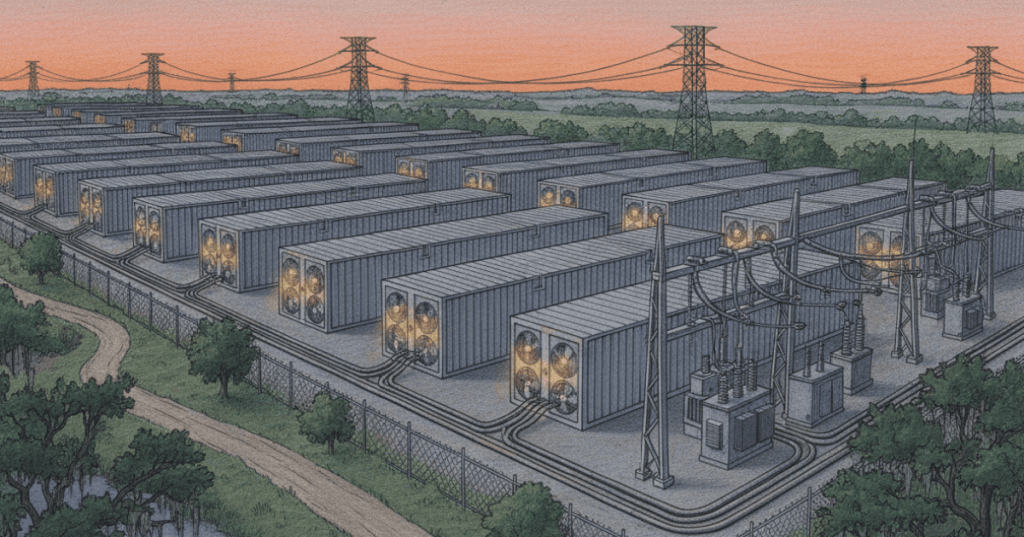
PowerCompute has increased contracted power at its Columbus, Mississippi computing site from 8.5 megawatts to 11 megawatts as a new Tennessee Valley Authority data-center rate takes effect.
The change shows how access to contracted electrical capacity is becoming a core infrastructure issue as Bitcoin mining, AI, and other large computing loads compete for power.
The New Contract Is For Up To 11 MW
PowerCompute said its US Digital Mining Mississippi subsidiary signed a new agreement with Columbus Light and Water on September 30. The company’s October 6 announcement says contracted demand increased by 2.5 MW, from 8.5 MW to 11 MW, while the site continued operating.
The underlying SEC Form 8-K independently confirms a power contract for up to 11,000 kilowatts of firm power. It also says the site’s estimated share of capital costs for utility facilities is $0. The initial contract term runs through September 16, 2030, with a possible five-year renewal if both parties agree.
TVA Now Treats Large Data Centers Differently
The Columbus facility moved from a general manufacturing rate to a Large Data Service rate. PowerCompute says the classification covers computational loads including Bitcoin mining, putting mining facilities inside the same broader power-policy framework as other large data centers.
For qualifying new or expanded data-center load above the first 5 MW, the company describes a capacity commitment charge of roughly $1.5 million per additional megawatt. PowerCompute says its 11 MW was under contract before the October 1 cutoff and was not assessed that charge.
Why The Timing Matters
At 11 MW, a hypothetical new project subject to a $1.5 million-per-MW charge above its first 5 MW would have 6 MW exposed to the mechanism, or roughly $9 million. That is only an illustration of the rate structure—not a cash payment or accounting gain reported by PowerCompute.
Columbus Light and Water is also returning a $300,000 cash deposit that will be replaced with a utility bond. PowerCompute says it plans to redirect the returned cash toward capacity buildout at the Mississippi site.
Flexible Computing Changes The Power Equation
The site uses different on-peak and off-peak operating behavior. That matches a broader mining characteristic covered in Can Bitcoin Mining Stabilize the Power Grid, or Nah?: ASIC fleets can reduce electrical demand when power becomes expensive or grid conditions tighten, then return when conditions improve.
The Site Remains Primarily A Bitcoin Mine
As of September 30, PowerCompute reported about 2,373 installed Antminer machines at Columbus producing roughly 205 PH/s. The company owns 26 MW of interconnected electrical capacity across Mississippi and Oklahoma, with about 22.5 MW primarily supporting Bitcoin mining and a smaller portion allocated to an enterprise HPC pilot.
The hardware side matters too. The underlying idea is the same one discussed in BitcoinVersus.Tech’s coverage of why miners follow usable electrical capacity: site performance depends not only on ASICs, but on what electricity is available, what it costs, and when the operator can consume it.
Mining And AI Can Share The Same Electrical Foundation
PowerCompute describes Bitcoin mining and high-performance computing as two different ways to use the same electrical infrastructure. Mining can use available electricity immediately and can be curtailed relatively quickly. HPC and AI require additional equipment, networking, cooling, customers, and stronger uptime guarantees.
That is why an already-interconnected megawatt is increasingly important. BitcoinVersus.Tech has also tracked data-center operators pursuing dedicated and behind-the-meter power as conventional grid interconnections become harder to secure.
The Bigger Story Is The Megawatt
PowerCompute’s expansion is 2.5 MW, but it illustrates a larger shift. The useful asset is not just a mining machine or GPU. It is the combination of land, interconnection, transformers, utility agreement, rate classification, cooling, network access, and permission to draw power.
For Bitcoin mining, the efficiency race therefore has two layers: produce more hashrate from each megawatt and secure megawatts on workable terms. The Mississippi contract is a compact example of both forces meeting at one site.
BitcoinVersus.Tech
Advertisement
Editor’s Note
We volunteer daily to keep the technical information on this platform verifiable.
BitcoinVersus.tech is not a financial advisor. This media platform reports on financial and technology subjects purely for informational purposes.


Leave a comment