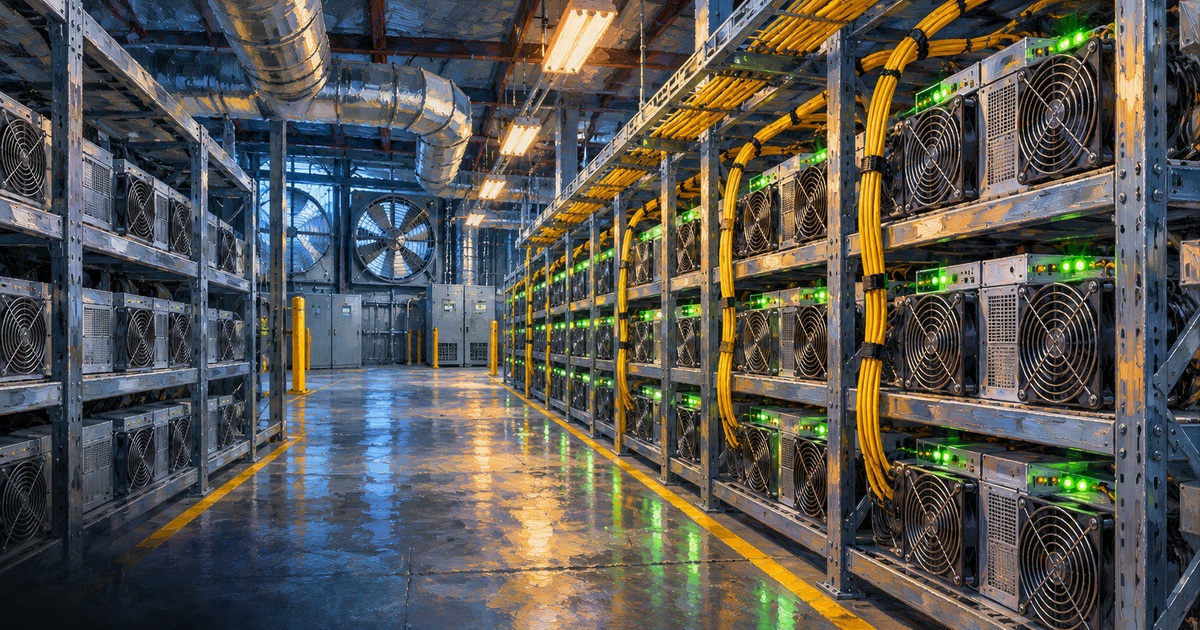

Original oil-painting editorial illustration; not a photograph of a Luxor customer facility.
Luxor Technology’s November 9, 2026, LuxOS firmware release targets a frequently overlooked source of electricity consumption: mining machines temporarily unable to produce hashes. The developer reports a reduction of 500–900 watts on certain S21-generation Antminers while every hashboard is in recovery cooldown. The improvement concerns idle recovery power rather than normal operating joules per terahash (J/TH).
The official November release notes also describe broader WhatsMiner board compatibility, power-supply support and corrections to pool failover and curtailment recovery. For large fleets, the practical question is whether less wasted energy and fewer interruptions translate into more accepted hashes for each kilowatt-hour purchased.
Why recovery power matters
When a mining controller detects an operating condition requiring recovery, affected hashboards may stop hashing while the hardware cools. A miner can still draw electrical power during that interval. LuxOS now disables the main power supply on supported NoPIC Antminers when all boards enter cooldown. The developer attributes the stated savings to that change. No independent wall-meter test accompanies the release, and the range should not be assumed for every machine.
A partial-board failure is a different operating state. A miner with one recovering board and other active boards still has productive work to perform. The release explicitly conditions its new behavior on recovery of every board, so the savings cannot be multiplied across all installed miners regardless of status.
The fleet-level electricity calculation
Consider an illustrative fleet of 1,000 compatible machines. If each spends a cumulative 30 minutes in full-board recovery over a measurement period, the reported 0.5–0.9 kW reduction implies 250–450 kWh of avoided electricity across the fleet. At an assumed energy rate of $0.05/kWh, the energy-only saving would be $12.50–$22.50. Neither the cooldown duration nor the electricity rate represents measured customer data. Actual savings scale with time in the affected state, and demand charges require separate analysis.
During productive operation, ASIC efficiency is power in watts divided by hashrate in TH/s. During a complete hashing interruption, dividing by zero is undefined. A better operational metric integrates total metered energy and cumulative accepted hashes across the entire observation period, capturing startup, cooldown, tuning and recovery losses.
Compatibility and reliability beyond the power bill
The same update expands support to 128 additional air-cooled WhatsMiner hashboard models in the VH, VK and VL families. It also differentiates unreadable or unsupported board identity information from a board that is absent, giving technicians a more useful diagnostic signal. Pool reconnection corrections and changes to waking curtailed machines address separate sources of downtime. Operators should validate model and board compatibility before deploying third-party firmware.
Related technical coverage includes Braiins OS 26.10 reliability improvements, Luxor Commander pool-routing incident analysis, Bitdeer fleet energy efficiency and PowerCompute’s planned ASIC replacement.
What mining operators should measure
A controlled rollout should compare matched hardware under similar ambient temperatures, recording wall energy, recovery duration, accepted shares, uptime and failed restarts. Luxor’s firmware documentation explains its thermal and power-management controls. The November changes offer a plausible way to reduce nonproductive energy, but verified site-level savings require operating data rather than extrapolation from a release note.
Sources: LuxOS changelog, November 9, 2026; LuxOS technical documentation; Commander miner monitoring documentation.
We volunteer daily to ensure the credibility of the information on this platform is Verifiably True. If you would like to support to help further secure the integrity of our research initiative, please scan the QR code below.



Leave a Reply