A Harvard-led research consortium is preparing to use artificial intelligence to reduce the resources required for reliable quantum computation. The initiative has received $12 million from the U.S. Department of Energy (DOE), with Harvard and Cornell publishing project details on November 20, 2026, followed by QuEra Computing’s participation announcement on November 23.
The project, formally named Application-Aware Error Correction Codesign for Scientific Quantum Computing (ASQC), is part of the Genesis Mission. It brings Harvard, MIT, Cornell, three national laboratories, QuEra, NVIDIA and Anthropic together to improve the relationship between scientific algorithms and the physical machines executing them. The award is research funding, not a completed quantum computing breakthrough.
Why error correction consumes computing resources
A physical qubit stores information in a controllable quantum system, but unwanted interactions and imperfect operations can corrupt its state. Researchers encode information across multiple physical qubits to create a logical qubit, then extract information about errors without directly measuring the encoded value. A classical decoder interprets those measurements to determine appropriate corrections.
Protection comes with costs: additional physical qubits, repeated measurements, control operations and classical processing. A quantum processor can therefore have impressive physical-qubit counts while offering considerably fewer protected logical qubits. Our quantum computing guide explains the distinction.
AI could allocate protection where it matters most
Rather than assume identical protection requirements for every calculation, ASQC researchers intend to evaluate which error patterns most affect a particular scientific result. AI can search candidate codes and decoding strategies, while researchers establish whether the resulting computations meet the required accuracy.
Cornell’s team will also investigate reinforcement-learning compilation for neutral-atom machines. A compiler must translate abstract operations into feasible hardware instructions, including moving atoms and applying quantum gates. Finding a better sequence could reduce operations and exposure to noise, depending on the hardware constraints. Cornell plans to evaluate hybrid quantum-classical approaches to interacting electrons as one scientific test.
From algorithms to real hardware
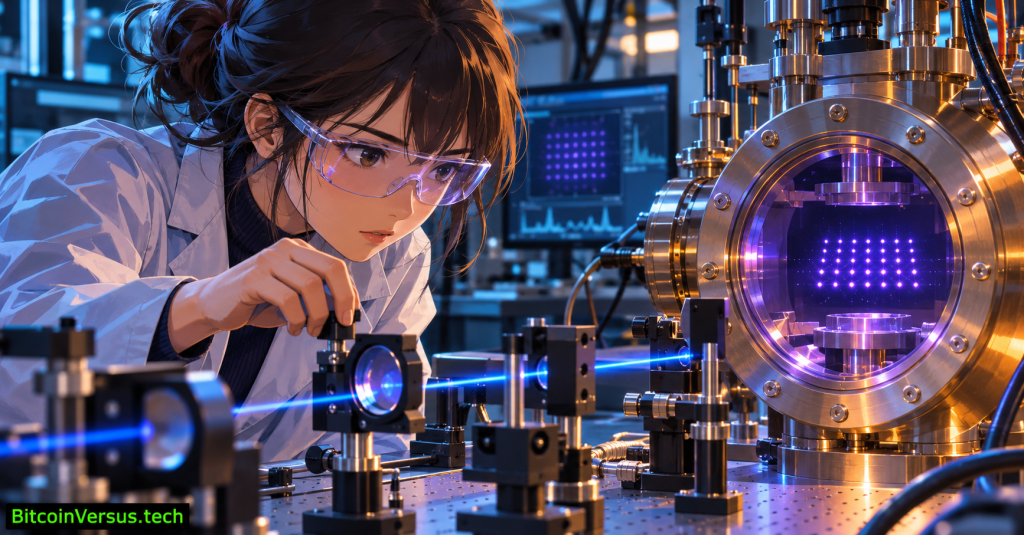
The consortium plans to evaluate its approaches on equipment at Harvard, MIT and QuEra. Neutral-atom computers use focused light to trap and manipulate individual atoms, with laser-driven interactions enabling quantum operations. Unlike an exclusively software-based benchmark, hardware testing can expose errors arising from imperfect control, atom loss and measurement.
The engineering challenge is relevant across architectures, including superconducting processors such as the IBM Nighthawk installation in Chicago. Other platforms, including molecular spin-photon research, face different physical constraints.
What would count as progress?
A credible result would compare a proposed code against an established baseline on the same scientific workload, accounting for logical error probability, physical-qubit requirements, circuit depth, decoder latency and output accuracy. An algorithm that uses fewer qubits but needs much longer execution may not deliver a net improvement. Hardware resource savings also do not automatically translate into equal reductions in facility electricity consumption.
For perspective, a hypothetical code requiring 500 physical qubits rather than 1,000 for equivalent protection would cut the qubit requirement by 50%. Such a comparison is illustrative, not an ASQC performance claim. The consortium has not yet reported a measured resource reduction from the funded project.
The new disclosures provide a closer look at one effort within the $159 million Genesis Mission Phase II funding portfolio. Its significance will ultimately depend on whether AI-designed protection produces reproducible scientific calculations with lower total overhead.
Sources: Harvard Gazette, November 20; Cornell University, November 20; QuEra announcement, November 23. Cover: AI-generated editorial illustration.
We volunteer daily to ensure the credibility of the information on this platform is Verifiably True. If you would like to support to help further secure the integrity of our research initiative, please scan the QR code below.



Leave a Reply