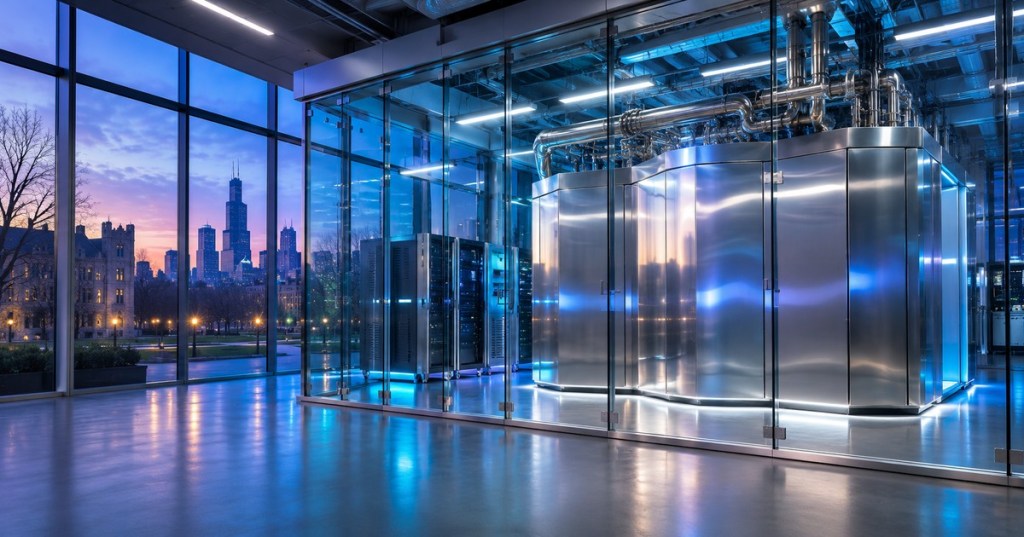
IBM has switched on a Quantum System Two at the University of Chicago’s Hyde Park Labs, marking the company’s first quantum computer in Illinois. Announced on November 6, 2026, the installation uses IBM’s Nighthawk r2 processor and is intended to support researchers working through the National Quantum Algorithm Center. The machine is operational now; its eventual move to the Illinois Quantum and Microelectronics Park remains a future step. IBM’s announcement and the university’s account independently identify the opening and location.
Quantum computing uses controllable quantum states, or qubits, to execute specially designed algorithms. Unlike conventional processors, qubits are sensitive to environmental disturbance and operational errors, so progress depends on useful circuit depth, fidelity, repeatability and the classical systems supporting the chip—not just the raw qubit count.
IBM Research, “Lab Tour: How IBM tests quantum processors” (December 13, 2024). Jerry Chow explains chip characterization, cryogenic hardware and performance testing in IBM’s research facilities. The footage predates the Chicago opening and does not document the new installation.
Inside the Chicago Machine
IBM’s technical deployment account identifies the processor as Nighthawk r2. It contains 120 programmable qubits connected through 218 couplers. Another 120 reset elements contribute to a total of 458 physical quantum elements in IBM’s description; those elements should not be mistaken for 458 programmable qubits. Greater connectivity can reduce routing overhead for selected circuits, but performance still depends on noise, calibration and algorithm structure.
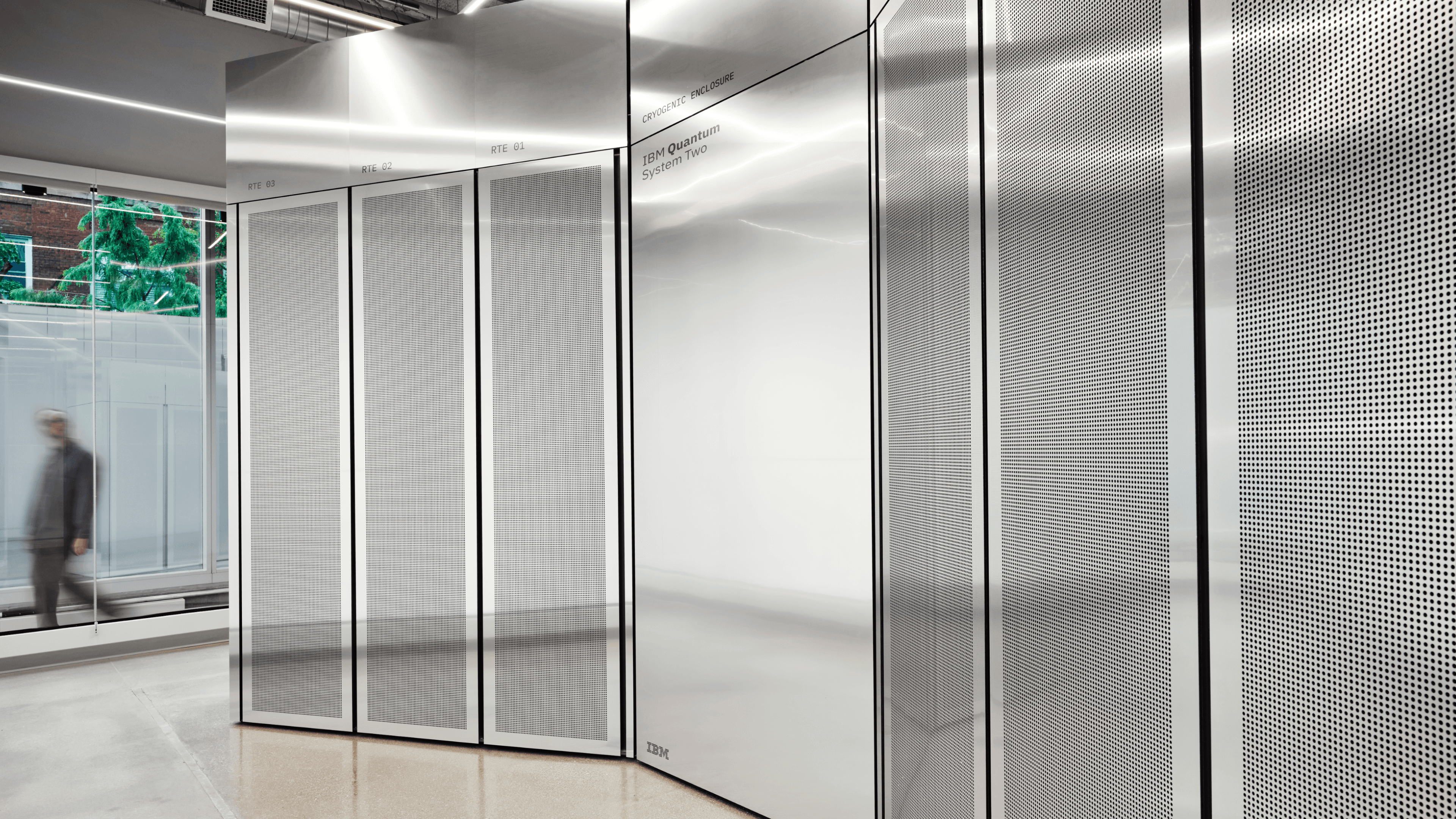
The system sits at street level behind windows at Hyde Park Labs, a building near the university campus. IBM and UChicago say the site will serve the National Quantum Algorithm Center while the planned larger campus is built. Illinois is therefore gaining access to a working quantum research system before its permanent research park is completed.
A Speed Claim With Important Limits
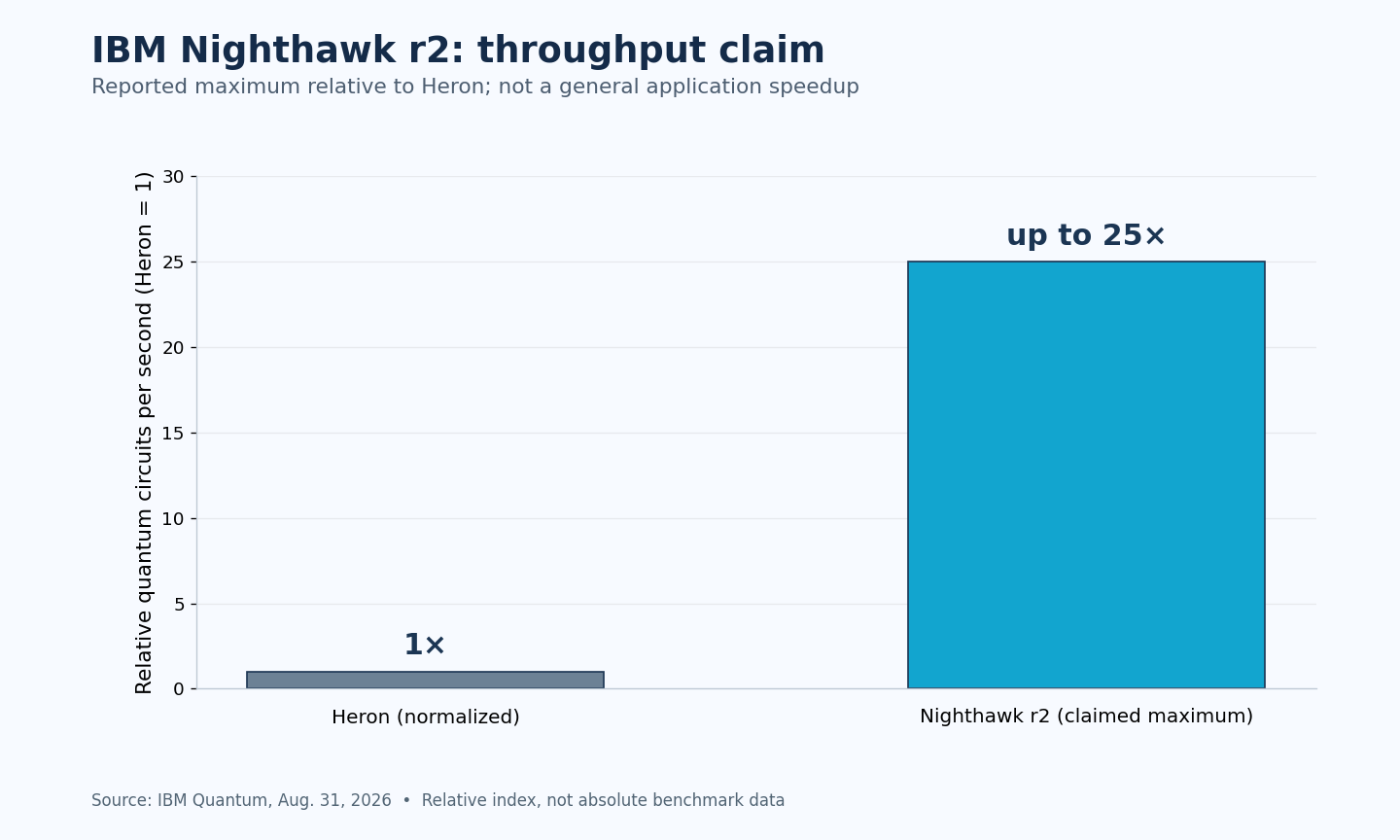
IBM says Nighthawk r2 can execute more than 100,000 quantum circuits per second, representing up to 25 times the circuit throughput of its Heron generation under the stated platform comparison. Faster repeated experiments can help researchers test error mitigation and algorithms more efficiently. However, a throughput ratio is not evidence that every quantum application runs 25 times faster, nor that the machine outperforms classical computers on general workloads. IBM’s August processor report describes the underlying fast-reset architecture.
Researchers have yet to demonstrate that every promised commercial use case delivers a practical advantage. IBM and its partners cite molecular simulation, electric-grid optimization and high-energy physics as active research programs. The announcements do not establish production deployments that already save grid operators money or produce new medicines. Separate work with AMD and Oak Ridge on quantum error correction addresses reliability, one of the field’s continuing engineering constraints.
From Research Facility to Regional Infrastructure
The Illinois partnership combines a university host, IBM hardware, national-laboratory collaborations and companies pursuing quantum algorithms. The permanent Illinois Quantum and Microelectronics Park is planned for the former U.S. Steel South Works site. Its completion, future access arrangements and commercial results remain separate from the verified startup of the Hyde Park machine.
Bloomberg Television, “From Chips to Qubits: Inside IBM’s Quantum System Two” (November 28, 2025). IBM’s Jerry Chow explains the architecture at IBM’s New York research hub; the segment is background footage, not video of Chicago’s November 2026 event.
The launch adds physical infrastructure to a region already building quantum research programs. Earlier IBM quantum manufacturing work demonstrates the industry’s reliance on conventional semiconductor fabrication. Competing trapped-ion developments at IonQ underscore that the best architecture for large-scale useful quantum computing remains unsettled.
IBM targets fault-tolerant quantum computing later in the decade, but its roadmap labels future milestones as goals subject to revision. As explained in BitcoinVersus.Tech’s post-quantum cryptography guide, planning for future cryptographic risk is a separate security task and does not require claiming the present Chicago system can defeat modern encryption. Chicago’s achievement is narrower and verifiable: a newly operational research machine, a documented modern processor and a developing local ecosystem. Useful industrial advantage, operating economics and large-scale error correction still require further evidence.
Primary Sources
IBM Newsroom, November 6, 2026; University of Chicago News, November 6, 2026; IBM Quantum’s Chicago deployment blog; IBM Quantum Nighthawk r2 technical blog; and IBM processor documentation.
Editor’s Note: IBM and the University of Chicago independently confirmed the Chicago installation on November 6, 2026. Specifications and performance ratios are attributed to IBM; no independent performance test was performed. The featured cover is original conceptual AI artwork, not a photograph of Hyde Park Labs. The installation photo is credited to IBM, and the original chart labels the manufacturer-reported relative maximum. Both videos predate the Chicago event and are contextual demonstrations; player rendering and playback were not independently confirmed at drafting.

To donate 5,000 sats, scan the QR code with a compatible Bitcoin wallet. On a phone, display the QR on another device or use the wallet’s image-import scanner where supported. Verify the payment destination and amount before confirming.
We volunteer daily to ensure the information on this platform is Verifiably True. If you would like to support the research, please scan the QR code.
BitcoinVersus.Tech is not a financial advisor. Financial information is reported for educational and journalistic purposes.


Leave a Reply