
IBM, AMD and the U.S. Department of Energy-funded Quantum Science Center at Oak Ridge National Laboratory announced a quantum error-correction co-design platform on November 5. The research environment pairs IBM quantum hardware with AMD-powered high-performance computing, aiming to make fragile quantum calculations more reliable as the field moves toward larger fault-tolerant systems. IBM’s announcement identifies error decoding, optimization and software orchestration as initial research priorities.

Quantum processors meet GPU-powered supercomputing
The initial platform co-locates IBM quantum computers, including its 120-qubit Nighthawk processor, with Oak Ridge’s Umbra high-performance computing system. Umbra uses AMD Instinct MI355X accelerators and fifth-generation EPYC processors. Co-location matters because quantum error correction requires repeated measurements and rapid classical interpretation of errors, rather than relying on quantum processing alone.
Quantum information is vulnerable to noise, imperfect gates and measurement errors. Error-correcting codes distribute protected information across multiple physical qubits; classical decoders then interpret measurement patterns to identify likely faults. The platform lets researchers compare the qubit, timing, sampling and computing requirements of different approaches. Related architecture questions appear in BitcoinVersus.Tech’s quantum hardware comparison.
The 2028 target remains a research milestone
The Department of Energy’s Q Competition aims for 100 logical qubits executing 100,000 hard operations by late 2028. IBM reports experimental results reaching up to 70 logical qubits and 438 hard operations. Dividing 100,000 by 438 gives approximately 228, so the hard-operation count would need to increase about 230-fold relative to that reported experiment. The two figures describe different performance dimensions and do not establish that the complete target is nearly achieved.
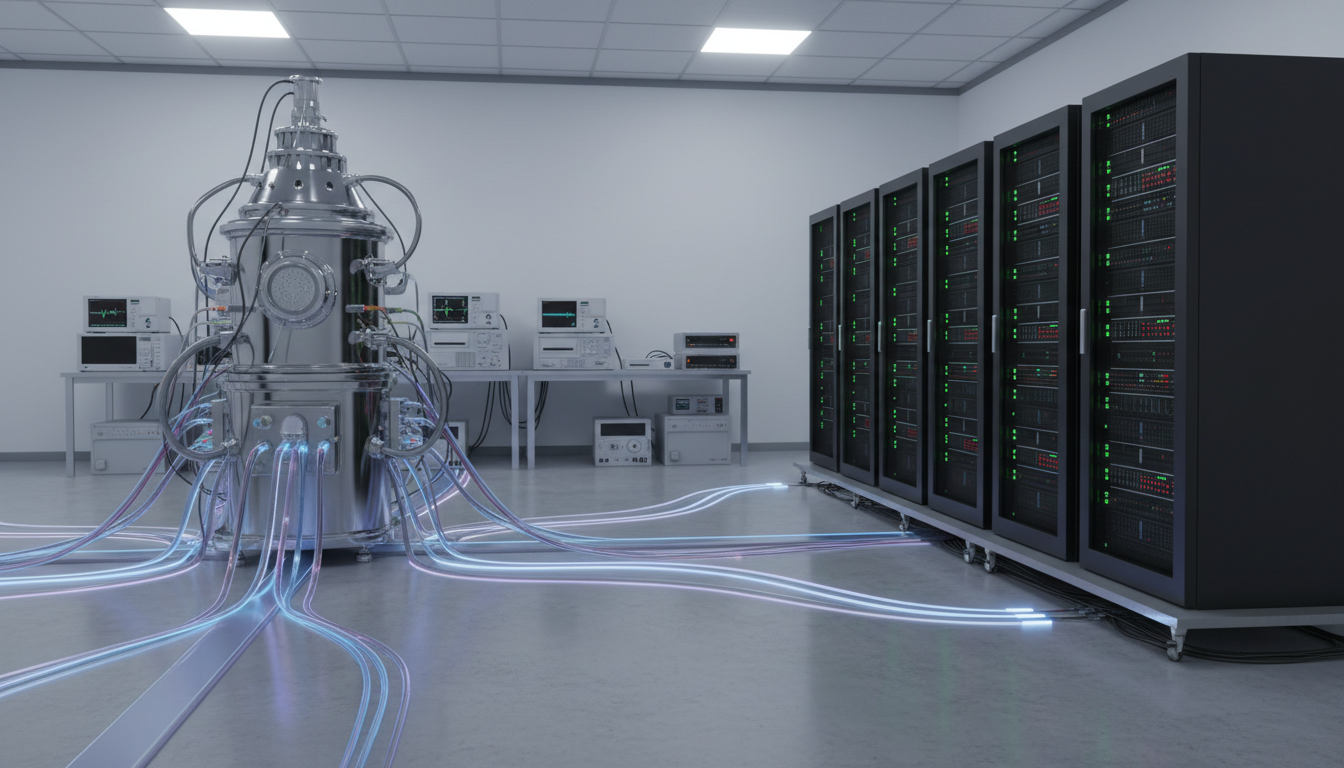
IBM says researchers can use its Quantum System API for mid-circuit measurement, pulse timing and raw measurement data. Teams will investigate decoding methods, compilation and hardware-aware optimization. The announcement also describes a future connection to the Oak Ridge Leadership Computing Facility, but gives no verified date for a completed connection or general public availability.
Practical limits and what comes next
GPU-assisted decoding may help reduce the time required to interpret errors, but classical computing adds its own power consumption, communication overhead and integration costs. Co-locating systems does not prove scalable fault tolerance, and the announced platform is a research environment rather than a commercially available fault-tolerant quantum computer. IBM’s earlier competitor error-reduction coverage illustrates why error metrics must be tied to the exact hardware, circuit and experimental conditions.
The project builds on IBM–Oak Ridge research using quantum and conventional supercomputers for scientific workloads and IBM–AMD work on decoding algorithms. It also extends the broader U.S. push to integrate advanced computing, described in BitcoinVersus.Tech’s DOE research funding coverage.
Quantum error correction also matters to long-term cryptographic risk assessments. BitcoinVersus.Tech previously examined whether quantum computers could threaten Bitcoin; the new IBM–AMD research platform does not demonstrate the cryptographically relevant capabilities required for such an attack.
Independent benchmarks of decoding speed, logical error rates, end-to-end latency and sustained operation counts will determine whether the platform produces meaningful progress. The near-term result is a new environment for testing quantum-classical integration, not a demonstration that quantum computers have solved their reliability problem.
BitcoinVersus.Tech Editor’s Note: We volunteer daily to ensure the credibility of the information on this platform is Verifiably True. If you would like to support to help further secure the integrity of our research initiatives, please donate using the QR code provided

For best QR-code scanning results, please scan this donation code from a desktop or larger screen. Mobile screens may prevent camera recognition. Verify the receiving address 3C9o19EH5HSiwEPyCTmEKzxhNCbo2X6TTb before sending.
Disclaimer: BitcoinVersus.Tech is not a financial advisor. This media platform reports on financial subjects purely for informational purposes.


Leave a Reply