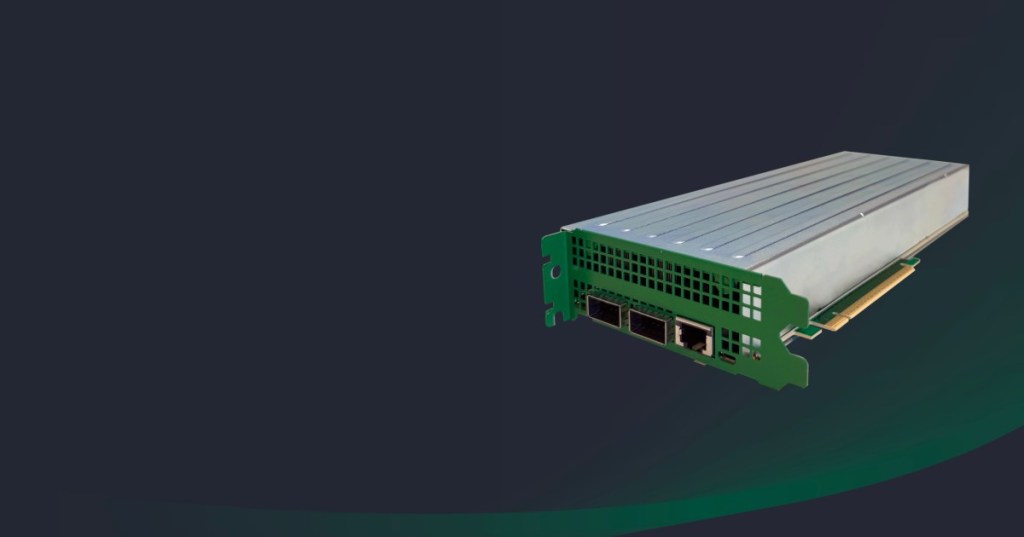
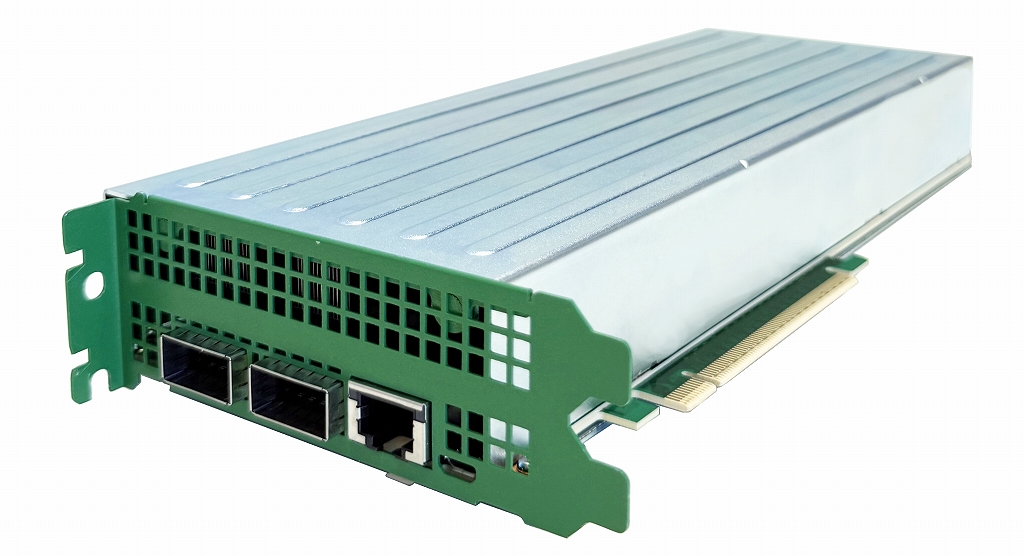
A server network card typically connects a machine to a nearby switch. Fujitsu subsidiary 1Finity wants to extend the server interface across metropolitan distances. On November 17, 2026, the company announced its Ultra Optical System N100, a PCI Express optical network interface card (NIC) rated for up to 800 gigabits per second over approximately 100 kilometers. Global availability is planned for April 2027, following advance orders beginning in November.
The company’s November 17 product briefing provides additional manufacturer context (video at its original source).
What 800G actually means
The N100 specifications describe two 400G optical interfaces using QSFP56-DD modules. The combined nominal rate is 800 Gb/s, equivalent to 100 GB/s before protocol overhead. Each individual 400G port corresponds to 50 GB/s. The specification is an aggregate interface rate, not evidence that an individual application can continuously transfer 100 GB of useful data every second.
PCI Express connects the card to a compatible server. The host interface, memory subsystem, network configuration and remote endpoint must all keep pace. A bottleneck anywhere along that path can reduce the usable transfer rate. BitcoinVersus.Tech’s earlier coverage of Uniti and Nokia’s 800G fiber-pair trial and Ciena’s 2,104-kilometer optical transmission examined different points in the connectivity chain. Neither is a direct application-performance comparison with the N100.
The speed of light imposes a deadline
Light travels through conventional silica fiber at roughly 200,000 kilometers per second. For a hypothetical 100-kilometer fiber path, propagation takes about 0.5 milliseconds one way and 1 millisecond round trip. Actual routes can be longer; transceivers, switching and endpoint processing introduce further delay.
At 800 Gb/s, a one-millisecond round trip produces a bandwidth-delay product of approximately 800 megabits, or 100 MB. A protocol may need roughly that much outstanding data to keep both ports fully occupied, depending on how traffic is distributed. A transfer that repeatedly waits for acknowledgments before sending more data can leave expensive network capacity unused.

Why extended RDMA matters
Remote direct memory access (RDMA) allows appropriately configured systems to transfer data without requiring the remote CPU to handle every transfer step. 1Finity’s proprietary extended RDMA implementation, xRDMA, targets the additional transfer inefficiencies associated with geographic separation. The company describes mechanisms intended to sustain throughput despite longer communication paths and packet loss.
Japanese trade publication Cloud Watch reported on November 24 that a company test involving 64 concurrent connections achieved inference-data transfer times below one-twentieth of its TCP/IP comparison. The result applies to the reported configuration, not every network or AI workload. The publication also describes a prospective 1.6 Tb/s upgrade in fiscal 2028, which remains a roadmap rather than a shipped specification.
Moving computing toward available electricity
The infrastructure concept is sometimes called scale-across: distributing computing capacity among separate facilities instead of expanding only one building. A remote site with spare electrical capacity could run independent inference jobs or asynchronous data processing. Our reports on Arista’s distributed AI networking and SC26’s scientific network describe complementary infrastructure approaches.
Distributed placement does not make distant GPUs equivalent to neighboring accelerators. Synchronization-intensive training may remain sensitive to propagation delay even with high bandwidth. The useful next measurements are sustained application throughput, tail latency, transfer recovery, power consumption and workload completion time under realistic conditions. The N100 announcement presents an opportunity to change where computing occurs; it does not demonstrate that geography has ceased to matter.
We volunteer daily to ensure the credibility of the information on this platform is Verifiably True. If you would like to support to help further secure the integrity of our research initiative, please scan the QR code below.



Leave a Reply