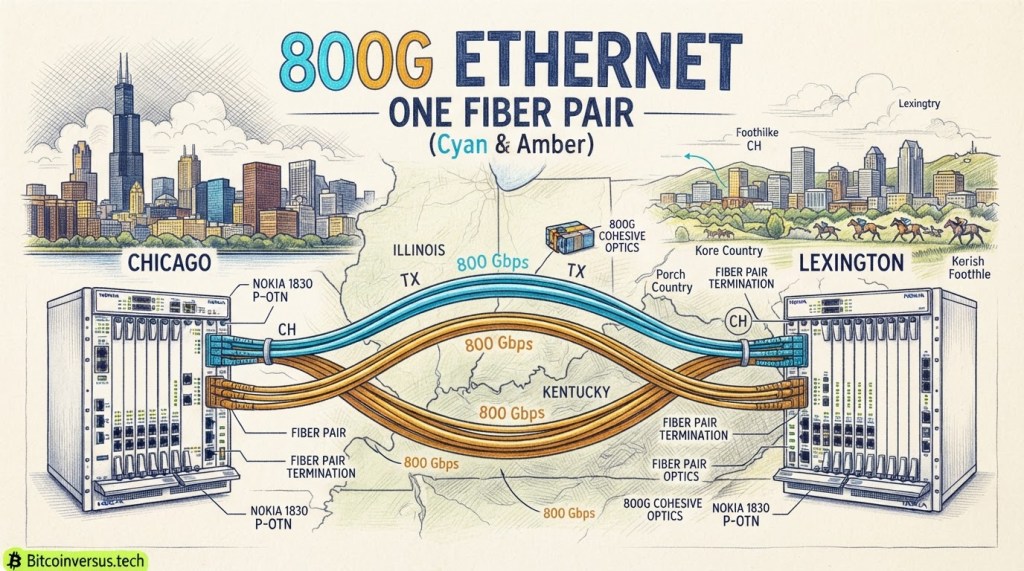
Uniti Wholesale and Nokia say they have successfully tested an 800-gigabit Ethernet customer connection using only one pair of optical fibers. Announced on November 12, 2026, the demonstration took place between Chicago, Illinois, and Lexington, Kentucky, and used Nokia’s 1830 Global Express (GX) optical transport platform. The milestone concerns the customer handoff—not proof that every segment of the intercity route uses just two strands.
The companies describe the achievement as an industry first for a single-fiber-pair 800GE service interface. Their original announcement identifies IEEE 802.3dj 800GBASE-LR4 as the technology behind the interface and says commercial availability is expected in the first quarter of 2027. That date is a company target, not a confirmed launch.
Nokia explains the optical networking equipment used to interconnect high-capacity data centers. The video provides technical background, not footage of Uniti’s November field trial.
Why One Fiber Pair Matters
At the customer’s network boundary, an optical interface converts electrical Ethernet signals into light traveling through fiber. A conventional duplex link uses one strand for transmission and another for reception. High-density alternatives may split an 800G interface across several parallel fiber pairs, increasing cabling and connector-management requirements.
The single-pair 800GBASE-LR4 approach is designed to carry an 800GE client signal over a duplex pair using multiple optical wavelengths. In other words, “one fiber pair” means two strands, not one strand, and the 800G label is the Ethernet interface rate rather than a guarantee about useful application throughput or the entire route’s physical fiber count.
Technicians managing optical transceivers, patch panels and optical power measured in dBm know why fewer connections matter. Fewer parallel strands can simplify labeling, patching and fault isolation at the demarcation point. However, the announcement does not provide insertion-loss budgets, measured bit-error rates, latency, power draw or an independently audited cost comparison.
Inside Nokia’s 1830 GX Platform
Nokia’s 1830 GX family supports modular transponders, optical line systems and coherent optics for metro and long-haul transport. The platform can carry high-bandwidth services between sites while allowing operators to select interfaces and transport configurations for their routes. The trial announcement does not specify every optical module or intermediate network element used.
Nokia and industry speakers discuss pluggable optics for data-center interconnect, including the progression from 400G toward 800G and beyond.
The development sits within a much larger shift. Earlier coverage followed Bluebird Fiber’s 400G backbone and 800G roadmap. BitcoinVersus.Tech recently compared 800G and 1.6T optical interfaces for AI infrastructure and covered 64 Tb/s transmission over hollow-core fiber. Those demonstrations address different portions of the optical stack: client ports, transmission technologies and total fiber capacity should not be treated as interchangeable numbers.
A Trial Today, Commercial Service Targeted for 2027
Uniti says it plans to offer the 800G service in the first quarter of 2027. Greg Ortyl, the company’s president of strategic accounts, presented the simplified handoff as a way to provide more bandwidth without forcing customers to manage additional fiber pairs. Nokia’s Scott Cohen linked the need for larger connections to growing cloud and AI traffic.
The important distinction is successful demonstration versus large-scale deployment. Uniti has reported a working trial; it has not yet documented commercial customer installations at scale or disclosed installation costs and reliability results. Future evidence should include service availability, optics interoperability, operating margins and field performance.
For network engineers, the practical story is straightforward: an 800G customer port that needs two optical strands rather than several pairs could make high-capacity interconnection easier to install and maintain. Whether it becomes cheaper in production will depend on equipment pricing, fiber availability, reach and actual operating results.


Leave a Reply